Cannabis Tax Exemption Eligibility Workflow: 2026 Guide
2026 update: what rescheduling changed for 280E (reviewed October 2026)
Effective April 22, 2026, a DOJ/DEA final order moved marijuana covered by a qualifying state medical license (and FDA-approved marijuana drugs) to Schedule III. Section 280E only applies to Schedule I and II substances, so state-licensed medical cannabis activity is generally no longer subject to 280E going forward. Adult-use cannabis remains in Schedule I and fully subject to 280E. The DEA proceeding to reschedule all marijuana was temporarily stayed in October 2026, and Treasury/IRS guidance on transition years and mixed medical/adult-use businesses is still pending.
Check where your business stands in about a minute.
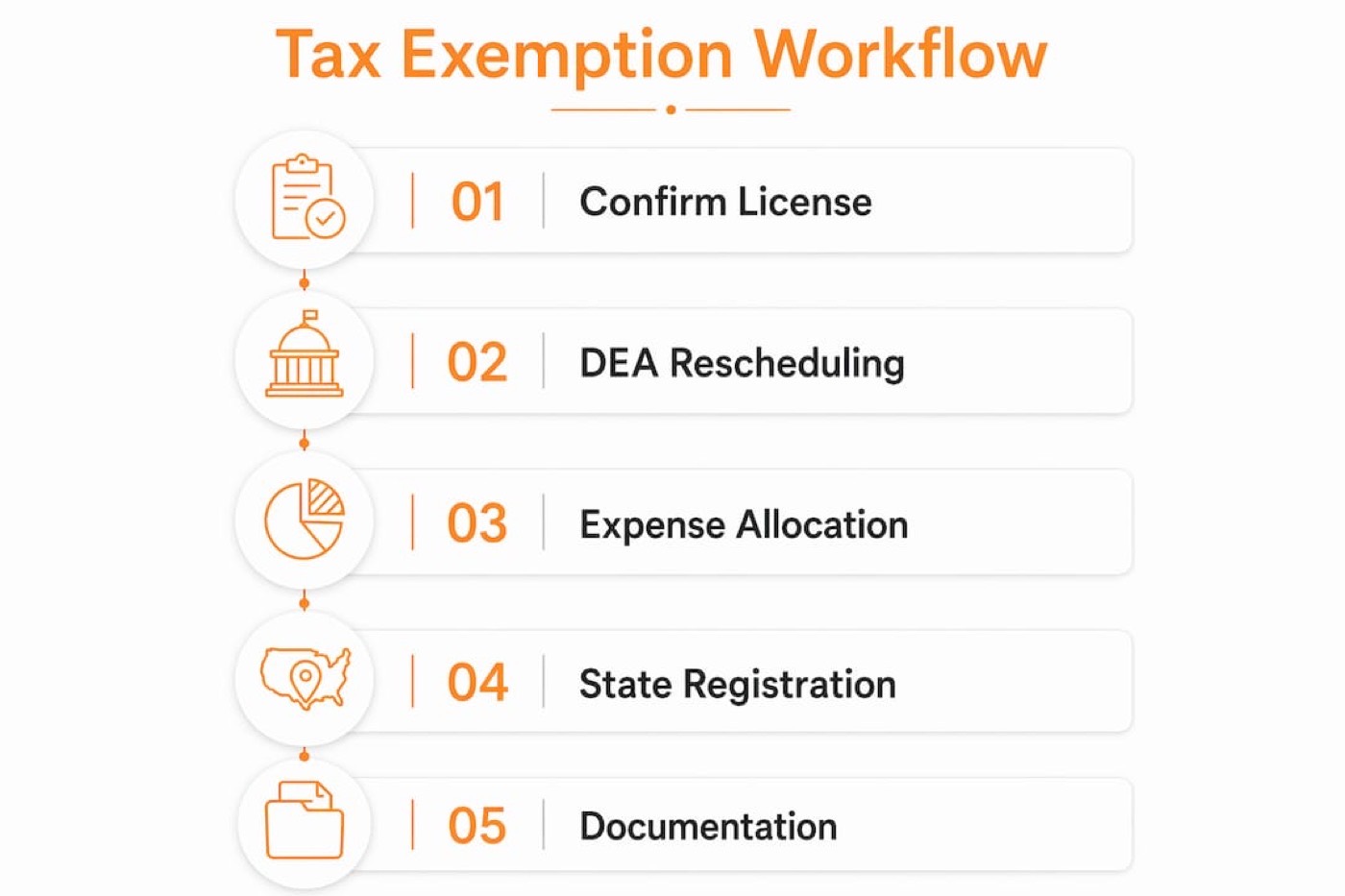
Tax exemption eligibility for cannabis businesses is now defined by whether your operations qualify under the DEA’s Schedule III reclassification, effective April 28, 2026. The tax exemption eligibility cannabis workflow your finance team needs to build starts with a single question: which of your licensed activities now fall outside Section 280E? The answer is not automatic. The Federal Register final rule rescheduled certain marijuana products to Schedule III, but the IRS has not issued a final determination. That gap between regulatory change and tax certainty is where operators get hurt.
How the 2026 DEA rescheduling affects federal cannabis tax exemption eligibility
Section 280E disallows all ordinary business deductions for entities trafficking in Schedule I or II controlled substances. The Schedule III rescheduling removes that bar for qualifying activities, opening a deductibility path that did not exist before April 2026. This is the most significant federal tax shift the cannabis industry has seen since 280E was first applied to cannabis operators.
The scope of relief is narrow. Only FDA-approved and state-licensed medical cannabis products are rescheduled to Schedule III. Adult-use and recreational cannabis remains Schedule I, and 280E still applies in full to those activities. If your dispensary holds both a medical and adult-use license, you do not get a blanket exemption. You get a partial one, and only if you can prove it.

The eligibility requirements for cannabis tax relief under Schedule III depend on three confirmable facts: your state license authorizes medical cannabis activity, your DEA registration aligns with Schedule III categories, and your operations are documented to reflect that alignment. None of these are assumed. All three must be verified and maintained in your compliance records. Understanding how this affects your effective tax rate is the first calculation your finance team should run.
Pro Tip: Do not treat the rescheduling as an automatic exemption. The Treasury and IRS are expected to issue transition guidance with a likely full-year rule for 280E relief starting 2026, but until formal IRS guidance is published, your tax position remains a legal argument, not a settled fact. Engage qualified tax counsel before filing.
Key facts your workflow must account for:
- Schedule III relief applies only to state-licensed medical cannabis activities with DEA registration alignment
- Recreational and adult-use operations remain fully subject to 280E regardless of rescheduling
- The IRS has not issued a final determination confirming the scope of relief
- Operators should document allocation methods and consider protective refund claims for prior years
- Tax counsel review is required before claiming exemption on any federal filing
What does the expense allocation workflow look like?
Mixed medical and adult-use operators face the hardest version of this problem. You cannot simply apply Schedule III relief to your whole entity. You must allocate expenses between qualifying Schedule III activities and non-qualifying Schedule I activities, and that allocation must be defensible under IRS scrutiny. Legal counsel should advise on which methodology applies to your specific license and entity structure.
The four allocation methods used in practice are:
- Direct tracing. Assign costs directly to the product line or activity that generated them. This is the most defensible method but requires granular cost tracking at the SKU or product category level.
- Gross receipts pro rata. Allocate shared costs based on the proportion of revenue from Schedule III versus Schedule I activities. Straightforward to calculate, but it requires clean revenue segmentation in your accounting system.
- Square-footage allocation. Divide facility costs based on the physical space dedicated to each activity. Useful for cultivation and processing operations where space is a meaningful cost driver.
- Product headcount or unit count. Allocate costs based on the number of units produced or sold per activity category. Works well for manufacturing and packaging operations.
No single method fits every operator. The right choice depends on your entity structure, license type, and the nature of your cost base. What matters most is consistency and documentation.
| Allocation method | Best suited for | Key documentation required |
|---|---|---|
| Direct tracing | Single-license or product-specific operators | SKU-level cost records, purchase orders |
| Gross receipts pro rata | Multi-license operators with shared overhead | Revenue segmentation by license type |
| Square-footage | Cultivation, processing, manufacturing | Floor plans, lease agreements, usage logs |
| Product/unit count | Packaging, distribution, retail | Unit production and sales records by category |
The separation between cost of goods sold and operating expenses matters here. COGS has always been deductible under 280E through IRC 471. The new opportunity is deducting operating expenses tied to Schedule III activities. That distinction must be explicit in your chart of accounts and your allocation methodology.
Pro Tip: Prepare a written position paper documenting your allocation methodology before filing. If the IRS questions your 280E treatment, a contemporaneous written record of your reasoning is significantly more defensible than a reconstruction after the fact. This document should reference your DEA registration, state license numbers, and the specific allocation method applied.
What are the state-level tax exemption workflow requirements?
State tax exemption workflows operate independently of federal law and carry their own prerequisites. Meeting the federal eligibility requirements for cannabis tax relief does not automatically satisfy state requirements. States impose their own registration processes, application fees, and certificate requirements before any exemption applies at the point of sale.
New York’s adult-use cannabis sales tax exemption process is the clearest current example. Under New York State guidance, operators must register with the Tax Department, pay a $600 application fee, and wait to receive a Tax Department certificate via email before distributing or selling exempt cannabis products. No certificate means no exemption, regardless of license status. Selling without the certificate creates a tax liability that cannot be retroactively corrected.
The operational checklist for state-level compliance typically includes:
- Confirm your state cannabis license is active and covers the product category seeking exemption
- Register with the state tax department as a cannabis operator (separate from your cannabis license)
- Submit the required application and pay any associated fees
- Receive and retain the state-issued exemption certificate before making exempt sales
- Update your point-of-sale system to reflect exemption status only after certificate receipt
- Align your inventory management system to track exempt versus taxable transactions separately
The timing issue is where operators get caught. Many assume their cannabis license is sufficient to trigger state tax exemptions. It is not. The state exemption workflow requires synchronizing license receipt, tax registration, and POS system configuration before the first exempt transaction occurs. A gap in any one of those three creates exposure.
| Requirement | Federal (Schedule III) | State (example: New York) |
|---|---|---|
| License type | State-licensed medical cannabis | Adult-use cannabis license |
| Registration | DEA Schedule III registration | NY Tax Department registration |
| Fee | None specified | $600 application fee |
| Certificate required | No formal certificate | Yes, Tax Department email certificate |
| Timing | Effective April 28, 2026 | Prior to first exempt sale |
Common pitfalls in cannabis tax exemption compliance
The most common failure point is treating rescheduling as a binary event. Operators either assume they qualify for full 280E relief or assume they do not qualify at all. Both positions are wrong for most multi-license operators. The correct approach is activity-level analysis, not entity-level analysis.
A second failure point is inadequate documentation. The IRS transition rules are not yet final. When guidance does arrive, operators who have been filing protective positions without written support will face reconstruction problems. Every allocation decision made now should be recorded in real time, not assembled later.
“The federal tax exemption impact from DEA rescheduling is causal but not definitive until IRS issues formal guidance, so operators must consult counsel and prepare defensible workflows now.” — Federal Register final rule
Protective refund claims deserve attention. If your prior-year filings were made under full 280E disallowance and you now have a credible argument for partial Schedule III relief, a protective claim preserves your right to a refund if IRS guidance confirms eligibility retroactively. This is not a speculative move. It is standard practice when regulatory changes create retroactive tax arguments.
Best practices for audit readiness in 2026:
- Maintain a live allocation methodology document updated with each regulatory change
- Segment your general ledger by CSA schedule category, not just by product line
- Reconcile DEA registration status and state license status quarterly
- Engage cannabis tax counsel to review your 280E position before each filing
- Track IRS and Treasury guidance releases and update your workflow within 30 days of any new publication
- Review your non-deductible expense treatment against the new Schedule III framework
What I’ve learned about building these workflows under pressure
The operators who are most exposed right now are not the ones who ignored the rescheduling. They are the ones who celebrated it without reading the fine print. I have seen finance teams update their tax projections the week the final rule published, removing 280E adjustments across the board, without confirming whether their DEA registration actually aligned with Schedule III categories. That is a material error.
The allocation problem in mixed-license environments is genuinely hard. There is no clean answer when a single facility serves both medical and adult-use customers, shares staff, and runs one inventory system. The gross receipts pro rata method is the most defensible starting point for most operators, but it requires clean revenue segmentation that most cannabis accounting systems were not built to produce. You may need to restructure your chart of accounts before you can even calculate the allocation correctly.
What I keep coming back to is the documentation gap. Most cannabis operators have improved their accounting practices significantly over the past five years. But position papers, allocation methodology memos, and IRS disclosure documentation are still rare. That is the work that protects you when the IRS eventually audits a 280E position filed under the new framework. The entity structure and licensing decisions you make now will determine how defensible your allocation is two years from now.
Do not wait for IRS final guidance to start building the workflow. Build it now, document every assumption, and treat it as a living document. The operators who come through the next audit cycle cleanly will be the ones who started this work in Q2 2026, not the ones who waited for certainty that may not arrive on a convenient schedule.
— JN
Build your tax exemption workflow with Cannabisbusinessminds
Getting the allocation right requires more than a methodology decision. It requires cost accounting infrastructure that can actually support the segmentation your tax position depends on.

Cannabisbusinessminds has built a library of resources specifically for finance professionals working through the 2026 rescheduling implications. Start with the cannabis inventory costing guide to understand how cost tracking at the product level supports your Schedule III allocation. For the broader accounting framework, the cost accounting cannabis guide covers the principles that connect your general ledger to your tax position. If you are assessing total tax exposure across your entity structure, the tax exposure breakdown is the right starting point.
FAQ
Does Schedule III rescheduling eliminate 280E for all cannabis operators?
No. Schedule III relief applies only to state-licensed medical cannabis activities. Adult-use and recreational cannabis remains Schedule I, and 280E continues to apply in full to those operations.
What is the first step in applying for cannabis tax exemption under the new rules?
Confirm that your state license and DEA registration both align with Schedule III categories, then document your allocation methodology before filing. The IRS has not issued a final determination, so a written position paper is your primary defense.
Do state tax exemptions apply automatically once you hold a cannabis license?
No. States like New York require separate tax department registration, application fees, and an issued certificate before any sales tax exemption applies. Operating without that certificate creates a tax liability regardless of license status.
What allocation method should mixed-license operators use?
Legal counsel should advise on the specific method, but gross receipts pro rata is the most common starting point for operators with shared overhead across medical and adult-use activities. The method must be applied consistently and documented in real time.
Should operators file protective refund claims for prior years?
Yes, if there is a credible argument that prior-year operations included Schedule III-qualifying activities. Protective refund claims preserve your right to a refund if IRS guidance confirms retroactive eligibility, and filing them now costs less than missing the window later.
Recommended
- Cannabis Tax Residency Explained for Business Owners – Cannabis Business Minds
- 7 Essential Cannabis Tax Forms Every Business Needs – Cannabis Business Minds
- What Is Effective Tax Rate in Cannabis Operations – Cannabis Business Minds
- How to Handle State Cannabis Taxes for Compliance – Cannabis Business Minds
This article is general education, not tax, legal or accounting advice. Cannabis rules change quickly; confirm how they apply to you with a qualified cannabis CPA or attorney.