Cannabis Tax Residency Explained for Business Owners
2026 update: what rescheduling changed for 280E (reviewed October 2026)
Effective April 22, 2026, a DOJ/DEA final order moved marijuana covered by a qualifying state medical license (and FDA-approved marijuana drugs) to Schedule III. Section 280E only applies to Schedule I and II substances, so state-licensed medical cannabis activity is generally no longer subject to 280E going forward. Adult-use cannabis remains in Schedule I and fully subject to 280E. The DEA proceeding to reschedule all marijuana was temporarily stayed in October 2026, and Treasury/IRS guidance on transition years and mixed medical/adult-use businesses is still pending.
Check where your business stands in about a minute.
Cannabis tax residency explained incorrectly costs operators real money. The confusion between state cannabis license residency requirements and actual tax residency status is one of the most expensive misunderstandings in this industry. These are two completely different legal concepts, and conflating them creates audit exposure, missed deductions, and compliance failures. Add the April 2026 DEA rescheduling of medical marijuana to Schedule III, and the tax residency picture gets significantly more complex for operators running both medical and recreational operations.
Table of Contents
- Federal tax residency tests for cannabis professionals
- State tax residency and cannabis licensing
- DEA rescheduling and what it means for 280E
- Practical frameworks for cannabis tax residency compliance
- My take on where most businesses get this wrong
- Resources to help you stay compliant
- FAQ
Federal tax residency tests for cannabis professionals
Tax residency at the federal level is binary. You either are a U.S. tax resident or you are not. For cannabis business owners who are non-citizens or who split time between the U.S. and other countries, the IRS uses the Substantial Presence Test to make that determination.
Here is how the math works:
- You must be physically present in the United States for at least 31 days in the current calendar year.
- Your weighted day count across three years must reach 183 days: 100% of current year days, plus one-third of prior year days, plus one-sixth of days from the year before that.
- If you cross both thresholds, you are classified as a U.S. tax resident and must file Form 1040 reporting worldwide income.
The weighted formula catches people who think they are safely below the threshold. A cannabis operator spending 120 days in the U.S. this year, 100 days last year, and 90 days the year before that clears the 183-day weighted threshold easily. That triggers full U.S. tax residency with global income reporting obligations.
What makes this worse for cannabis professionals: partial days count as full days toward the Substantial Presence Test. A flight layover. A morning meeting before catching an international flight. Even a few hours in the U.S. can push someone over the threshold and trigger worldwide income reporting obligations.
The Closer Connection Exception via Form 8840 offers a potential escape. If you exceed the day count but can demonstrate a closer connection to a foreign country through tax home, family ties, and bank accounts, you can avoid U.S. resident classification. Cannabis owners who frequently travel for multi-state licensing, investor meetings, or regulatory appearances need to know this form exists.
Pro Tip: Keep a contemporaneous travel log with timestamps, not just date entries. The IRS looks at partial days, and a log that just says “February 12: traveled” does not hold up against a day-counting audit.
State tax residency and cannabis licensing
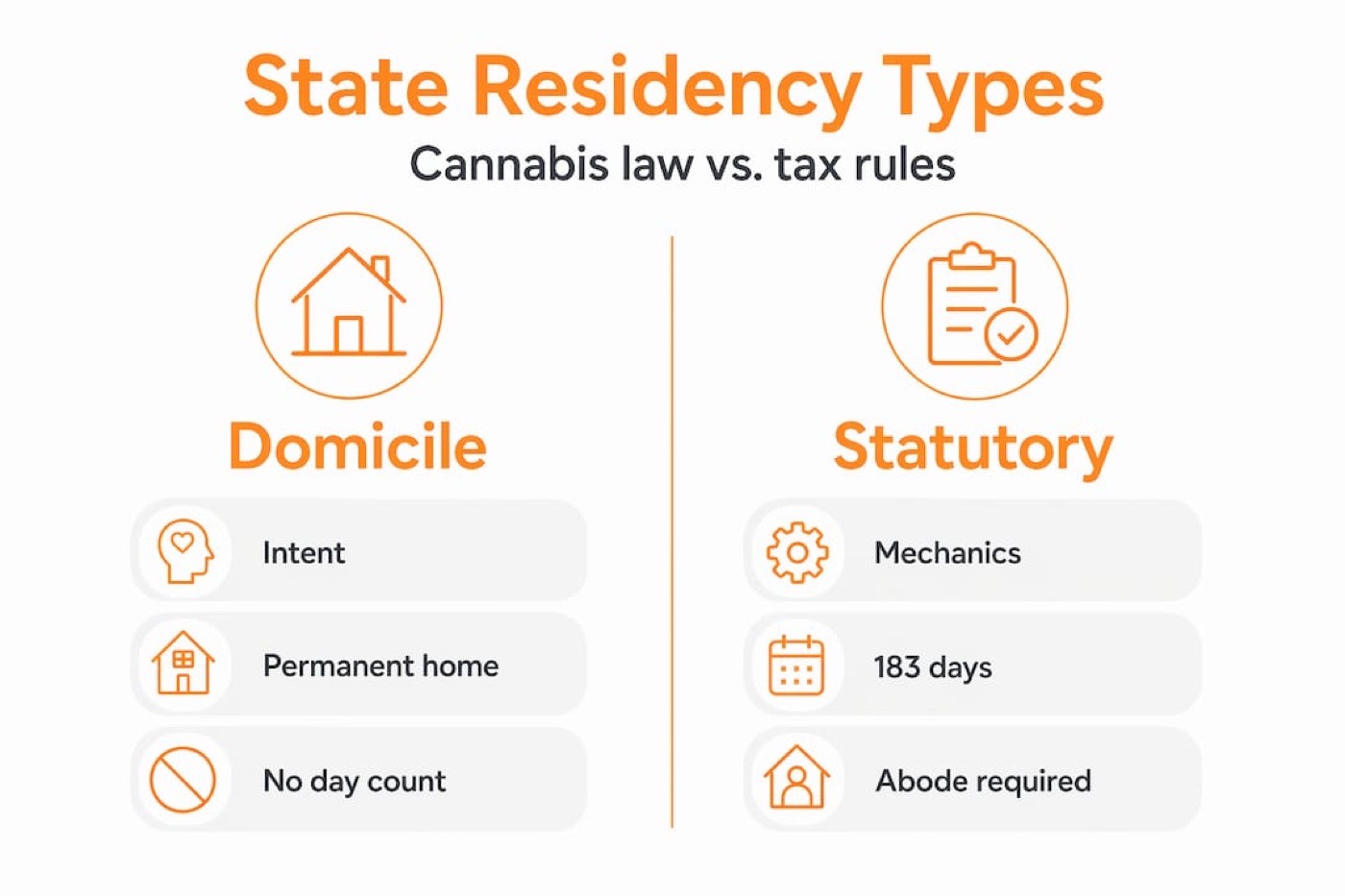
State tax residency operates on two parallel tracks: domicile and statutory residency. Understanding the difference determines your actual tax exposure, and most cannabis operators do not have clean answers on either.
Domicile is where you intend to make your permanent home. It is subjective but carries serious legal weight. Where you vote, where your family lives, where your primary bank accounts sit, and where your professional license is registered all feed into a domicile determination.

Statutory residency is purely mechanical. Spending 183 or more days in a state with a permanent place of abode makes you a statutory resident for tax purposes, regardless of where you claim domicile. This catches cannabis operators who own or maintain a residence in a high-tax state while claiming domicile elsewhere.
| Residency Type | Basis | Key Threshold |
|---|---|---|
| Domicile | Intent to make permanent home | No specific day count; totality of facts |
| Statutory Residency | Physical presence plus abode | 183+ days with permanent place of abode |
| Cannabis License Residency | Regulatory licensing requirement | State-specific; often tied to operations |
The table shows why cannabis license residency and tax residency are not interchangeable. States require owners to demonstrate ties to the jurisdiction to obtain a cannabis license. That documentation, proof of a local address, utility bills, and lease agreements, is exactly what state tax auditors look for when building a statutory residency case against someone claiming domicile elsewhere.
State tax authorities use cannabis license applications as primary indicators of statutory residency in audits. When you file a cannabis license application showing a local address and permanent ties to the state, you have handed the auditor a roadmap. Dual residency can result in paying full resident-level taxes in two states simultaneously. That is not a theoretical risk. It happens.
States with no income tax, like Washington and Nevada, create a different trap. Operators think establishing cannabis operations there eliminates state income tax exposure. But statutory residency requires the 183-day threshold with a permanent abode. If you maintain a home in California and spend more than 183 days there while also running a Nevada operation, California taxes your worldwide income as a full resident.
Pro Tip: If you are relocating domicile to a no-income-tax state tied to a cannabis license, document the move aggressively: new voter registration, vehicle registration, bank accounts, and updated estate planning documents. Intent alone is not sufficient.
DEA rescheduling and what it means for 280E
On April 22, 2026, the DEA formally rescheduled state-licensed medical marijuana to Schedule III. This is the most consequential federal tax development for cannabis operators in decades. The rescheduling removes Section 280E deduction restrictions for medical cannabis businesses, allowing them to claim standard federal business deductions for the first time.
Recreational cannabis remains classified under Schedule I. Section 280E still applies fully to recreational cannabis operations. That distinction is where the compliance burden lands for multi-license operators.
“Failure to maintain auditable separation can cause the IRS to apply Section 280E across an entire business, negating the medical tax relief entirely.” — Bloomberg Law
The practical implications for operators carrying both license types are significant:
- Medical cannabis revenues and expenses must be tracked in completely separate cost centers, not just tagged differently in a general ledger.
- Payroll, utilities, and shared overhead costs must be allocated using a defensible methodology, such as square footage or revenue percentage, documented and consistently applied.
- Section 280E remains fully active for the recreational side, meaning those deductions disappear if the accounting systems blur the line between the two streams.
- Federal prescription requirements apply for individual medical deductions under IRC § 213. A formal medical prescription is required for medical cannabis expenses to qualify as itemized deductions, not just a state medical card.
- Multi-license businesses face the highest risk because a single audit finding of inadequate segregation can collapse the entire medical deduction structure.
For operators running blended medical and recreational dispensaries, the compliance cost of building and maintaining proper segregation systems is real. Read how Schedule III changes 280E to understand the full accounting architecture required. But that cost is substantially lower than losing the deductions entirely because the IRS determined the books were insufficiently separated.
Practical frameworks for cannabis tax residency compliance
Knowing the rules is one thing. Applying them without creating audit exposure is the harder work. Here is how to approach this systematically.
-
Document physical presence with precision. Maintain a daily log of your physical location, including city and state, for every day of the calendar year. Use calendar apps, credit card statements, and hotel receipts to corroborate the log. The IRS and state tax authorities expect supporting documentation that holds up under scrutiny.
-
Establish and defend your domicile with facts, not just intent. Register to vote in your domicile state, update your driver’s license, title vehicles there, and use a domicile-state attorney for estate planning. Courts and tax auditors look at the full factual pattern, not just a declaration.
-
Treat cannabis license applications as tax residency triggers. When applying for a cannabis license that requires local residency, immediately assess whether that application creates statutory tax residency exposure in that state. A license application showing a permanent local address is an admission the tax authority will find.
-
Build separate accounting systems for medical and recreational revenues before you need them. Retroactive segregation does not satisfy the IRS. You need auditable accounting systems in place from the transaction level. Chart of accounts separation, separate cost centers, and separate POS reporting for medical and recreational sales are the minimum viable structure.
-
Retain a cannabis tax specialist before multi-state expansion. The intersection of cannabis residency rules, taxes on cannabis sales, and multi-state statutory residency creates scenarios that general practice CPAs are not equipped to handle. The tax planning strategies needed for cannabis dispensaries are specific enough that generalist advice creates more risk than it mitigates.
Pro Tip: When you are not sure whether a cannabis license residency requirement creates tax residency exposure, assume it does and document accordingly. The cost of over-documentation is low. The cost of under-documentation in a residency audit is not.
The cannabis tax residency issues that lead to audits are almost always documentation failures, not legal uncertainty. The rules are knowable. The mistakes are preventable.
My take on where most businesses get this wrong
I have reviewed enough cannabis tax situations to see the same pattern repeat. Operators assume that because they followed state cannabis residency rules to get licensed, their tax residency situation is handled. It is not even close to handled. Those are parallel legal frameworks that occasionally overlap and frequently conflict.
The day-counting problem is the one I find most underestimated. Cannabis professionals who travel constantly for licensing meetings, investor presentations, and multi-state operations are the exact people who rack up enough U.S. presence to trigger unexpected federal or state tax residency. Most of them are not tracking days. They are tracking deals.
Post-rescheduling, the segregation problem compounds everything. I have seen well-intentioned operators who understand 280E in theory but have point-of-sale systems and general ledgers that make clean segregation impossible to prove in an audit. The IRS does not grade on intent. It grades on documentation.
The highest-stakes error I see is treating cannabis tax residency issues as a problem to solve after the fact, usually when a notice arrives. By then, the options narrow considerably. Building the documentation infrastructure before you need it is the only approach that actually protects you.
Do not rely on your cannabis attorney and your general CPA dividing this work between themselves without someone specifically accountable for the tax residency and 280E intersection. That gap is where audit exposure lives.
— JN
Resources to help you stay compliant
Cannabis tax residency issues do not resolve themselves, and the post-rescheduling environment has raised the stakes for every operator running medical and recreational operations under the same roof. Cannabisbusinessminds has built resources specifically for finance professionals and business owners working through these exact challenges.

The cannabis accounting guidance on Cannabisbusinessminds covers compliance accounting practices that address Section 280E segregation, revenue stream documentation, and the structural requirements that protect deductions under the new medical cannabis framework. If you are managing tax exposure across multiple licenses or states, the tax exposure resources provide a direct breakdown of where liabilities concentrate and how to plan around them. For operators who want to start with cost structure and build up, the cost accounting guide gives you the foundational methodology that makes medical and recreational segregation auditable.
These are not theoretical frameworks. They are built for the compliance environment cannabis operators actually face.
FAQ
What is cannabis tax residency?
Cannabis tax residency refers to a business owner’s or professional’s legal status as a tax resident under federal IRS rules or state law, separate from any state cannabis licensing residency requirement. It determines which income is taxable and in which jurisdiction.
Does a cannabis license make you a tax resident in that state?
No. A cannabis license requires regulatory residency but does not automatically establish tax residency. However, cannabis license applications are frequently used by state tax authorities as evidence of statutory residency during audits.
How does the 2026 DEA rescheduling affect Section 280E?
The April 2026 rescheduling of medical marijuana to Schedule III removes Section 280E deduction restrictions for medical cannabis operations. Section 280E still applies fully to recreational cannabis businesses.
What triggers state tax residency for a cannabis business owner?
Spending 183 or more days in a state with a permanent place of abode triggers statutory residency regardless of where you claim domicile, creating full state income tax obligations.
Can a cannabis operator have dual state tax residency?
Yes. Dual residency is a real risk for cannabis operators with business and housing ties in multiple states, and it can result in paying full resident-level income taxes in two states simultaneously. Proper documentation of domicile and physical presence is the only reliable defense.
Recommended
- Tax Exposure Cannabis – Impact on US Businesses – Cannabis Business Minds
- What Is Tax Liability for Cannabis? Complete Breakdown – Cannabis Business Minds
- Why Cannabis Taxes Are High for U.S. Businesses – Cannabis Business Minds
- Cannabis Entity Tax Status: Key U.S. Compliance Factors – Cannabis Business Minds
This article is general education, not tax, legal or accounting advice. Cannabis rules change quickly; confirm how they apply to you with a qualified cannabis CPA or attorney.