The Role of Tax Credits in Cannabis: 2026 Guide

2026 update: what rescheduling changed for 280E (reviewed October 2026)
Effective April 22, 2026, a DOJ/DEA final order moved marijuana covered by a qualifying state medical license (and FDA-approved marijuana drugs) to Schedule III. Section 280E only applies to Schedule I and II substances, so state-licensed medical cannabis activity is generally no longer subject to 280E going forward. Adult-use cannabis remains in Schedule I and fully subject to 280E. The DEA proceeding to reschedule all marijuana was temporarily stayed in October 2026, and Treasury/IRS guidance on transition years and mixed medical/adult-use businesses is still pending.
Check where your business stands in about a minute.
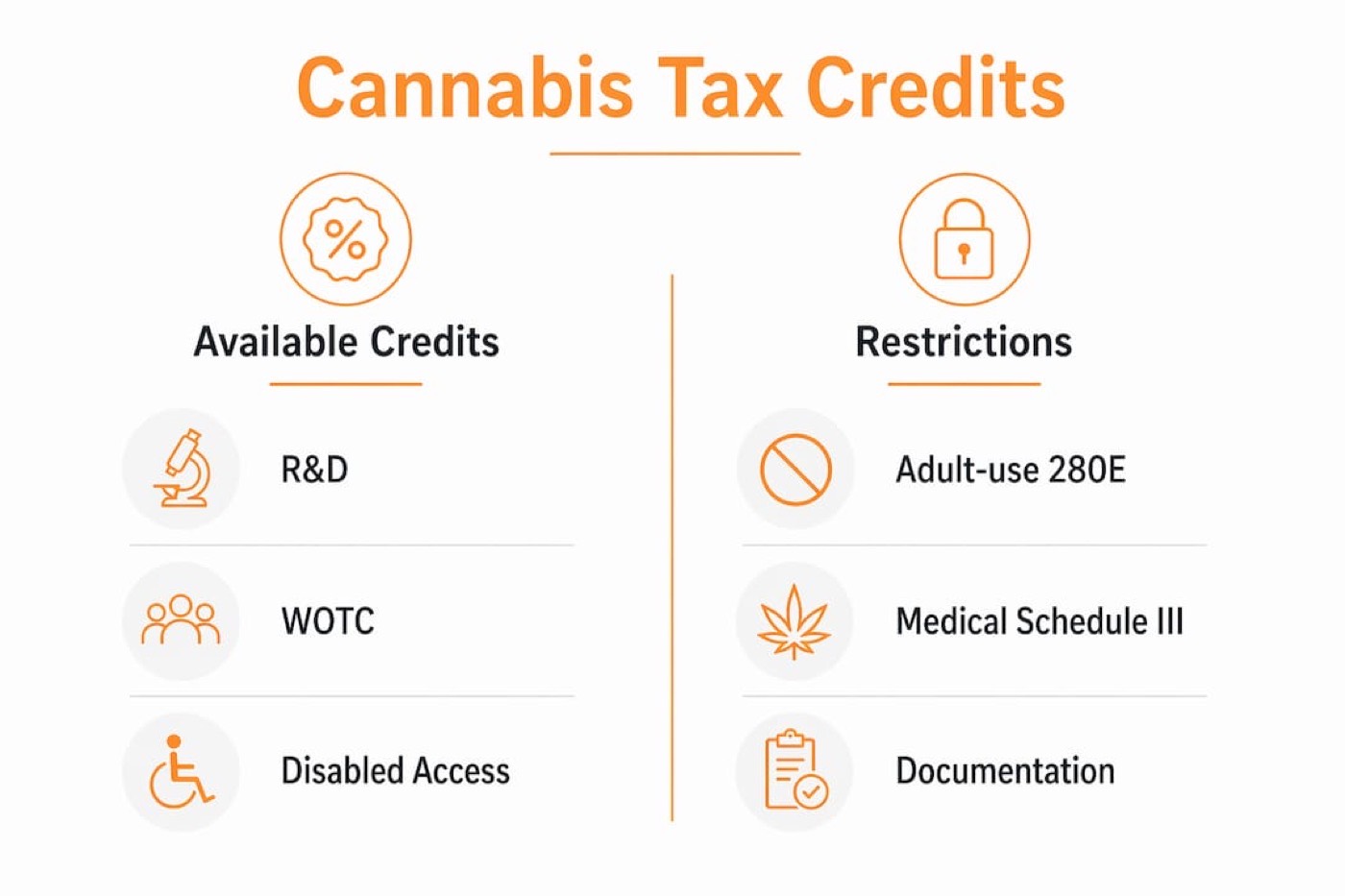
Tax credits for cannabis businesses became viable federal tax planning tools in 2026 following the DEA’s rescheduling of specific medical cannabis products from Schedule I to Schedule III, which lifts the prior federal prohibition on deductions and credits under Section 280E. The DEA rescheduling on April 22, 2026 reclassified certain medical cannabis, enabling qualifying businesses to claim federal tax credits like the Section 41 R&D credit for the first time. The role of tax credits in cannabis is no longer theoretical. For medical cannabis operators, credits like the Work Opportunity Tax Credit (WOTC) and the R&D credit under Section 41 are now primary financial planning tools, not aspirational line items. Adult-use cannabis remains under Section 280E. That distinction is where your compliance work lives.
What tax credits can cannabis businesses access post-2026?
The structural shift here is not that new credits were created. The credits always existed. Section 280E simply made them inaccessible by disallowing deductions and credits for businesses trafficking in Schedule I or II controlled substances. With qualifying medical cannabis now at Schedule III, that wall comes down for covered activities.
Section 41 R&D tax credit
The Section 41 Research and Development tax credit is the most significant credit now available to qualifying medical cannabis operators. Eligible activities include developing new cultivation techniques, improving extraction processes, formulating new delivery methods, and conducting clinical or efficacy research on cannabis compounds. The credit is calculated as a percentage of qualified research expenses (QREs), which include wages, supplies, and contract research costs tied to qualifying activities.

The key shift: R&D credits move from secondary to primary tax planning tools for qualifying operators starting in 2026. That means cannabis finance teams need to build QRE tracking into their accounting systems now, not at year-end.
Pro Tip: Document R&D activities contemporaneously. Retroactive reconstruction of qualifying expenses is defensible but harder to sustain under audit. Build a project-level cost tracking system that maps labor, supplies, and contractor costs to specific research activities in real time.
Work Opportunity Tax Credit (WOTC)
The WOTC reduces tax liability directly for cannabis businesses that hire from targeted groups, including ex-felons, veterans, and long-term unemployment recipients. The credit ranges from $1,200 to $9,600 per qualifying hire depending on the target group and hours worked. For cannabis operators with high seasonal labor needs, this credit can be material. WOTC certification requires filing IRS Form 8850 with the state workforce agency within 28 days of the employee’s start date. Miss that window and the credit is gone.
Other credits worth evaluating
Beyond R&D and WOTC, medical cannabis operators should evaluate the Disabled Access Credit under Section 44, the employer-provided childcare credit under Section 45F, and energy efficiency credits if applicable to their facilities. These are smaller in dollar terms but stack with R&D and WOTC to produce a meaningful aggregate reduction in federal tax liability.
| Credit | Code Section | Typical Benefit | Key Requirement |
|---|---|---|---|
| R&D Credit | Section 41 | 6–20% of QREs | Qualifying research activities, contemporaneous docs |
| Work Opportunity Tax Credit | Section 51 | $1,200–$9,600 per hire | Form 8850 filed within 28 days of hire |
| Disabled Access Credit | Section 44 | Up to $5,000 | Eligible small business, accessibility expenditures |
| Employer Childcare Credit | Section 45F | Up to $150,000 | Qualified childcare facility or resource costs |
How Section 280E limited cannabis tax benefits and what changed
Section 280E is a single sentence with outsized consequences. It disallows all deductions and credits for any trade or business that consists of trafficking in a controlled substance under Schedule I or II of the Controlled Substances Act. The IRS and courts interpret “trafficking” broadly. Regular commercial activity qualifies as trafficking for these purposes, meaning dispensaries, cultivators, and processors all fell under 280E regardless of state licensing status.
The practical effect was severe. Cannabis businesses could only deduct cost of goods sold (COGS) under Section 471. All other operating expenses, including wages, rent, marketing, and professional fees, were nondeductible. Credits were equally blocked. A cannabis operator with $5 million in gross profit and $3 million in operating expenses paid federal income tax on the full $5 million, not the $2 million net.
What rescheduling actually changes
Rescheduling to Schedule III removes the 280E barrier for activities tied to Schedule III medical cannabis. It does not create a new deduction regime. It restores the normal tax treatment that every other business receives. That means ordinary and necessary business expenses become deductible, and federal tax credits become claimable for qualifying medical cannabis activities.
The distinction between medical and adult-use cannabis is now the central compliance question. Section 280E continues to block deductions and credits for adult-use cannabis, which remains Schedule I. Operators running both medical and recreational operations must segregate expenses by activity type. That segregation is not optional. It is the foundation of every credit claim you file.
Medical vs. adult-use: the tax treatment gap
| Activity Type | Schedule | 280E Applies? | Credits Available? |
|---|---|---|---|
| Medical cannabis (qualifying) | Schedule III | No | Yes |
| Adult-use / recreational cannabis | Schedule I | Yes | No |
| Mixed operations (unsegregated) | Both | Partial | Risk of disallowance |
For vertically integrated operators, expense allocation guidance from Treasury will determine how costs are apportioned across activities. That guidance is pending. File conservatively until it arrives.
Compliance and documentation challenges in claiming cannabis tax credits
Claiming federal tax credits post-rescheduling is not a matter of checking a box on your return. The IRS will scrutinize these claims, particularly in the first years after rescheduling when audit selection criteria are still being calibrated. Here is what defensible compliance looks like in practice.
-
Build contemporaneous records for R&D activities. The IRS requires that qualifying research be documented at the time it occurs, not reconstructed later. This means project logs, time tracking by employee, supply purchase records tied to specific research activities, and contractor agreements that identify the research purpose. Retroactive claims require careful documentation and are harder to defend under audit.
-
Segregate Schedule III and Schedule I activities in your chart of accounts. Every cost center, revenue stream, and labor allocation must be coded by activity type before you file. Mixed-activity businesses that cannot produce clean segregation will face partial or full disallowance of credits. Purpose-built cost tracking is not a best practice here. It is a filing requirement.
-
Wait for Treasury expense allocation guidance before finalizing credit claims. The forthcoming guidance will define how shared costs, such as facility overhead and management salaries, are allocated between Schedule I and Schedule III activities. Filing before that guidance is issued creates amendment risk. Model your credits now, but file with appropriate conservatism.
-
Prepare for audit on WOTC certifications. The 28-day filing window for Form 8850 is a hard deadline. Maintain copies of all certifications, state agency responses, and employee eligibility documentation. WOTC audits focus on timing and target group verification.
-
Integrate credit computations with deduction and expensing elections. Post-rescheduling tax planning requires coordination between deductions, expensing elections under Section 174, and credit calculations to avoid mismatches that reduce credit value or invite scrutiny.
Pro Tip: Set up a dedicated cost center for each qualifying R&D project before expenses are incurred. Mapping costs to projects after the fact is possible but creates documentation gaps that IRS agents will flag during examination.
Practical tax planning strategies for cannabis businesses leveraging tax credits
The Treasury transition rule treats rescheduling as applying to the full taxable year that includes the effective date. For calendar-year operators, that means full-year 2026 eligibility for Schedule III medical cannabis activities. This is a significant planning advantage. It allows clean annual modeling rather than mid-year proration.
Practical planning priorities for cannabis finance teams in 2026 and beyond:
-
Model full-year credit benefits now. Use the transition rule to project R&D and WOTC credits for the full 2026 tax year. Build two scenarios: one assuming Treasury expense allocation guidance arrives before filing, one assuming it does not. The gap between those scenarios defines your filing risk.
-
Coordinate with state-level incentives. Several states with medical cannabis programs offer their own R&D credits, hiring incentives, or tax abatements. California, Illinois, and Colorado each have state-level programs worth evaluating alongside federal credits. Stacking federal and state credits requires careful sequencing to avoid double-counting.
-
Align hiring strategy with WOTC target groups. If your operation has seasonal labor needs, build a WOTC-eligible hiring pipeline. Partner with state workforce agencies and reentry programs to identify qualified candidates. The credit is real money per hire and scales with headcount.
-
Review entity structure for credit optimization. Pass-through entities, including S corporations and partnerships, pass credits to owners. C corporations retain and apply credits directly. The optimal structure depends on owner-level tax rates and the magnitude of credits generated. This is a conversation for your tax counsel, not a year-end afterthought.
-
Monitor IRS and Treasury guidance actively. The full-year transition rule applies only to Schedule III covered activities. Any guidance that narrows the definition of qualifying medical cannabis activities will affect credit eligibility retroactively. Subscribe to IRS notice releases and Baker Tilly, Withum, and similar cannabis tax practices for real-time updates.
Understanding your effective tax rate in cannabis operations is the baseline from which credit planning starts. Credits reduce effective rate directly. Know your baseline before you model the benefit.
Where I think most cannabis operators will get this wrong
The rescheduling is genuinely significant. But the reaction I see in the industry, which is to assume that credits are now freely available and refunds are coming, is getting ahead of the facts. The credits exist. The legal barrier is down for qualifying medical activities. What is not resolved is how the IRS will treat mixed-activity businesses, how Treasury will define expense allocation, and how aggressively auditors will scrutinize the first wave of credit claims.
The operators who will benefit most are the ones who treat this like a new compliance function, not a windfall. That means building documentation systems before filing, not after an audit notice arrives. It means conservative expense segregation until Treasury guidance is clear. And it means understanding that rescheduling does not equal full tax relief for all revenues.
The businesses I would be most concerned about are vertically integrated operators running both medical and adult-use operations without a clean cost segregation methodology. They are the most exposed to disallowance and the most likely to face audit. If that describes your operation, the priority is not credit modeling. It is fixing your chart of accounts.
One more thing: retrospective relief remains uncertain. Do not build cash flow projections around refunds for prior years until guidance explicitly supports them. Plan forward, not backward.
— JN
Deepen your cannabis tax and accounting knowledge
If you are working through the financial implications of rescheduling for your operation, the technical details matter as much as the strategic overview. Cannabisbusinessminds has built out a library of resources specifically for cannabis finance professionals working through these questions.

Start with the cannabis inventory costing guide to understand how cost of goods sold calculations interact with the new credit regime. Then work through the tax exposure analysis to quantify your current federal liability and model the impact of available credits. For operators building out their accounting infrastructure, the cost accounting guide covers the expense segregation methodology you need before filing any credit claim. Cannabisbusinessminds covers the technical depth that generic tax resources skip.
FAQ
What is the role of tax credits in cannabis after 2026?
Tax credits in cannabis became operationally relevant in 2026 after the DEA rescheduled qualifying medical cannabis to Schedule III, removing Section 280E barriers that previously blocked credits like the Section 41 R&D credit and WOTC for covered medical activities.
Does Section 280E still apply to cannabis businesses?
Section 280E still applies to adult-use and recreational cannabis, which remains Schedule I. Only businesses with qualifying Schedule III medical cannabis activities are relieved of 280E restrictions, and only for those specific activities.
What documentation is required to claim the R&D tax credit?
Operators must maintain contemporaneous records of qualifying research activities, including project logs, employee time allocations, supply costs tied to specific projects, and contractor agreements identifying the research purpose, all mapped to Section 41 requirements.
Can cannabis businesses claim both R&D and WOTC credits?
Yes. Medical cannabis operators qualifying under Schedule III can claim both the Section 41 R&D credit and WOTC simultaneously, provided they meet the documentation and certification requirements for each credit independently.
How does expense segregation affect cannabis tax credit eligibility?
Businesses running both medical and adult-use operations must segregate all costs by activity type in their chart of accounts. Unsegregated expenses tied to Schedule I activities remain subject to 280E disallowance, which can invalidate credit claims across the entire return.
Recommended
- Cannabis Tax – Cannabis Business Minds
- What Is Effective Tax Rate in Cannabis Operations – Cannabis Business Minds
- Understanding indirect tax on cannabis: a guide for U.S. operators – Cannabis Business Minds
- Cannabis Tax Professionals: Complete Role Breakdown – Cannabis Business Minds
This article is general education, not tax, legal or accounting advice. Cannabis rules change quickly; confirm how they apply to you with a qualified cannabis CPA or attorney.