Cannabis Regulatory Risk Explained: Safeguarding U.S. Dispensaries

2026 update: what rescheduling changed for 280E (reviewed October 2026)
Effective April 22, 2026, a DOJ/DEA final order moved marijuana covered by a qualifying state medical license (and FDA-approved marijuana drugs) to Schedule III. Section 280E only applies to Schedule I and II substances, so state-licensed medical cannabis activity is generally no longer subject to 280E going forward. Adult-use cannabis remains in Schedule I and fully subject to 280E. The DEA proceeding to reschedule all marijuana was temporarily stayed in October 2026, and Treasury/IRS guidance on transition years and mixed medical/adult-use businesses is still pending.
This article was written before the order took effect. Check where your business stands in about a minute.
Few industries challenge compliance officers like the American cannabis sector, where over 90 percent of dispensaries report facing significant regulatory concerns each year. Federal law and state policies rarely align, creating a minefield of legal uncertainties. For those managing financial compliance, this article delivers actionable clarity on the biggest threats facing dispensaries and offers practical solutions to reduce regulatory risk and handle Section 280E tax exposure with greater confidence.
Key Takeaways
| Point | Details |
|---|---|
| Understanding Regulatory Frameworks | Cannabis businesses must navigate complex federal and state regulations that often conflict, necessitating constant vigilance and compliance management. |
| Managing Financial Exposure | Section 280E significantly limits tax deductions for cannabis dispensaries, creating high effective tax rates that challenge profitability and operational flexibility. |
| Importance of Compliance Systems | Developing robust compliance tracking systems and staff training programs is essential for mitigating risks and ensuring adherence to regulatory mandates. |
| Proactive Risk Management | Implementing sophisticated technological and organizational strategies can significantly reduce regulatory risks and enhance business resilience in the cannabis industry. |
Defining Cannabis Regulatory Risk in the U.S.
Cannabis regulatory risk represents the complex legal vulnerabilities and compliance challenges faced by U.S. dispensaries operating in a landscape of conflicting federal and state regulations. At its core, this risk stems from the fundamental legal paradox where cannabis remains a Schedule I controlled substance federally, while simultaneously being legal for medical or recreational use in numerous states.
The regulatory risk environment is characterized by significant legal uncertainties that directly impact business operations. Evolving regulatory frameworks create substantial compliance challenges for cannabis businesses, exposing them to potential federal prosecution, financial service restrictions, and operational limitations. These risks manifest through multiple dimensions – legal, financial, operational, and compliance – each presenting unique challenges that demand strategic navigation.
Specifically, cannabis dispensaries must contend with three primary regulatory risk categories: legal risk from potential federal enforcement, financial risk due to banking restrictions, and compliance risk from varying state-level regulations. The federal government’s continued classification of cannabis as illegal creates a persistent threat of prosecution, while simultaneously preventing traditional banking services, forcing many dispensaries into complex cash-management scenarios. State-level regulations further compound these challenges, with each jurisdiction maintaining distinct rules around licensing, product standards, taxation, and operational protocols.
Here’s a summary of major regulatory risks faced by cannabis dispensaries and their business impacts:
| Risk Category | Key Source | Example Impact |
|---|---|---|
| Legal Risk | Federal prohibition (CSA) | Possibility of prosecution |
| Financial Risk | Restrictive banking, Section 280E | Limited access to banking |
| Compliance Risk | Diverse state/local regulations | Operational inconsistency |
| Operational Risk | Cash handling, recordkeeping requirements | Increased security concerns |
Pro tip: Develop a comprehensive compliance tracking system that monitors federal, state, and local regulatory changes in real-time to proactively mitigate potential regulatory risks.
Major Federal and State Laws Impacting Dispensaries
Navigating the legal landscape of cannabis dispensaries requires a comprehensive understanding of the intricate web of federal and state regulations that simultaneously conflict and coexist. At the federal level, the Controlled Substances Act (CSA) remains the primary legislative framework, classifying cannabis as a Schedule I substance and creating significant legal complexities for dispensaries. This classification effectively prohibits the manufacture, distribution, and possession of cannabis, despite growing state-level legalization efforts.
State laws have emerged as critical counterpoints to federal restrictions, with each jurisdiction developing unique regulatory frameworks for cannabis businesses. These state-level regulations typically address crucial operational aspects such as licensing requirements, product standards, taxation protocols, and permissible sales quantities. Some states have implemented comprehensive medical cannabis programs, while others have fully legalized recreational use, creating a patchwork of regulatory approaches that dispensaries must carefully navigate.
The regulatory tension between federal and state laws creates a complex compliance environment for dispensaries. Federal non-enforcement policies like the Cole Memo have provided some temporary relief, but dispensaries must remain vigilant about potential legal risks. Key challenges include restricted access to banking services, complex tax reporting requirements under Internal Revenue Code Section 280E, and the constant threat of federal intervention. State-level cannabis licensing and compliance programs have become increasingly sophisticated, requiring dispensaries to maintain rigorous documentation and adhere to constantly evolving regulatory standards.
This table compares federal and state approaches to cannabis regulation:
| Aspect | Federal Law (CSA) | State Laws |
|---|---|---|
| Cannabis Status | Schedule I, illegal | Legal for medical/recreational |
| Enforcement Focus | Prohibition, rare guidance | Licensing, safety, operations |
| Tax Treatment | No deductions (280E) | Normal tax deductions vary |
| Banking Access | Severely restricted | Sometimes permitted via state |
Pro tip: Maintain a dedicated legal compliance team or consultant who specializes in cannabis regulations to continuously monitor and adapt to changing federal and state legislative landscapes.
Understanding Section 280E and Financial Exposure
Section 280E represents one of the most significant financial challenges for cannabis dispensaries, creating a punitive tax environment that dramatically increases operational costs. The Internal Revenue Code provision prohibits cannabis businesses from deducting standard business expenses on federal tax returns, effectively forcing companies to pay taxes on gross income rather than net income. This unique tax treatment stems from cannabis’s federal classification as a Schedule I controlled substance, resulting in effective tax rates that can exceed 70% for many dispensaries.
The financial implications of Section 280E are particularly devastating for cannabis retailers. Typical business expenses such as rent, utilities, marketing, and employee wages cannot be deducted, which means dispensaries must calculate their tax liability on total revenue instead of profits. This creates an extraordinary financial burden that significantly constrains business growth, reduces operational flexibility, and makes profitability substantially more challenging compared to businesses in other industries.
Dispensaries have developed several strategies to mitigate the impact of Section 280E, including careful corporate structuring and meticulously tracking tax exposure to optimize their financial position. Some businesses create separate legal entities to separate plant-touching and non-plant-touching operations, allowing certain expenses to be deducted under alternative business units. Sophisticated tax planning and rigorous accounting practices have become essential survival skills for cannabis businesses navigating this complex regulatory landscape.
Pro tip: Consult with a cannabis-specialized tax professional who understands Section 280E intricacies to develop a comprehensive tax mitigation strategy tailored to your specific dispensary operations.
Compliance Obligations for Cannabis Businesses
Cannabis businesses operate within an extraordinarily complex regulatory landscape that demands meticulous attention to multifaceted compliance requirements. Regulatory frameworks span federal, state, and local jurisdictions, creating a challenging environment of overlapping and sometimes conflicting mandates. These obligations extend far beyond simple licensing, encompassing intricate requirements for product safety, documentation, tracking, marketing restrictions, and operational protocols.
At the core of cannabis business compliance are several critical areas of focus. Seed-to-sale tracking represents a fundamental requirement, mandating comprehensive documentation of cannabis products from cultivation through final sale. Businesses must implement robust systems that record every transaction, movement, and transformation of cannabis products. Laboratory testing becomes another crucial compliance dimension, with stringent requirements for potency verification, contaminant screening, and product safety assessments. Advertising and marketing restrictions further complicate operational strategies, with regulations tightly controlling how cannabis products can be promoted and to whom.
Navigating these compliance obligations requires a proactive and systematic approach. Cannabis compliance demands continuous education and adaptive strategies to address the dynamic regulatory environment. Successful cannabis businesses invest significantly in compliance infrastructure, including dedicated legal and regulatory teams, sophisticated tracking technologies, and ongoing training programs. Security protocols, rigorous recordkeeping, and transparent reporting mechanisms become essential survival skills in an industry characterized by intense regulatory scrutiny.
Pro tip: Develop a comprehensive compliance management system that integrates real-time regulatory tracking, automated documentation processes, and periodic internal audit mechanisms to stay ahead of evolving cannabis regulations.
Common Regulatory Mistakes and How to Avoid Them
Cannabis dispensaries face numerous potential regulatory pitfalls that can jeopardize their entire business operation. Common compliance mistakes often stem from inadequate security protocols and poor tracking mechanisms, which create significant legal and financial vulnerabilities. These errors can range from seemingly minor documentation issues to substantial breaches that might result in immediate license revocation.
One of the most critical areas of potential regulatory failure involves patient privacy, inventory management, and purchase limit enforcement. Dispensaries frequently encounter challenges with customer purchase tracking, where individuals attempt to circumvent legal purchasing limits through tactics like ‘looping’ – purchasing multiple times at different locations to exceed authorized quantities. Robust technological solutions and comprehensive staff training become essential in preventing these compliance breaches. Additionally, strict adherence to product packaging, labeling requirements, and maintaining meticulous seed-to-sale documentation are non-negotiable operational standards.
Navigating the complex regulatory landscape requires a proactive and systematic approach to compliance management. Dispensaries must invest in comprehensive compliance infrastructure that includes continuous staff education, regular internal audits, and adaptive technological systems. This means developing sophisticated tracking mechanisms, implementing rigorous security protocols, and maintaining transparent communication channels with regulatory authorities. Successful cannabis businesses recognize that compliance is not a one-time achievement but an ongoing, dynamic process requiring constant vigilance and adaptation.
Pro tip: Implement quarterly comprehensive compliance audits and maintain a dedicated compliance officer who stays current with evolving state and federal regulations.
Effective Strategies to Reduce Risk
Cannabis dispensaries must adopt a comprehensive, proactive approach to regulatory risk management that goes beyond mere compliance. Developing evidence-based policy strategies becomes crucial in mitigating potential legal and operational vulnerabilities. This requires a multi-dimensional strategy that integrates technological solutions, staff training, and robust internal control mechanisms.
Effective risk reduction begins with implementing sophisticated technological tracking systems that provide real-time monitoring and documentation. These systems must encompass seed-to-sale tracking, comprehensive inventory management, and precise customer purchase documentation. Critical components include advanced point-of-sale software capable of preventing purchase limit circumvention, automated compliance reporting mechanisms, and integrated security protocols that create multiple layers of operational oversight.
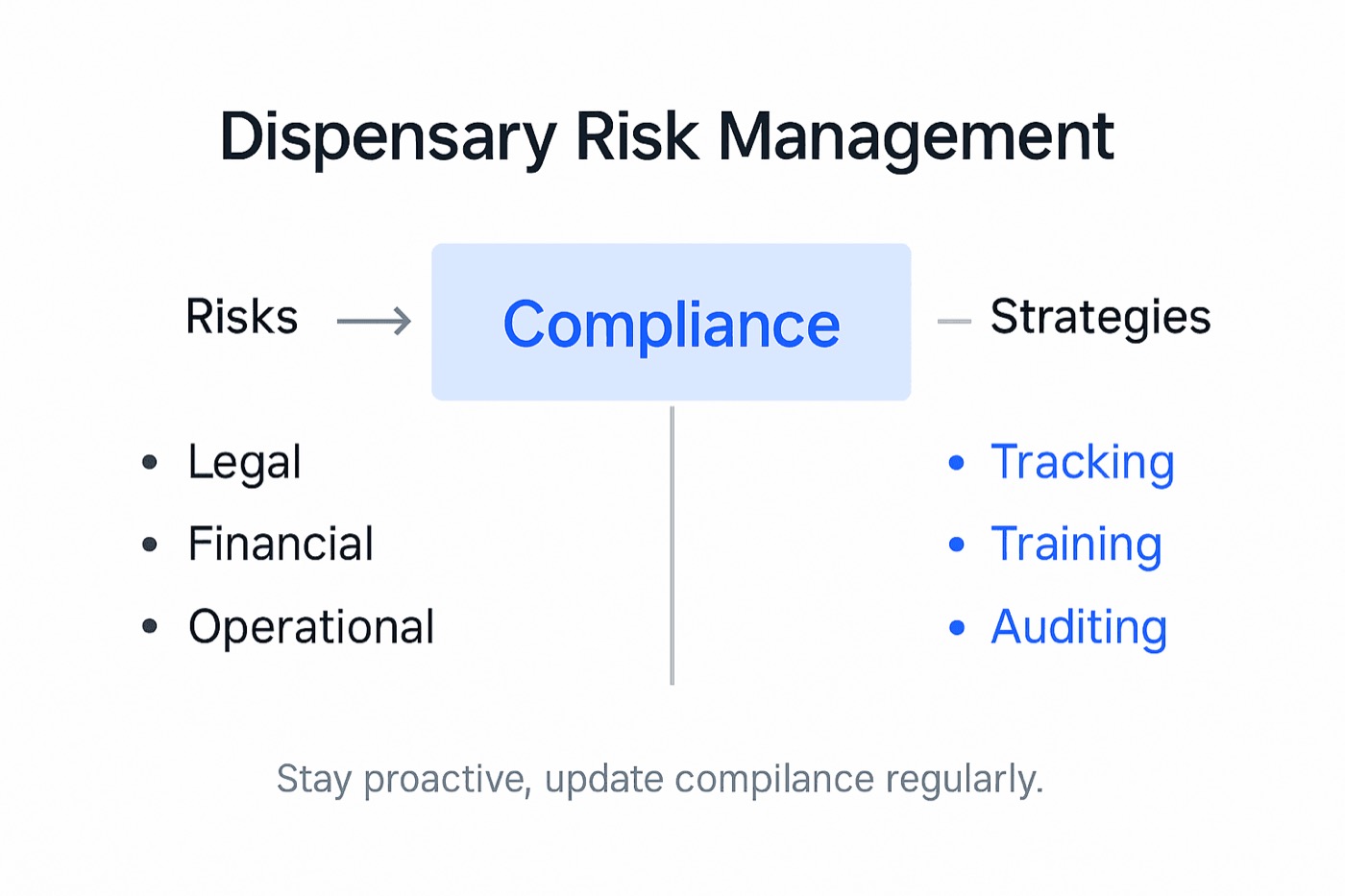
Beyond technological solutions, successful risk mitigation demands a holistic organizational approach. Comprehensive staff training programs designed to build a culture of compliance represent a fundamental strategy for reducing regulatory exposure. This includes regular educational sessions on evolving regulations, detailed procedural training, and creating internal accountability mechanisms that empower employees to recognize and report potential compliance risks. Dispensaries must also maintain transparent communication channels with regulatory authorities, demonstrating a commitment to proactive collaboration and continuous improvement.
Pro tip: Conduct monthly internal compliance audits and maintain a dynamic risk management framework that adapts quickly to changing regulatory landscapes.
Frequently Asked Questions
What is cannabis regulatory risk?
Cannabis regulatory risk refers to the legal vulnerabilities and compliance challenges faced by dispensaries due to conflicting federal and state regulations regarding cannabis legality.
How does Section 280E impact cannabis dispensaries financially?
Section 280E of the Internal Revenue Code prohibits cannabis businesses from deducting standard business expenses, forcing them to pay taxes on gross income, which can result in tax rates exceeding 70% for many dispensaries.
What are the main categories of regulatory risk for cannabis dispensaries?
The main categories of regulatory risk include legal risk from potential federal enforcement, financial risk due to banking restrictions, and compliance risk from varying state regulations governing cannabis operations.
Why is compliance tracking important for cannabis businesses?
Compliance tracking is crucial for cannabis businesses to monitor regulatory changes in real-time, maintain operational consistency, and avoid potential legal and financial penalties associated with non-compliance.
Recommended
- Dispensary Licensing Explained: Complete Compliance Guide – Cannabis Business Minds
- The Essential Guide to Cannabis Business Risk Management – Cannabis Business Minds
- What Is Cannabis Compliance: Impact on U.S. Businesses – Cannabis Business Minds
- 7 Essential Cannabis Dispensary Compliance Tips for Success – Cannabis Business Minds
This article is general education, not tax, legal or accounting advice. Cannabis rules change quickly; confirm how they apply to you with a qualified cannabis CPA or attorney.