Why Create a Compliance Calendar for Cannabis Businesses
2026 update: what rescheduling changed for 280E (reviewed October 2026)
Effective April 22, 2026, a DOJ/DEA final order moved marijuana covered by a qualifying state medical license (and FDA-approved marijuana drugs) to Schedule III. Section 280E only applies to Schedule I and II substances, so state-licensed medical cannabis activity is generally no longer subject to 280E going forward. Adult-use cannabis remains in Schedule I and fully subject to 280E. The DEA proceeding to reschedule all marijuana was temporarily stayed in October 2026, and Treasury/IRS guidance on transition years and mixed medical/adult-use businesses is still pending.
Check where your business stands in about a minute.
If you operate a cannabis business and think a compliance calendar is optional paperwork, you have not seen what a missed regulatory deadline costs. We are talking license suspensions, IRS enforcement actions, and operational shutdowns that kill revenue for months. The reason to create a compliance calendar in cannabis is not administrative tidiness. It is survival. This industry runs on layered federal, state, and local obligations that shift constantly, and cannabis compliance failures carry consequences that sink otherwise profitable operations.
Table of Contents
- Why cannabis compliance deadlines are unlike any other industry
- How to build a cannabis compliance calendar that actually works
- Real benefits of maintaining a compliance calendar
- Operational structure: making the calendar more than a reminder tool
- My take: compliance calendars are the foundation, not the finish line
- How Cannabisbusinessminds can support your compliance calendar setup
- FAQ
Why cannabis compliance deadlines are unlike any other industry
Cannabis operators face a regulatory burden that stacks multiplicatively, not additively. You are not managing one set of rules. You are managing federal law, state licensing requirements, local ordinances, tax authority mandates, and track-and-trace obligations simultaneously. For multi-state operators, that burden multiplies by the number of jurisdictions you operate in. Each state has its own renewal cycles, reporting windows, and inspection timelines. Missing one layer does not just affect that jurisdiction. It can trigger scrutiny across your entire portfolio.
The 2026 federal picture made this sharper. The April 2026 DOJ order reclassified state-licensed medical cannabis, and operators had only 60 days to register with DEA by June 22 to receive priority review and safe harbor protection. That is not a soft deadline. Missing it means losing safe harbor and facing operational uncertainty with no federal protection. A compliance calendar with that date locked in at least 120 days out was the difference between prepared and scrambling.
IRS scrutiny is the other pressure point in 2026. The agency is aggressively auditing multi-state operators for Section 280E compliance and clawing back erroneous refunds. One operator was ordered to repay $8.4 million plus interest. That is not an audit adjustment. That is a business-altering event, and it stems directly from poorly tracked tax positions and missed filing windows.
The deadlines you need to integrate into a cannabis regulatory calendar span every layer:
- DEA registration and renewal deadlines under Schedule III reclassification
- State cannabis licensing renewals and operational permit renewals
- METRC reporting cycles and inventory reconciliation windows
- IRS filing dates including Form 1120, payroll tax deposits, and Form 5472
- State excise tax and cannabis-specific tax remittance schedules
- Employee training certification renewals tied to state licensing conditions
Pro Tip: If you operate in three or more states, map each jurisdiction’s deadlines in a separate tab within your master calendar, then create a consolidated view sorted by date. You will find date clusters where simultaneous obligations collide, which is exactly when businesses lose track.
How to build a cannabis compliance calendar that actually works
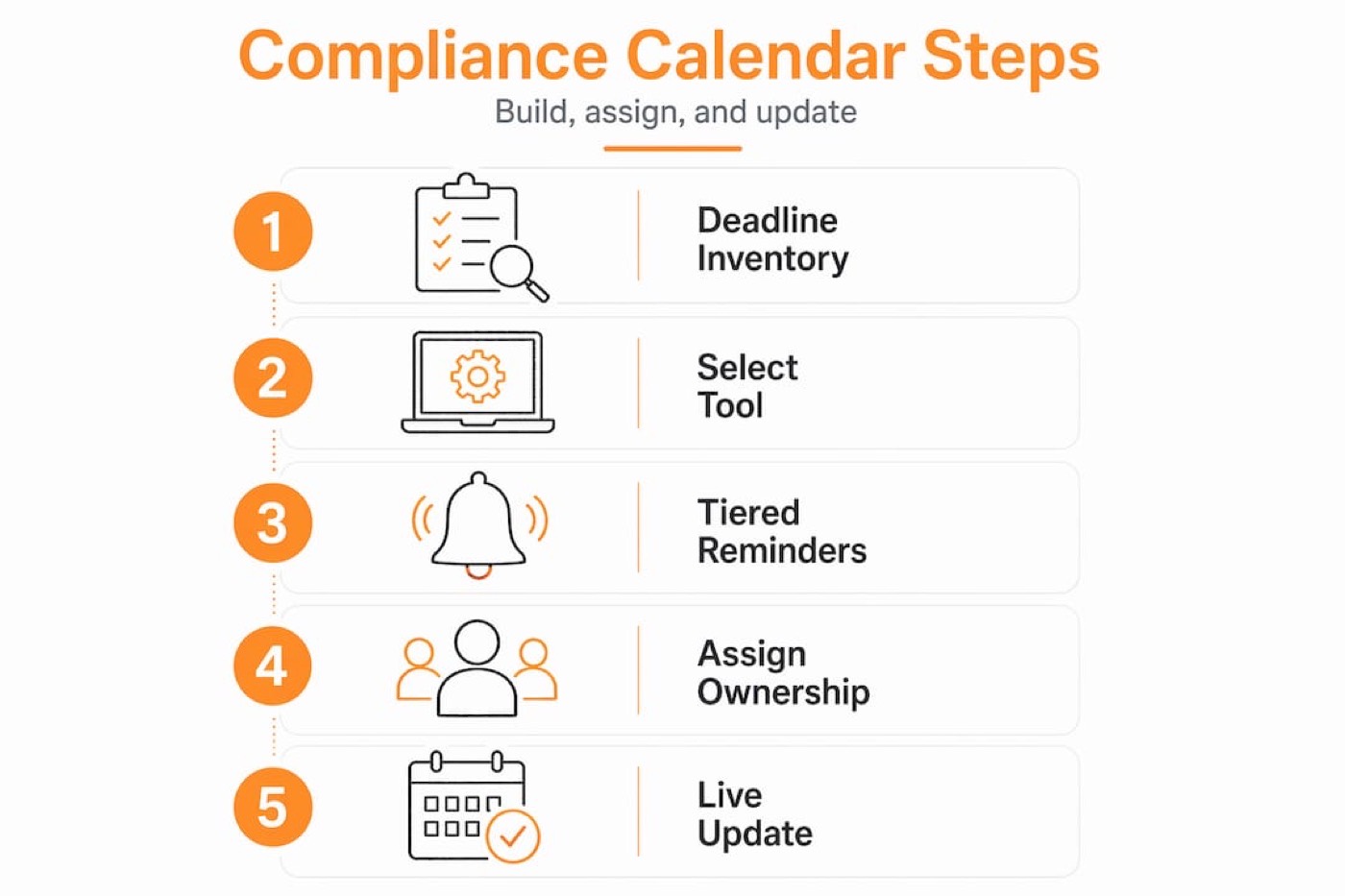
Most operators who say they have a compliance calendar have a spreadsheet someone made once and nobody updates. That is not a calendar. That is a document with historical value and no operational function. A working cannabis regulatory calendar has four components: a complete deadline inventory, a tiered reminder system, assigned ownership, and a live update mechanism.
Step 1: Build the full deadline inventory
Pull every recurring and one-time obligation across all jurisdictions. Include federal tax filings, DEA-related requirements, state license renewals, local permit renewals, METRC reconciliation windows, and internal audit schedules. Do not guess. Pull source documents from each state agency and the IRS. This is the foundation everything else depends on.
Step 2: Select your tool
The right format depends on your operation size:
| Operation Size | Recommended Tool | Key Benefit |
|---|---|---|
| Single-state, 1-3 licenses | Google Calendar or Excel | Low cost, easy to maintain |
| Multi-state, 4-10 licenses | Compliance software (e.g., dedicated GRC platforms) | Centralized tracking, automated alerts |
| Enterprise multi-state | Integrated ERP compliance module | Links to finance, HR, and operations |
Step 3: Set tiered reminders
Tiered reminders at 120, 90, 60, and 30 days before each deadline are the standard that compliance professionals use. The 120-day alert is for preparation. The 90-day is for documentation gathering. The 60-day is for submission drafts and internal review. The 30-day is for final execution. Collapsing these into a single “due soon” alert is how things get missed.
Step 4: Assign ownership
Every calendar item needs a named owner, not a department. “Finance team files Form 1120 by March 15” is not accountability. “Sarah Chen owns the Form 1120 filing, with escalation to CFO if not confirmed complete by March 10” is accountability.
Step 5: Build in a live update protocol
The DEA Schedule III situation is proof that federal regulations can create hard deadlines with almost no warning. Your calendar needs a designated person responsible for scanning regulatory updates from the DEA, IRS, and each state agency on a defined schedule, monthly at minimum, and triggering calendar updates when anything changes.
Pro Tip: A well-maintained cannabis compliance calendar reduces management stress and frees up leadership time by making preparation systematic rather than reactive. Operators who build this correctly report fewer emergency escalations as a direct result.
Real benefits of maintaining a compliance calendar
The case for a compliance calendar is not aspirational. It is financial. Missed deadlines generate penalties as high as $435 per return per month, and IRS Form 5472 carries a minimum fine of $25,000. For a multi-state operator with multiple entities, those numbers compound quickly.

License lapses are the more catastrophic outcome. A state cannabis license that lapses because a renewal date was missed does not just mean a fine. It means the business cannot legally operate in that state until reinstatement, assuming reinstatement is even available. Regulators in some states treat a missed renewal as grounds for license termination, not just suspension.
Audit readiness is the third benefit, and it is often underweighted. When the IRS or a state agency announces an audit, your compliance calendar becomes the first evidence of intent and preparation. A documented history of proactive deadline management signals to auditors that your operation takes obligations seriously. METRC and tax authority inspections go better when you can show reconciliation was performed on schedule, not just when someone asked for it.
“Operators treating compliance as an afterthought face suspensions, fines, and loss of operational rights. Compliance is a core operational discipline equal in importance to cultivation or retail, requiring continuous attention and dedicated resources.” Northstar Financial Advisory
There is also a softer benefit that shows up at the board and investor level. Structured compliance documentation builds confidence that the business can scale without creating regulatory liability. Investors in multi-state platforms have lost money because compliance infrastructure did not grow with the operation. A visible, maintained compliance calendar is evidence that management has this under control.
Operational structure: making the calendar more than a reminder tool
A compliance calendar that sits in a shared drive and sends automated emails is only as good as the people responsible for acting on it. This is where most operations fail. The tool works. The accountability structure around it does not.
A dedicated compliance officer with enterprise-wide authority is not optional for operators above a certain scale. That person owns the master calendar, has direct escalation access to the CEO, and is not subordinate to legal or finance. Fragmented compliance responsibility, where a controller handles tax deadlines and general counsel handles licensing, creates gaps where nothing is anyone’s job.
The calendar system itself must be structured so that alerts cannot be silenced without documented acknowledgment. An alert dismissed without explanation is a compliance failure waiting to happen. The system should require the responsible party to confirm the task is complete, in progress, or escalated, with a written note attached to the calendar item. That documentation is your defense in an audit or license review.
Pro Tip: Link each calendar item to a specific SOP. The DEA Schedule III registration, for example, requires documented SOPs as part of the registration process itself. If your calendar item triggers a training reminder alongside the registration deadline, you catch both requirements in one system prompt.
The following table shows how METRC-specific calendar items should be structured for operational specificity:
| Calendar Item | Frequency | Assigned Owner | Tolerance Threshold |
|---|---|---|---|
| METRC inventory reconciliation | Weekly | Inventory Manager | 0.5% variance tolerance |
| POS-to-vault reconciliation | Daily | Vault Manager | Zero tolerance |
| METRC manifest audit | Monthly | Compliance Officer | Zero unresolved discrepancies |
| State reporting submission | Per state schedule | Compliance Officer | Per state deadlines |
Connecting your compliance calendar to your cannabis accounting system closes the loop between financial reporting and regulatory obligations. When a state excise tax filing is due, your accounting records need to be current enough to support accurate numbers. Those two systems operating independently is how discrepancies end up in front of auditors.
My take: compliance calendars are the foundation, not the finish line
I have worked with cannabis operators who had expensive compliance software and still got caught with lapsed licenses. I have also worked with operators using a simple Google Sheet who had zero enforcement actions across five states over three years. The difference was never the tool. It was whether leadership treated compliance deadlines as non-negotiable, the same way they treated payroll.
What I have seen too many times is this: a general counsel manages licensing renewals in their head, a controller tracks tax dates in a personal calendar, and nobody is running a master view. The operation grows to three states, and suddenly the licensing cycle in the second state slips because the person who knew that date left the company. One missed renewal. One regulatory hold. Six figures in legal fees and lost revenue to get the license back.
The compliance calendar is not the goal. It is the infrastructure that makes the goal, which is uninterrupted licensed operation, achievable. Operators who treat it as a living document, reviewed quarterly, updated with every regulatory change, and tied to personnel accountability, do not scramble when auditors arrive. They pull a calendar with documented history and let it speak for them.
The most disciplined operators I have seen also use the calendar to drive internal culture. When every department head knows there is a 90-day alert on the next state renewal and they own part of the documentation, compliance stops being a compliance problem and starts being an operations discipline. That shift is where the real protection comes from.
— JN
How Cannabisbusinessminds can support your compliance calendar setup
If you are building or rebuilding your compliance infrastructure, the resources on Cannabisbusinessminds are structured for exactly this work.

The platform covers cannabis accounting practices that integrate directly with compliance calendar management, from 280E tax position tracking to multi-state cost allocation methods that hold up under audit. For operators evaluating whether they need dedicated compliance leadership, the analysis on compliance officer necessity walks through the business case with specifics. The budgeting resources also connect financial planning to compliance cost tracking, helping operators budget for licensing fees, renewal costs, and audit preparation before those line items create cash flow pressure. Cannabisbusinessminds covers what you need to manage cannabis finance and regulatory obligations as a single integrated function, not two separate problems.
FAQ
What is a cannabis compliance calendar?
A cannabis compliance calendar is a centralized tracking system that organizes all federal, state, and local regulatory deadlines for a cannabis business, including license renewals, tax filings, METRC reporting windows, and DEA registration dates, with tiered reminders to prompt timely action.
How does a compliance calendar reduce IRS audit risk?
A compliance calendar reduces IRS audit risk by prompting on-time tax filings, supporting accurate 280E cost allocation documentation, and creating a documented record of proactive compliance that auditors treat as evidence of good faith.
What happens if a cannabis business misses a compliance deadline?
Missed deadlines can result in penalties of $435 per return per month, minimum fines of $25,000 for specific IRS forms, license suspension or termination, and the loss of safe harbor protections under federal registration requirements.
How often should a cannabis compliance calendar be updated?
Your cannabis regulatory calendar should be reviewed and updated at minimum monthly, with immediate updates triggered any time a regulatory agency issues new requirements, rule changes, or deadline modifications relevant to your operating jurisdictions.
Who should own the compliance calendar in a cannabis business?
A dedicated compliance officer with direct CEO access should own the master calendar. Splitting ownership between general counsel and finance creates accountability gaps that result in missed deadlines and untracked obligations.
Recommended
- What Is Cannabis Compliance: Impact on U.S. Businesses – Cannabis Business Minds
- Why legal compliance is critical for U.S. cannabis finance – Cannabis Business Minds
- Why your cannabis business needs a compliance officer – Cannabis Business Minds
- Data privacy compliance guide for cannabis businesses – Cannabis Business Minds
This article is general education, not tax, legal or accounting advice. Cannabis rules change quickly; confirm how they apply to you with a qualified cannabis CPA or attorney.