Why Compliance Technology Matters for Cannabis Businesses
2026 update: what rescheduling changed for 280E (reviewed October 2026)
Effective April 22, 2026, a DOJ/DEA final order moved marijuana covered by a qualifying state medical license (and FDA-approved marijuana drugs) to Schedule III. Section 280E only applies to Schedule I and II substances, so state-licensed medical cannabis activity is generally no longer subject to 280E going forward. Adult-use cannabis remains in Schedule I and fully subject to 280E. The DEA proceeding to reschedule all marijuana was temporarily stayed in October 2026, and Treasury/IRS guidance on transition years and mixed medical/adult-use businesses is still pending.
Check where your business stands in about a minute.
Compliance technology in cannabis is not a back-office luxury. It is the operational and financial backbone that keeps licenses intact, audits defensible, and tax positions from collapsing under IRS scrutiny. Cannabis businesses face regulatory pressure that most industries never encounter: state-mandated seed-to-sale tracking, annual audits, purchase limit enforcement, and Section 280E restrictions that punish documentation errors directly in the tax calculation. Understanding why compliance technology matters for cannabis operations means looking past checkbox thinking and into the real mechanics of how these systems protect revenue, reduce exposure, and keep regulators satisfied.
Table of Contents
- Why compliance technology matters in cannabis operations
- Audit readiness and regulatory inspections
- Compliance tech and Section 280E documentation
- Emerging technology improving compliance accuracy
- My take on compliance technology in practice
- Explore compliance and financial resources at Cannabisbusinessminds
- FAQ
Why compliance technology matters in cannabis operations
Most operators think of METRC as a reporting requirement. That framing costs money. METRC normalized and connected to your workflows becomes an operational backbone, enabling root-cause analysis, faster troubleshooting, and proactive regulatory insight. The difference between those two approaches shows up in audits, in tax returns, and in how quickly you can respond when a regulator asks a pointed question.
Here is what compliance technology actually delivers at the operational level:
- Automated data entry via METRC API eliminates transcription errors and the double-entry problem that plagues manual reporting workflows
- Mobile data capture at the source replaces manual log sheets and removes the transcription layer entirely
- Inventory visibility at scale supports both regulatory reporting and internal financial controls across multiple locations
- Error categorization that distinguishes between data errors requiring human correction and system errors eligible for automated retry mechanisms
- Alerting and queue management that surfaces integration failures before they compound into compliance gaps
That last point deserves direct attention. Treating all API errors the same masks problems and delays corrections. A data error that silently retries for 48 hours is not a system error. It is a compliance failure waiting to surface in an audit. Designing your integration with proper error routing is not optional configuration. It is the difference between a defensible record and a gap.
Pro Tip: Build your METRC integration with a queue, retry logic, and a separate alerting channel for data errors requiring human review. Do not treat connectivity as the finish line.
The operational impact of getting this right extends beyond regulatory reporting. When your compliance data is accurate and current, your inventory costing, cost of goods sold calculations, and financial statements all become more defensible. That connection between operational compliance and financial reporting is where finance teams often underestimate the role of technology.
| Integration Approach | Error Handling | Audit Risk | Finance Impact |
|---|---|---|---|
| Manual METRC entry | No automation, high transcription error rate | High | Unreliable COGS data |
| Basic API connection | Uniform retry, no categorization | Medium | Periodic data gaps |
| Sophisticated integration | Data vs. system error split, alerting, queue | Low | Consistent, audit-ready records |
Audit readiness and regulatory inspections
Nevada’s Cannabis Compliance Board conducts around 700 audits annually, and nearly every licensed operator faces a compliance inspection within a given year. That frequency changes the calculus entirely. You are not preparing for an audit. You are operating in a state of continuous audit readiness, and compliance technology is what makes that sustainable.

Digital audit trails in modern platforms go beyond storing raw data. They capture decisions, rejection reasons, and reconciliation notes alongside the transactions themselves. Contextual decisions digitally attached to records let auditors understand why a manifest was adjusted, not just that it was. That distinction matters. A regulator who sees a corrected entry without context assumes the worst. A regulator who sees a corrected entry with a timestamped note, an approval, and a documented reason moves on.
Here is what a fully prepared audit response looks like in practice:
- The regulator requests transaction records for a specific date range
- Your system returns structured, searchable records in minutes rather than hours
- Each record includes attached compliance notes, employee ID, and approval timestamps
- Discrepancies have documented explanations rather than gaps
- ID verification logs confirm purchase limit enforcement for every customer transaction
That fifth point is worth its own discussion. ID scanners with UV, hologram, and barcode validation create automated age verification logs that are not subject to employee memory or manual log errors. For dispensaries operating at high transaction volume, that digital record is often the clearest evidence you have that purchase limits and age restrictions were enforced consistently.
Pro Tip: Configure your compliance system to attach reconciliation notes at the time of correction, not retroactively before an audit. Retroactive documentation has lower credibility and is easier for a regulator to challenge.
Audit readiness built on technology also supports the importance of compliance from a staffing perspective. Your compliance officer can respond to inspection requests without pulling an entire team offline. That is a real operational cost reduction, not a theoretical one.
Compliance tech and Section 280E documentation
Section 280E is where compliance technology stops being operational and becomes financially critical. The statute denies deductions for ordinary business expenses, leaving only cost of goods sold as a deductible line. That restriction makes the quality and completeness of your documentation directly proportional to your tax liability.
Here is how compliance tech affects your 280E position:
- Transaction-level records from integrated systems provide the audit trail that supports COGS allocations across product categories
- Inventory movement data from METRC feeds reconciliation between operational reports and financial statements, reducing the restatement risk that triggers IRS scrutiny
- Automated expense trails create consistency between what your POS captures, what METRC records, and what your accounting system reports
- Reconciliation support across three data sets — operational, regulatory, and financial — produces a defensible position under examination
Documentation quality and compliance tech are consistently cited by cannabis tax planning professionals as the primary variables in managing 280E exposure. This is not about finding deductions. It is about defending the ones you legitimately have.
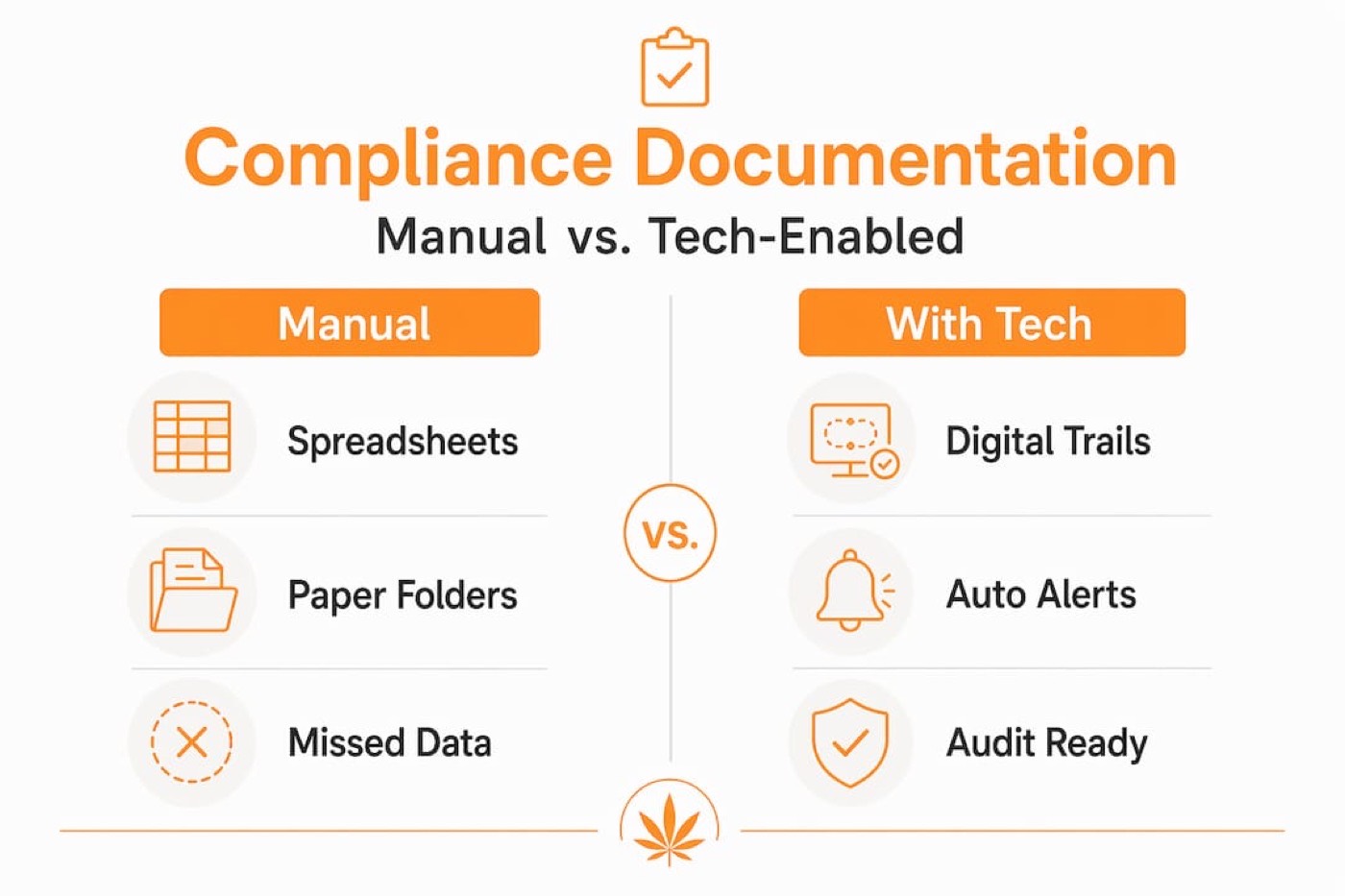
| Documentation Source | Without Compliance Tech | With Compliance Tech |
|---|---|---|
| COGS support | Manual spreadsheets, reconciliation gaps | Automated METRC-to-accounting tie-out |
| Expense allocation | Inconsistent categorization | System-enforced categorization rules |
| Audit defense | Reactive document assembly | Pre-assembled, searchable records |
| IRS examination risk | Elevated due to inconsistencies | Reduced through consistent data trails |
For finance teams working with cannabis clients, understanding cannabis tax compliance means understanding that every gap in the operational data chain is a potential gap in the tax return. Integration between METRC, your POS, and your accounting system is not a technical project. It is a tax risk mitigation project. You can also work with qualified tax resolution professionals, such as IRS tax debt specialists, when prior-year exposure has already materialized.
Emerging technology improving compliance accuracy
AI has moved from pilot status in compliance to production-grade reliability. AI models now score 80 to 100% on legal reasoning tasks, which has accelerated enterprise adoption in regulatory text interpretation and KYC/AML processing. For cannabis businesses, that translates to faster, more accurate compliance decisions without increasing headcount.
The practical applications are expanding quickly:
- AI-enabled document processing automates data extraction, cross-checking between documents, and exception flagging, reducing the volume of manual review required
- Vision-language models lower errors in interpreting regulatory documents and flagging non-compliant entries before they enter official records
- Computer-use agents navigate legacy compliance software the way a human analyst would, enabling monitoring and reporting without manual intervention
- ID verification hardware integrated with POS and compliance systems creates consistent enforcement logs and digital records that hold up under inspection
- Multi-location purchase verification through connected systems prevents customers from exceeding state purchase limits across different retail locations
The ID verification piece is operational, not theoretical. Integration with POS and compliance systems improves audit defensibility while protecting customer data, which is a regulatory requirement in several states. A standalone scanner that does not log to your compliance system is a compliance gap with a blinking light on top.
Pro Tip: When evaluating compliance tech vendors, ask specifically how their system categorizes and routes API errors. Vendors who cannot distinguish between data errors and system errors at the integration level are selling connectivity, not compliance.
The next evolution in cannabis compliance tech is full integration: AI document processing connected to METRC data, connected to your accounting system, connected to ID verification logs. That data chain is what proactive compliance monitoring looks like in practice, where issues surface before they reach an auditor’s desk.
My take on compliance technology in practice
I have reviewed cannabis businesses where the compliance system was treated as a cost center. The data was there, technically, but nobody had connected it to the financial statements. COGS calculations were built off manual counts. The METRC records and the accounting records told different stories. That gap created an IRS examination that took two years and six figures to resolve.
What I have found is that operators who get this right do not just avoid penalties. They run better businesses. When your compliance data feeds your inventory costing, you find shrinkage faster. When your audit trail includes reconciliation notes, your compliance officer resolves inspection requests in hours. When your ID verification logs are integrated, your purchase limit enforcement is not a person’s memory. It is a timestamped record.
The challenge I see most often is integration complexity treated as a reason to delay. Operators connect METRC to their POS, call it done, and assume the data is clean. It usually is not. Error routing, data normalization, and alerting require deliberate build decisions that most vendors gloss over.
My position is direct: compliance technology is not overhead. It is the infrastructure that determines whether your tax return, your audit response, and your operational reporting are consistent with each other. When they are not, the cost is always higher than the technology would have been.
— JN
Explore compliance and financial resources at Cannabisbusinessminds
If this article clarified where your compliance infrastructure has gaps, the next step is applying that understanding to your financial reporting and inventory management.

Cannabisbusinessminds has built out a focused set of resources for cannabis finance professionals tackling exactly these intersections. The cannabis inventory costing guide covers how compliance tech integration affects COGS calculations and what finance pros need to get that reconciliation right. For the broader financial picture, the cannabis accounting resource covers the full scope from tax documentation to financial reporting in a regulatory context. And if you are working with a client where the compliance officer role is still being defined, the article on why your business needs a compliance officer is a useful reference for scoping that function against your technology stack.
FAQ
What does compliance technology do in cannabis?
Compliance technology automates seed-to-sale tracking, integrates with METRC, creates digital audit trails, and connects operational data to financial reporting. It reduces transcription errors, supports regulatory inspections, and improves documentation quality for tax purposes.
Why is Section 280E relevant to compliance tech?
Section 280E limits cannabis businesses to deducting only cost of goods sold, which means documentation accuracy directly affects tax liability. Compliance technology improves the consistency and completeness of records needed to support COGS allocations under IRS examination.
How often do cannabis businesses face regulatory audits?
In states like Nevada, the Cannabis Compliance Board conducts around 700 audits per year, meaning virtually all licensees are inspected annually. Continuous audit readiness, supported by compliance technology, is the only sustainable operating posture.
What is the risk of poor API error handling in METRC integrations?
When METRC integrations treat data errors and system errors the same way, compliance problems can go undetected until an audit surfaces them. Data errors require human correction while system errors can be retried automatically. Misrouting them delays fixes and creates record gaps.
How does AI improve cannabis compliance accuracy?
AI models now achieve 80 to 100% accuracy on legal reasoning tasks, enabling faster regulatory document interpretation, automated exception flagging, and KYC/AML processing. In cannabis, AI-enabled document processing reduces manual review volume and improves the consistency of compliance records.
Recommended
- Why legal compliance is critical for U.S. cannabis finance – Cannabis Business Minds
- What Is Cannabis Compliance: Impact on U.S. Businesses – Cannabis Business Minds
- What Is Indirect Tax Compliance for Cannabis Businesses – Cannabis Business Minds
- Why your cannabis business needs a compliance officer – Cannabis Business Minds
This article is general education, not tax, legal or accounting advice. Cannabis rules change quickly; confirm how they apply to you with a qualified cannabis CPA or attorney.