Why your cannabis business needs a compliance officer
Most cannabis business owners assume that getting licensed means you’re compliant. That assumption is wrong, and it’s one of the most expensive mistakes you can make. Regulators at the state level and, increasingly, at the federal level expect cannabis businesses to maintain active, ongoing compliance programs led by a designated individual with real authority. Skipping this step doesn’t just create administrative headaches. It puts your license, your revenue, and your entire operation at risk in ways that most owners don’t see coming until it’s too late.
Table of Contents
- Why compliance in cannabis is different
- What regulators expect: The compliance officer role
- Consequences of not designating a compliance officer
- How to designate and empower an effective compliance officer
- The compliance officer: More than a formality or checkbox
- Take compliance further with expert guidance
- Frequently asked questions
Key Takeaways
| Point | Details |
|---|---|
| Regulatory complexity | Cannabis businesses face state and federal compliance demands that require more than basic internal policies. |
| Officer designation matters | Naming a specific compliance officer is often required and signals operational readiness to regulators. |
| Risk mitigation | Failure to designate can result in denied licenses, regulatory penalties, or business disruption. |
| Empowerment is key | Effective compliance officers need authority, resources, and support to navigate complex legal landscapes. |
| Strategic advantage | Businesses that take compliance officer roles seriously gain stability and prepare for long-term industry changes. |
Why compliance in cannabis is different
To understand why a compliance officer is essential, let’s first clarify how cannabis compliance uniquely challenges businesses. This industry doesn’t operate like a standard regulated business, such as a restaurant with health codes or a financial firm with SEC rules. Cannabis businesses sit at the intersection of state law, local ordinances, and a federal legal framework that still classifies the plant as a Schedule I controlled substance. That combination creates compliance demands that no checklist or part-time administrator can reliably manage.
Understanding what cannabis compliance means in practice reveals layers that surprise even experienced operators. You’re not just managing paperwork. You’re managing seed-to-sale tracking, employee background requirements, security protocols, advertising restrictions, testing mandates, and financial reporting obligations, all at the same time, all subject to change with little notice.
Here’s what makes cannabis compliance structurally different from other industries:
- Multi-jurisdictional overlap: Your state license, local permit, and any applicable federal obligations may each carry separate requirements that don’t always align neatly.
- Dynamic regulations: State cannabis regulators frequently update rules, sometimes quarterly, which means yesterday’s compliant operation may be out of step today.
- High-stakes consequences: A compliance violation in cannabis doesn’t result in a slap-on-the-wrist fine like a parking ticket. It can mean license suspension, product destruction, or permanent revocation.
- Federal overlay: As Brown & Blaier notes, designating a responsible compliance role is especially important when federal compliance requirements apply in addition to state licensing, such as DEA registration and the operational segregation of medical versus adult-use activities.
“The complexity of cannabis regulations isn’t a temporary growing pain. It’s the structural reality of operating in a dual-regulated environment, and businesses that treat compliance as an afterthought pay for it eventually.”
Successfully navigating licensing requirements requires someone who wakes up thinking about your regulatory exposure every single day. That’s the job of a compliance officer, and it’s not a role you can effectively split with your HR manager or assign to a part-time consultant.
What regulators expect: The compliance officer role

With cannabis compliance’s multidimensional nature clear, it’s crucial to understand what regulators specifically demand from businesses. The answer varies by state, but the trend is unmistakable: regulators are increasingly codifying the compliance officer role into licensing requirements, not just suggesting best practices.
Some U.S. jurisdictions explicitly require identifying a specific person by name as the compliance officer in cannabis establishment licensing and renewal applications. Rhode Island is a clear example, but it reflects a growing national pattern. When a regulator asks for a named individual, they’re signaling that compliance is a governance issue, not just an operational one. They want to know who is accountable.
Here’s a comparison of how different regulatory approaches treat this role:
| Regulatory approach | States/examples | Compliance officer requirement |
|---|---|---|
| Named officer required | Rhode Island, several medical states | Specific individual identified on license application |
| Role implied but not named | Many adult-use states | Compliance function expected; person not always named |
| Federal overlay applies | Operations with DEA registration | Officer must bridge state and federal obligations |
| Local additional layer | Cities with local cannabis permits | Officer may need to address local conditions separately |
The core duties regulators and licensing programs associate with this role are well established. Compliance officers are expected to review documentation, oversee track-and-trace and record systems, and conduct inspections and audits. In practice, that means:
- Documentation review: Systematically reviewing standard operating procedures, employee records, vendor agreements, and license conditions to ensure everything stays current and accurate.
- Track-and-trace oversight: Managing or closely supervising your seed-to-sale tracking system to catch discrepancies before regulators do, because regulators will find them.
- Internal audits: Conducting scheduled and surprise internal audits that mirror what a state inspector would do, so your team is always audit-ready.
- Regulator communication: Serving as the primary point of contact for regulatory agencies, which ensures consistent, accurate, and legally appropriate responses.
- Incident management: When something goes wrong, such as a product recall, a tracking error, or a security breach, the compliance officer leads the response and documents corrective actions.
Pro Tip: Never treat the officer designation as a formality. Regulators notice when the named compliance officer has no real authority or access within the organization. If your compliance officer can’t enforce policy or escalate issues directly to ownership, the designation is practically meaningless and could raise red flags during an audit.
Understanding cannabis report filing essentials and maintaining a strong audit trail are two areas where a well-empowered compliance officer makes an immediate, measurable difference. These aren’t abstract responsibilities. They are the specific tasks regulators check during inspections.
Consequences of not designating a compliance officer
Now that we know what regulators want, let’s consider the very real consequences of failing to get this right. The risks aren’t theoretical. They show up in license denials, enforcement actions, and business closures that cost operators everything they’ve built.
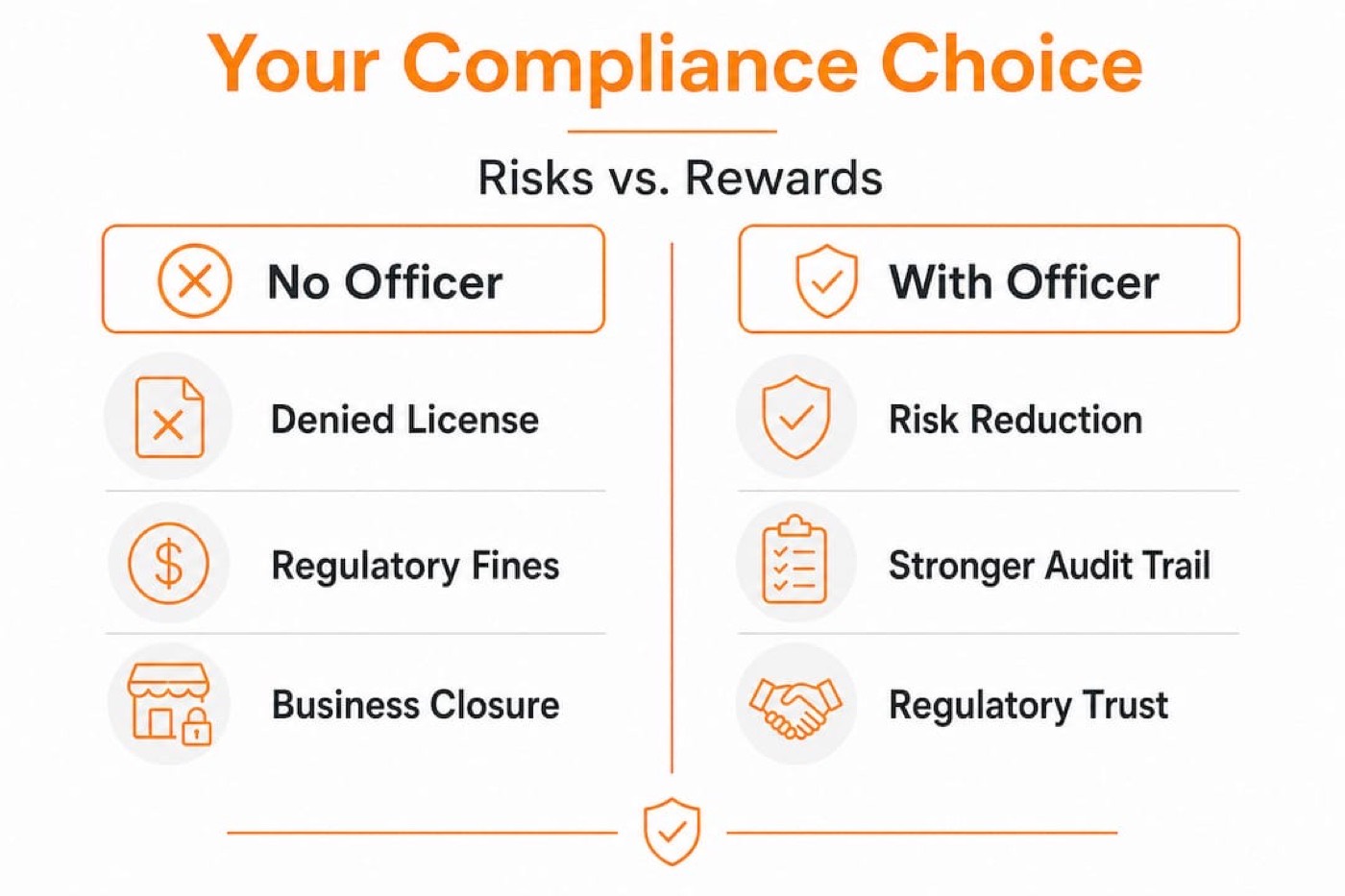
The most immediate risk is a rejected or delayed license application. If a state requires a named compliance officer and your application is missing that designation, it doesn’t move forward. In competitive markets where license caps exist, a delayed application isn’t just frustrating. It can be the difference between operating and sitting on the sidelines while a competitor takes your market share.
Consider the range of consequences businesses have faced when compliance functions break down:
- License suspension or revocation: Regulators in multiple states have revoked licenses when operators couldn’t demonstrate adequate compliance systems during inspections.
- Financial penalties: Fines for compliance failures range from hundreds to hundreds of thousands of dollars depending on the violation and jurisdiction.
- Product destruction: Tracking discrepancies or testing failures that a compliance officer might have caught early can result in entire product batches being destroyed at the operator’s expense.
- Criminal exposure: In extreme cases, particularly where federal law is implicated, compliance failures can create personal legal liability for owners and officers.
The federal dimension deserves special attention. State licensing alone may be insufficient for activities that fall within the federal controlled-substances framework. The recommendation is clear: conduct a federal compliance gap analysis and implement operational segregation between activities like medical and adult-use cannabis. Without a compliance officer who understands both levels, businesses operating in this space are flying blind.
“A federal compliance gap analysis isn’t something you do once and file away. It’s an ongoing process that requires someone with the expertise and authority to act on what they find.”
The concept of a gap analysis is important here. A gap analysis compares your current compliance state against what regulators require and identifies where you’re falling short. This is a core tool for any effective compliance function and a strong argument for why the regulatory risk for dispensaries must be managed by a dedicated, qualified person, not crowdsourced across a management team that has other priorities.
The hard truth is that many cannabis businesses don’t realize how exposed they are until something goes wrong. By then, the cost of fixing the problem is exponentially higher than the cost of preventing it. A compliance officer is, in financial terms, an insurance policy with a proactive return on investment.
How to designate and empower an effective compliance officer
Avoiding risk is important, but success means proactively setting up your compliance function for impact. Here’s how to actually do that in a way that satisfies regulators and strengthens your operation.
Start with a clear, structured process for designation:
- Assess your jurisdiction’s requirements: Research your state’s specific licensing rules. Does your application require a named individual? What qualifications does that person need? Check renewal requirements too, since some states require reaffirming or updating the designation annually.
- Select a qualified individual: Look for someone with experience in regulatory compliance, preferably in cannabis or a similarly regulated industry like pharmaceuticals, alcohol, or financial services. They need to understand documentation systems, audit processes, and the consequences of non-compliance. Legal or accounting backgrounds can also be strong foundations.
- Document the appointment formally: Create an internal resolution or letter of appointment that defines the compliance officer’s role, authority, reporting structure, and scope. This documentation matters if regulators ask how the role was established.
- Notify the regulator as required: Submit any required notifications or application updates to your state agency. Keep copies of all correspondence. Some states also require notifying regulators of any changes to the designated compliance officer.
- Define scope explicitly: The officer’s responsibilities should be spelled out in writing, covering both state obligations and any applicable federal obligations. Federal overlay issues may require the compliance officer’s scope to include crosswalks between state rules and federal obligations, including DEA registration and segregation concepts where relevant.
Designation alone isn’t enough. Empowerment is what makes the role work. Your compliance officer needs access to operational data, the authority to pause activities that raise compliance concerns, a direct line to ownership or the board, and a realistic budget for training, legal consultation, and compliance tools.
Pro Tip: Build compliance into your operational strategy from the beginning, not as an HR checkbox or an afterthought during license renewal season. Businesses that treat compliance as a core function integrate their compliance officer into strategic planning meetings, product launches, and vendor selection decisions. That integration is what separates businesses that stay licensed from those that don’t.
Think carefully about data privacy compliance as well, since cannabis businesses collect sensitive customer information through loyalty programs and point-of-sale systems. Your compliance officer should understand these obligations alongside the regulatory ones.
The compliance officer: More than a formality or checkbox
Stepping back, it’s clear that not all compliance officer designations are created equal, and here’s what most businesses miss.
The dominant mental model in the cannabis industry still treats compliance as a cost center: something you fund because you have to, managed by someone whose job is to keep you out of trouble. That model produces compliance officers who are reactive, underfunded, and organizationally invisible. It produces the kind of compliance function that passes an initial license review but falls apart under the pressure of growth or a surprise inspection.
The businesses that are genuinely well-positioned for long-term success treat their compliance officer as a strategic asset. They understand that a strong compliance function doesn’t just prevent problems. It creates the documented operational history and regulatory credibility that becomes a competitive advantage when markets mature, when federal reform advances, or when institutional investors start evaluating cannabis companies for acquisition or partnership.
Federal reform, when it comes, will not favor businesses that scrambled to assemble compliance documentation after the fact. It will favor businesses that can demonstrate years of rigorous, documented, proactive compliance practice. Your compliance officer is the person who builds that record every single day.
There’s also a culture argument worth making. Organizations where understanding cannabis compliance is part of the shared identity, not just the compliance officer’s personal burden, tend to catch issues earlier, respond more effectively, and maintain stronger relationships with regulators. Culture flows from leadership, but it’s sustained by having a credible, empowered compliance function that employees take seriously.
The most effective compliance officers we’ve observed in this industry are business partners first and rule-followers second. They understand your financial pressures, your growth goals, and your operational realities. They help you find compliant pathways to what you want to do, rather than simply saying no. That kind of judgment can’t be reduced to a checklist, and it’s precisely why the role deserves genuine investment.
Take compliance further with expert guidance
You’ve seen how much is at stake when cannabis businesses fail to prioritize compliance and how much value a well-empowered compliance officer can deliver. The next step is making sure you have the right frameworks, knowledge, and resources to build a compliance function that actually holds up under scrutiny.
Cannabis Business Minds exists to give you that foundation. Whether you’re building out your compliance program from scratch, preparing for a license renewal, or trying to understand how cannabis compliance essentials apply to your specific operation, our guides and resources are designed for exactly this kind of work. We cover regulatory risk, report filing, audit trails, and the financial side of compliance that most operators overlook. You don’t have to figure this out alone. Explore our library and build the compliance program your business deserves.
Frequently asked questions
Is designating a compliance officer legally required for all cannabis businesses?
In many U.S. states, you must identify a specific compliance officer on your license application, and some require this for renewal as well. Requirements vary by jurisdiction, so always check your specific state’s licensing rules.
What could happen if my business does not designate a compliance officer?
Failure to designate can lead to denied licenses, regulatory fines, or business closure. State licensing alone may be insufficient when federal obligations also apply, compounding the risk for operators who skip this step.
Should the compliance officer handle federal DEA and state requirements?
Yes. Designating a responsible compliance role is especially important when federal requirements apply alongside state licensing, so the officer’s scope should cover both levels where relevant.
What are the main duties of a cannabis compliance officer?
The main duties include reviewing documentation, overseeing track-and-trace systems, and conducting internal audits and inspections. Regulators and licensing programs define these responsibilities explicitly in many jurisdictions.
How do I choose the right compliance officer for my cannabis business?
Look for someone with direct regulatory experience, strong attention to detail, and a working knowledge of both state and federal law. Prior experience in cannabis, pharmaceuticals, or financial services compliance is especially valuable for navigating this industry’s unique demands.
Recommended
- What Is Cannabis Compliance: Impact on U.S. Businesses – Cannabis Business Minds
- How to Choose Cannabis Accountant for Compliance Success – Cannabis Business Minds
- 7 Essential Cannabis Dispensary Compliance Tips for Success – Cannabis Business Minds
- Cannabis Regulatory Risk Explained: Safeguarding U.S. Dispensaries – Cannabis Business Minds
This article is general education, not tax, legal or accounting advice. Cannabis rules change quickly; confirm how they apply to you with a qualified cannabis CPA or attorney.