What is cannabis tax nexus? Know your obligations
2026 update: what rescheduling changed for 280E (reviewed October 2026)
Effective April 22, 2026, a DOJ/DEA final order moved marijuana covered by a qualifying state medical license (and FDA-approved marijuana drugs) to Schedule III. Section 280E only applies to Schedule I and II substances, so state-licensed medical cannabis activity is generally no longer subject to 280E going forward. Adult-use cannabis remains in Schedule I and fully subject to 280E. The DEA proceeding to reschedule all marijuana was temporarily stayed in October 2026, and Treasury/IRS guidance on transition years and mixed medical/adult-use businesses is still pending.
Check where your business stands in about a minute.
Most cannabis entrepreneurs assume that if they don’t have a storefront, warehouse, or employee in a state, they have no tax obligations there. That assumption has been wrong since 2018, and it’s costing cannabis businesses real money. Understanding what is cannabis tax nexus, and specifically how economic activity alone can now trigger state tax obligations, is one of the most critical financial competencies you can develop. Nexus determines where you must register, collect, and remit taxes. Get it wrong, and you’re looking at back taxes, penalties, and audits that no operator wants.
Table of Contents
- Defining cannabis tax nexus: physical connection versus economic activity
- Federal income tax nexus and its separate role under IRC §280E
- State cannabis tax nexus in practice: multi-state obligations and compliance triggers
- Operational strategies and nuances in managing cannabis tax nexus
- Examples of state cannabis tax administration linked to nexus and compliance
- Why many cannabis entrepreneurs misjudge tax nexus and how to avoid costly errors
- Explore your cannabis tax compliance solutions with Cannabis Business Minds
- Frequently asked questions
Key Takeaways
| Point | Details |
|---|---|
| Tax nexus triggers obligations | Cannabis tax nexus creates state tax registration and filing duties when physical or economic connections exist. |
| Economic nexus matters | Since 2018, economic nexus based on sales volume or transactions can create tax obligations without any physical presence. |
| Federal nexus differs | IRC §280E affects federal tax deductions based on business activity, not state nexus. |
| States vary widely | Each state sets its own nexus criteria and tax thresholds requiring ongoing monitoring. |
| Proactive nexus management | Rolling reviews and operational mapping prevent costly compliance failures and back taxes. |
Defining cannabis tax nexus: physical connection versus economic activity
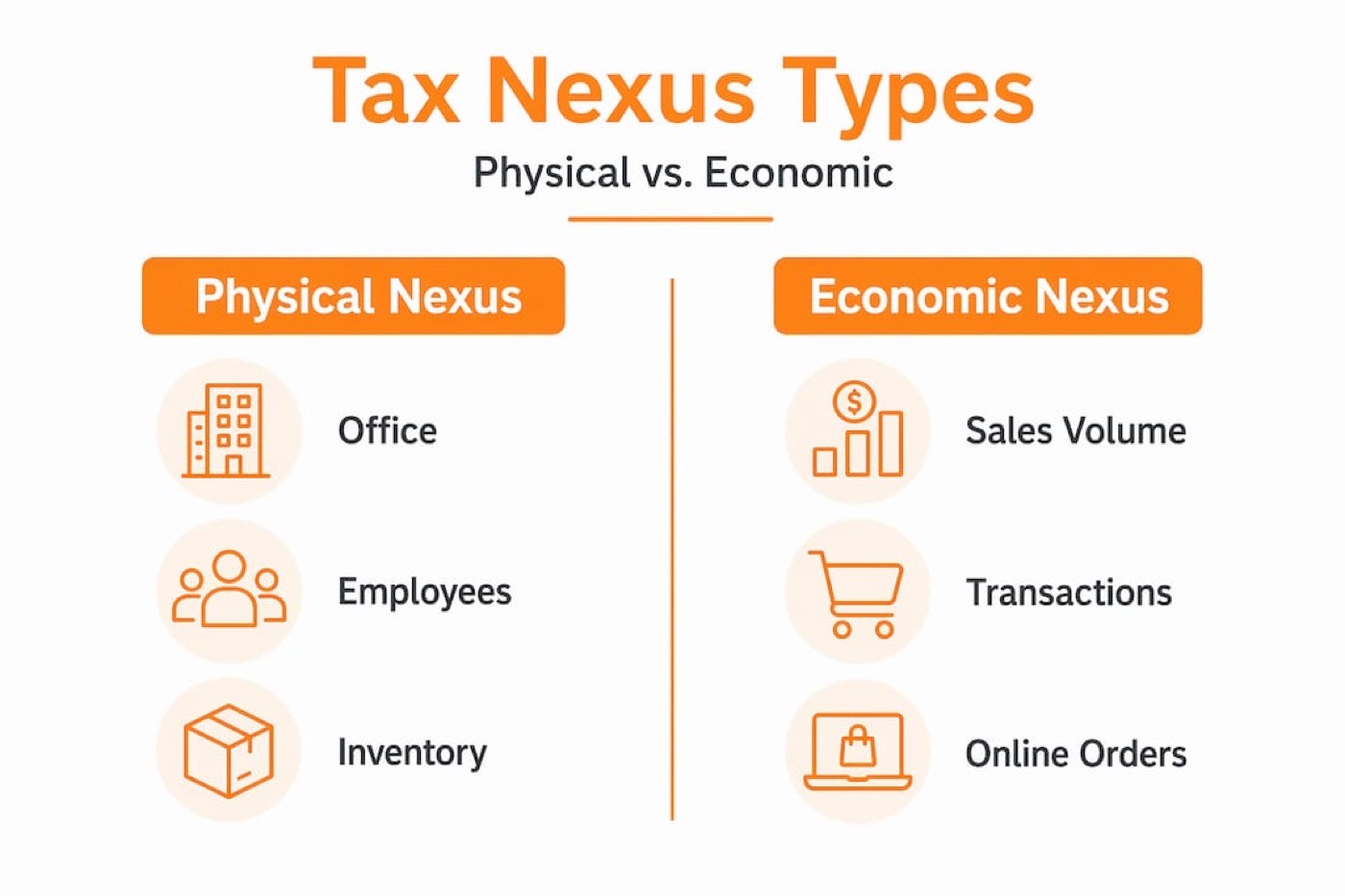
Tax nexus, at its core, means a sufficient connection between your business and a state that legally obligates you to collect and remit that state’s taxes. For cannabis businesses, sales-tax nexus falls into two categories: physical nexus and economic nexus.
Physical nexus is the older, more intuitive standard. It applies when your cannabis business has a tangible footprint in a state. Think a licensed dispensary, a cultivation facility, a warehouse storing inventory, or even an employee who lives and works in-state. If any of those exist, you have physical nexus there. Full stop.

Economic nexus is the newer and, frankly, more disruptive standard. It doesn’t care where your employees sleep or where your inventory sits. It triggers based purely on your sales activity in a state, specifically whether you’ve crossed that state’s defined revenue or transaction count thresholds. Since the Supreme Court’s 2018 South Dakota v. Wayfair ruling established economic nexus as constitutionally valid, states have moved aggressively to enforce it.
Here’s what this means in practice for cannabis operators:
- A multi-state cannabis brand selling via delivery into a neighboring state may trigger nexus without a single employee or location there.
- An online cannabis accessories retailer crossing $100,000 in sales into a state hits economic nexus even if they’ve never set foot there.
- Inventory stored at a third-party fulfillment center in another state creates physical nexus, even if you don’t own that facility.
- Participating in a cannabis trade show or pop-up event in a state can establish temporary physical nexus in some jurisdictions.
- Each state sets its own thresholds, so you may have nexus in California and not in Montana based on identical sales volumes.
Understanding cannabis tax exposure across every state where you sell or operate is no longer optional. It’s the foundation of sound cannabis financial management.
Pro Tip: Before assuming you have no nexus in a state, pull your sales data by state for the past 12 months and compare it against each state’s economic nexus threshold. You may already be obligated to collect and remit taxes you haven’t been tracking.
Now that you know how nexus defines your tax obligations, we will unpack federal distinctions and why cannabis tax nexus differs from federal tax issues.
Federal income tax nexus and its separate role under IRC §280E
This is where a lot of cannabis finance professionals make a costly conceptual error: they conflate state sales tax nexus with federal tax obligations. The two are entirely separate frameworks governed by different rules.
Federal income tax for cannabis businesses is not driven by where you have a physical or economic presence. It’s driven by what you sell. Specifically, IRC §280E denies all deductions and credits for businesses trafficking in Schedule I or Schedule II controlled substances under federal law. Cannabis remains federally classified as Schedule I, which means the statute applies to virtually every cannabis operator in the U.S., regardless of which states they operate in.
The critical distinction here:
- State sales tax nexus asks, “Where are you selling, and does your activity trigger a registration and collection obligation in that state?”
- IRC §280E asks, “What are you selling?” If the answer is cannabis, you lose access to most ordinary business deductions at the federal level, regardless of your state footprint.
So when you hear cannabis operators say they’re confused about their tax obligations, this is often the root of it. They’re trying to solve a federal problem with state nexus logic, or vice versa. The compliance work required for each is fundamentally different. State nexus work involves mapping sales and operations across jurisdictions. IRC §280E work involves restructuring your cost accounting to maximize cost of goods sold, since that’s the only deduction that survives the statute.
The potential rescheduling impact on IRC §280E is an evolving story, but until federal law changes, treating these as two separate compliance tracks is non-negotiable.
With federal income tax considerations clarified, the next section dives deeper into state-level cannabis tax obligations and how nexus drives compliance.
State cannabis tax nexus in practice: multi-state obligations and compliance triggers
Once you accept that economic nexus is real and enforceable, the next question is: what exactly triggers it, and how do you manage obligations across multiple states? The answer varies by jurisdiction, which is exactly what makes this hard.
Each state defines nexus and measures thresholds differently, meaning your compliance team needs state-by-state analysis, not a one-size-fits-all approach. Here’s a practical sequence for managing state cannabis tax nexus:
- Map your sales by state for the prior 12-month period and the current calendar year to date.
- Identify each state’s economic nexus threshold, typically $100,000 in revenue or 200 transactions, though some states use revenue only.
- Check for physical presence triggers including inventory storage, contractors, employees, or events in each state.
- Register for sales tax in every state where nexus exists before collecting from customers.
- Set up collection systems at point of sale to apply the correct state (and often local) tax rate.
- File and remit on schedule per each state’s required filing frequency, which may be monthly, quarterly, or annual.
The table below illustrates how two major cannabis states handle nexus and tax obligations very differently:
| Factor | Minnesota | New York |
|---|---|---|
| Primary cannabis tax | 15% gross receipts tax | 9% distributor / 13% retail excise |
| Additional taxes | State and local sales tax | State and local sales tax |
| Nexus trigger | Sales activity in state | Business role (distributor vs. retailer) |
| Filing frequency | Varies by volume | Quarterly |
| Registration required | Yes, even without storefront | Yes, by business role |
The Minnesota model layers a gross receipts tax on top of standard sales taxes, which means a dispensary selling $500,000 annually in-state owes the gross receipts tax plus applicable sales taxes. New York takes a role-based approach, taxing distributors and retailers at different rates and requiring each to register based on their function in the supply chain.
Pro Tip: Don’t assume your nexus status is static. A seasonal sales spike or new delivery territory can push you past an economic nexus threshold mid-year. Build quarterly nexus reviews into your compliance calendar.
Operational strategies and nuances in managing cannabis tax nexus
Understanding what triggers nexus is step one. Building systems to track it continuously is what separates compliant operators from those who get surprised by a back-tax bill three years later.
Nexus mapping starts from commercial reality: where products are stored, where employees or contractors work, and where sales occur. For cannabis businesses with multi-entity structures, which is common for licensing and liability reasons, each entity may carry its own nexus footprint. The management company, the licensed retailer, and the distribution arm may each trigger different nexus in different states.
Key operational practices that reduce nexus risk:
- Track sales by state in real time, not just at year-end. This is the only way to catch threshold crossings before they create retroactive obligations.
- Audit contractor locations, since a bookkeeper or sales rep working remotely in another state can establish physical nexus without anyone noticing.
- Log trade show and event participation by state and date. Even a two-day appearance can trigger nexus in some jurisdictions.
- Review inventory storage agreements with third-party logistics providers to confirm you understand the nexus implications of every warehouse location.
- Document your nexus analysis in writing each quarter so you have a defensible paper trail if a state auditor comes knocking.
Miscalculating nexus is not just a paperwork problem. Back taxes plus interest plus penalties can easily reach six figures for a mid-size operator who’s been non-compliant for two or three years. The financial exposure from nexus errors often dwarfs the original tax obligation.
Reviewing cannabis entity tax considerations as part of your nexus analysis is worth the time, especially if your business structure has evolved as you’ve scaled.
Examples of state cannabis tax administration linked to nexus and compliance
Minnesota and New York offer two of the most instructive examples of how state cannabis tax nexus shapes actual compliance obligations, and they illustrate just how different the experience can be across borders.
Minnesota imposes a 15% gross receipts cannabis tax layered alongside standard state and local sales taxes. Nexus is established through sales activity, meaning a retailer doesn’t need a brick-and-mortar location to trigger registration and filing requirements. The layered tax structure also means operators need clean revenue tracking to calculate each component accurately.
New York takes a more role-specific approach. Distributors pay a 9% excise tax while retailers pay 13%, with quarterly filing requirements for both. Nexus here is partly defined by your operational role in the supply chain. If you distribute cannabis in New York, you register and file as a distributor. If you retail, you register as a retailer. Trying to apply the wrong framework, or ignoring the distinction entirely, creates immediate compliance gaps.
Key takeaways from these state examples:
- Registration is required even without a physical storefront if sales nexus thresholds are crossed.
- Tax type and rate depend on your business role, not just where you sell.
- Local tax variations add another layer, particularly in Minnesota where municipal rates differ.
- Filing deadlines and frequencies vary, so each state’s calendar needs to be tracked separately.
Why many cannabis entrepreneurs misjudge tax nexus and how to avoid costly errors
Here’s the uncomfortable truth: most cannabis operators building out their tax compliance processes in 2026 are still working from a pre-2018 mental model. They think about nexus as something that requires a building, a license plate, or a storefront in a state. That framework is outdated and expensive.
A major misconception is that nexus only requires physical presence. After South Dakota v. Wayfair, economic nexus rules apply broadly, and state tax authorities have been aggressively pursuing back taxes from businesses that ignored this shift. Cannabis operators, who already operate under heavier regulatory scrutiny than most industries, are not exempt.
The second major misjudgment is conflating state sales tax nexus with federal 280E compliance. Operators who focus all their attention on 280E deduction strategies sometimes overlook the state-level nexus mapping work entirely. Both need dedicated attention. Neither substitutes for the other.
The third problem is static analysis. Many cannabis finance teams run a nexus review once, at formation or during a licensing round, and then never update it. Sales patterns change. New delivery channels open up. A single contract with a retailer in a new state can cross an economic nexus threshold overnight. The operators who get caught aren’t necessarily the ones who ignored nexus entirely. They’re often the ones who understood it once and stopped paying attention.
“Ignoring economic nexus is not just risky, it’s costly. Tax authorities are catching up and pursuing back taxes aggressively.” That’s not a theoretical warning. It’s what practitioners working in cannabis tax compliance are seeing on the ground in 2026.
The solution is proactive, continuous nexus mapping tied directly to your revenue data, combined with clear separation of your state and federal compliance workflows. Treat them as two distinct disciplines, staff them accordingly, and review both on a rolling basis. Understanding why tax compliance matters for cannabis businesses goes beyond avoiding penalties. It’s about building a business that can survive an audit, attract investors, and scale without inherited tax liabilities.
Explore your cannabis tax compliance solutions with Cannabis Business Minds
If this article clarified the complexity of cannabis tax nexus, you now understand why getting expert guidance isn’t optional for serious operators. Multi-state nexus analysis, IRC §280E cost structuring, and state-specific registration requirements are not areas where general business accounting knowledge is enough.

Cannabis Business Minds is built specifically for cannabis finance professionals navigating exactly these challenges. From in-depth resources on cannabis tax fundamentals to detailed accounting frameworks and professional cannabis accounting services, the platform gives you the tools to track nexus, file accurately, and stay ahead of regulatory changes. Use the tax exposure analysis tools to assess where your business currently stands before a state auditor makes that decision for you. Early compliance planning is always less expensive than reactive remediation.
Frequently asked questions
What triggers cannabis tax nexus in a state?
Cannabis tax nexus is triggered by either physical presence, such as an office, employees, or inventory in the state, or economic activity exceeding that state’s defined revenue or transaction thresholds. Both types of nexus require registration, collection, and filing in that state.
Does having no physical presence in a state mean no cannabis tax nexus?
No. Since the 2018 Wayfair ruling, economic nexus based on sales volume or transaction counts can create cannabis tax obligations even without any physical presence in the state. Sales volume alone is enough.
How is federal tax nexus different from state sales tax nexus for cannabis?
IRC §280E denies deductions based on what your business sells, not where it operates, while state sales tax nexus concerns where your cannabis sales and operations create a collection and filing obligation at the state level. These are two entirely separate compliance frameworks.
How often should cannabis businesses review their tax nexus status?
Cannabis businesses should conduct rolling nexus reviews regularly, ideally quarterly, since changing sales volumes, new delivery territories, or operational expansions can cross thresholds at any point in the year, creating new obligations immediately.
Can cannabis businesses deduct typical expenses on federal taxes?
No. Due to IRC §280E disallowing deductions for businesses trafficking federally controlled substances, cannabis operators cannot deduct most ordinary business expenses at the federal level, with cost of goods sold being the primary exception.
Recommended
- How to Handle State Cannabis Taxes for Compliance – Cannabis Business Minds
- What Is Tax Liability for Cannabis? Complete Breakdown – Cannabis Business Minds
- What Is Tax Compliance for Cannabis Businesses – Cannabis Business Minds
- How to Handle Cannabis Sales Tax for Compliance – Cannabis Business Minds
This article is general education, not tax, legal or accounting advice. Cannabis rules change quickly; confirm how they apply to you with a qualified cannabis CPA or attorney.