The cannabis CFO’s essential role in financial success
2026 update: what rescheduling changed for 280E (reviewed October 2026)
Effective April 22, 2026, a DOJ/DEA final order moved marijuana covered by a qualifying state medical license (and FDA-approved marijuana drugs) to Schedule III. Section 280E only applies to Schedule I and II substances, so state-licensed medical cannabis activity is generally no longer subject to 280E going forward. Adult-use cannabis remains in Schedule I and fully subject to 280E. The DEA proceeding to reschedule all marijuana was temporarily stayed in October 2026, and Treasury/IRS guidance on transition years and mixed medical/adult-use businesses is still pending.
Check where your business stands in about a minute.
While most financial leaders assume their core skills will transfer across industries, the cannabis CFO operates in a fundamentally different world. Every accounting decision intersects with patchwork state regulations, federal tax code conflicts, banking restrictions, and investor expectations that are unlike anything in mainstream finance. This guide breaks down the real responsibilities, critical KPIs, compliance priorities, and strategic mindset that separate effective cannabis CFOs from those who simply survive the chaos. If you lead finance in this industry, what follows is built specifically for you.
Table of Contents
- Why the cannabis CFO is unlike any other financial leader
- Core responsibilities: From compliance to capital strategy
- Compliance, tax, and the 280E equation
- KPIs and metrics every cannabis CFO must track
- Why mastering nuance—not just numbers—defines the cannabis CFO’s future
- Build your cannabis finance expertise
- Frequently asked questions
Key Takeaways
| Point | Details |
|---|---|
| Cannabis finance is unique | CFOs face more complex obligations than any other regulated industry due to tax, reporting, and banking challenges. |
| Compliance drives strategy | Robust reporting, reconciliations, and GAAP compliance are not just legalities—they shape capital and growth. |
| Know your KPIs | Tracking the right operational KPIs is vital for survival, cash flow management, and investor trust. |
| 280E remains a threat | Tax exposure under Section 280E persists until IRS guidance changes, demanding ongoing vigilance. |
| Adapt and lead | The best cannabis CFOs synthesize compliance mastery and agile strategy to deliver lasting value. |
Why the cannabis CFO is unlike any other financial leader
The unique terrain of cannabis finance demands highly specialized leadership. A CFO at a traditional consumer goods company worries about margin compression and supply chain costs. A cannabis CFO worries about all of that, plus whether the bank will close their account tomorrow, whether state seed-to-sale tracking integrates with their general ledger, and whether an IRS audit will treat their largest expense categories as completely non-deductible.

This is not hyperbole. Cannabis businesses operate as federally illegal enterprises under Schedule I of the Controlled Substances Act, even while being fully licensed at the state level. That legal tension creates financial obligations that do not exist anywhere else. Banking access remains restricted for many operators, forcing CFOs to manage large cash volumes with minimal institutional support. Capital markets treat cannabis differently, with investors demanding unusually rigorous documentation before committing funds.
The cannabis financial planning guide touches on the foundational elements, but the CFO role extends well beyond planning into real-time regulatory navigation. Here is what separates cannabis finance leadership from standard corporate finance:
- 280E compliance strips away most ordinary business deductions, forcing CFOs to understand cost of goods sold accounting at a granular level
- State-by-state licensing creates overlapping compliance calendars, reporting formats, and tax schedules
- Limited banking means cash management requires creative solutions and rigorous internal controls
- Seed-to-sale tracking mandates state-level inventory visibility that must also reconcile with financial statements
- Capital access demands investor-ready reporting that matches GAAP standards closely, even for private operators
“As the industry matures, the CFO role shifts to investor-ready GAAP reporting and capital discipline amid tighter markets.”
Understanding GAAP for cannabis is no longer optional. As institutional investors enter the space and multi-state operators pursue public listings, the financial reporting bar has risen sharply. The CFO who cannot produce clean, auditable GAAP statements becomes a liability rather than an asset.
Core responsibilities: From compliance to capital strategy
Understanding the challenges is just the beginning. What exactly does a cannabis CFO do day-to-day?
The short answer: far more than their counterparts in standard industries. The role requires managing compliance calendars, investor communications, team oversight, system integrations, and forward-looking strategy simultaneously. A single error in state reporting can trigger license risk. A misstep in cost accounting can create a tax liability that wipes out a year’s profits.
Here is how cannabis CFO duties compare to typical corporate finance roles:
| Responsibility | Traditional CFO | Cannabis CFO |
|---|---|---|
| Financial reporting | GAAP compliance | GAAP plus state-specific standards |
| Tax strategy | Federal and state deductions | 280E restrictions, cost allocation strategy |
| Banking | Standard institutional access | Restricted access, cash management complexity |
| Inventory oversight | General visibility | Seed-to-sale tracking integration with GL |
| Compliance | SEC or standard regulatory | Multi-agency, multi-state licensing requirements |
| Investor reporting | Quarterly earnings | Ongoing due diligence, investor-ready documentation |
The reconciliation challenge deserves special attention. Financial reporting in cannabis requires GAAP-compliant statements, reconciliations between point-of-sale systems, seed-to-sale platforms, and the general ledger, along with meeting state-specific standards. That is three separate data streams that must tell the same story with no material discrepancies.
Here is how effective cannabis CFOs manage this process on a routine basis:
- Map each system’s data outputs before selecting accounting software, ensuring your GL can accept automated feeds from POS and seed-to-sale platforms
- Establish daily reconciliation protocols so discrepancies surface immediately rather than at month-end
- Create clear audit trails for every inventory adjustment, transfer, or disposal event
- Standardize chart of accounts to align with both state reporting requirements and GAAP presentation
- Document all policies in writing so that reconciliations can withstand regulatory review and investor due diligence
The financial reporting guide provides detailed templates and checklists for structuring these workflows. Combine that with a strong understanding of audits in cannabis and you have a robust foundation for both compliance and capital strategy.
Pro Tip: Centralize all reconciliations within a single accounting platform that maintains full audit trails. When due diligence or a regulatory review happens, the ability to produce clean documentation immediately protects both the license and investor confidence.
Compliance, tax, and the 280E equation
Among the CFO’s duties, compliance and tax present ongoing battles with high-dollar stakes.
Section 280E of the Internal Revenue Code is the single most impactful tax provision in cannabis finance. Originally enacted in 1982 to prevent drug traffickers from deducting business expenses, it now applies to every state-licensed cannabis operator in the country. The rule disallows all deductions for businesses trafficking in Schedule I or Schedule II controlled substances, with one exception: cost of goods sold.
That exception is where cannabis CFOs earn their keep. Properly classifying costs as part of COGS versus operating expenses directly determines a company’s effective federal tax rate. A dispensary with $10 million in revenue could pay an effective federal rate of 50% or higher if cost allocation is poorly structured. That same dispensary, with rigorous cost accounting, might bring that rate down to a range that allows actual profitability.
Understanding cannabis compliance means recognizing that 280E is not just a tax problem. It is a business model problem that touches pricing strategy, hiring decisions, facility design, and capital allocation.
The potential rescheduling of cannabis to Schedule III could end 280E and save the industry an estimated $2.3 billion annually. However, the IRS has stated clearly that 280E applies until a final rule is published, meaning the current tax burden remains fully in force.
This creates a planning trap for CFOs who assume rescheduling is imminent. The smart approach is to continue aggressive COGS optimization while monitoring IRS guidance closely. The cannabis tax professionals who have worked through multiple IRS examination cycles consistently recommend building compliance processes that work under current law while remaining flexible enough to adapt when the regulatory environment shifts.
Practical actions every cannabis CFO should take right now:
- Review all cost allocation methodologies against current IRS guidance annually
- Document the business rationale for every cost classified as COGS versus operating expense
- Model the financial impact of Schedule III reclassification on your current structure
- Maintain a regulatory change log so your team can respond quickly when guidance updates
Pro Tip: Do not wait for rescheduling to restructure your cost allocation. If 280E ends, the extra compliance rigor costs nothing. If it persists and your allocations are challenged, the savings from proper documentation can be substantial.
KPIs and metrics every cannabis CFO must track
Strategic compliance and reporting rely on measuring what matters. Here is what every cannabis CFO should monitor.
Raw financial statements tell part of the story. Operational KPIs complete the picture by connecting production decisions to profitability outcomes. The metrics that matter most in cannabis are a blend of financial fundamentals and industry-specific operational indicators.
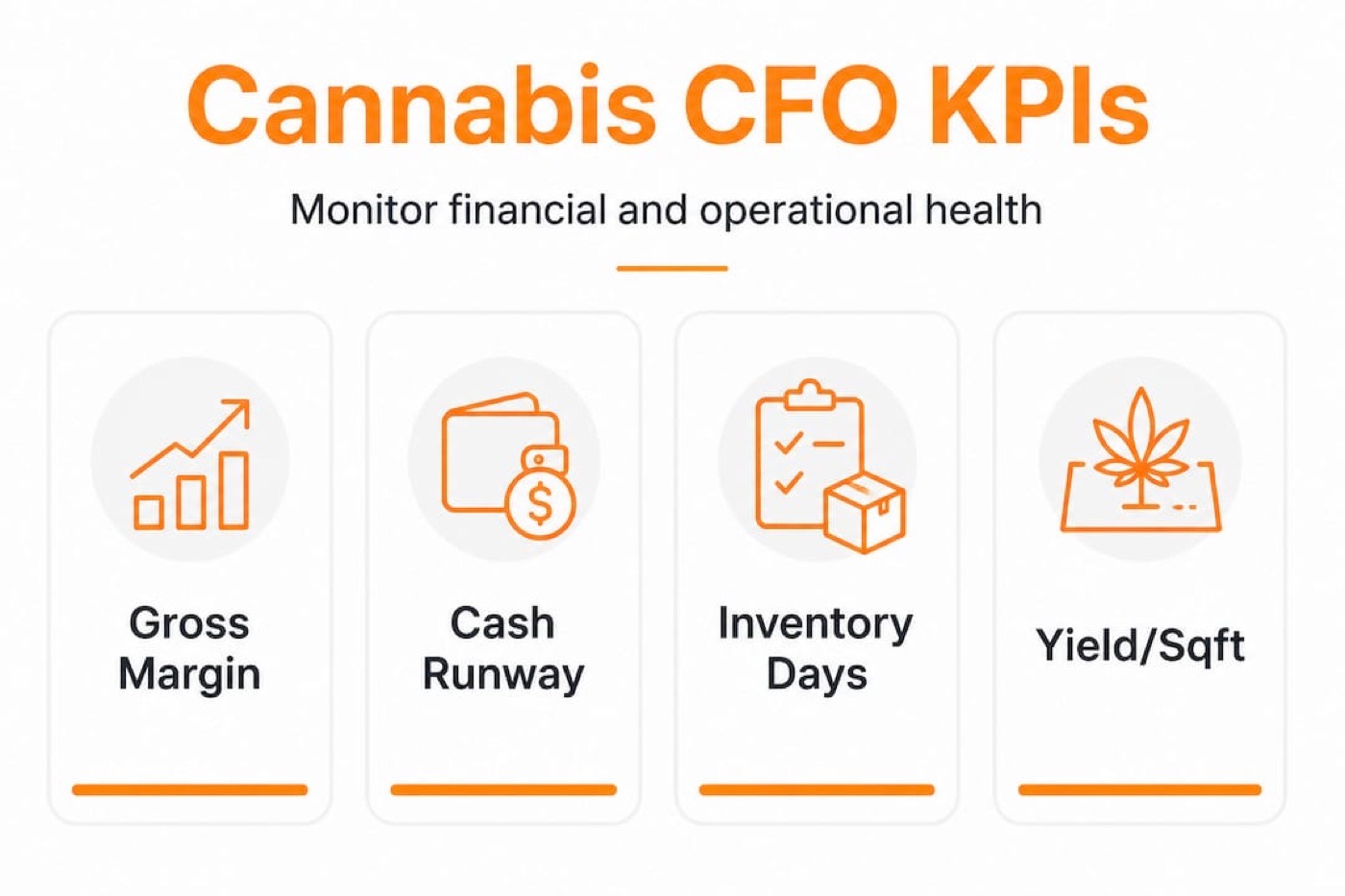
| KPI | Definition | Why it matters |
|---|---|---|
| Gross margin by category | Revenue minus COGS per product line | Reveals true profitability after 280E cost allocation |
| Cash runway | Months of operating expenses covered by current cash | Critical given limited banking access and capital constraints |
| Inventory days | Average days inventory sits before sale | Affects compliance, cash flow, and perishability risk |
| Yield per sq ft | Revenue or units produced per square foot of canopy | Core cultivation efficiency metric tied to capital deployed |
| Contribution per order | Net contribution per customer transaction | Drives pricing and product mix decisions |
| LTV:CAC ratio | Customer lifetime value vs. acquisition cost | Should be at or above 3:1 for sustainable growth |
The financial reporting checklist covers how to structure these metrics within your reporting calendar for board-level reviews and investor updates.
Here is how each KPI connects to real decisions your organization makes every week:
- Gross margin by category tells you whether a product line is subsidizing another, which matters enormously when 280E prevents full deduction of operating costs
- Cash runway determines whether you can accept payment terms from a new vendor or need to negotiate faster receivables from wholesale accounts
- Inventory days flags when product is aging on shelves, which creates compliance risk if state tracking records show discrepancies between physical and digital counts
- Yield per sq ft drives capital expenditure decisions around lighting upgrades, cultivation space expansion, or genetic selection
- LTV:CAC ensures your customer acquisition investment generates returns that survive the effective tax rate burden imposed by 280E
Disciplined KPI tracking also builds credibility with investors. When a CFO walks into a capital raise with clean, consistent historical metrics, it signals operational rigor that distinguishes you from operators who treat reporting as an afterthought.
Why mastering nuance—not just numbers—defines the cannabis CFO’s future
Here is a view you will not hear in most finance forums: technical accounting competence is now the floor, not the ceiling, for cannabis CFOs.
The market has produced a generation of cannabis financial leaders who can read a balance sheet and navigate 280E. That is necessary, but it is no longer sufficient. The operators who are winning today employ CFOs who function as part strategist, part regulatory interpreter, and part risk manager. They do not just report on what happened. They shape what happens next.
The common failure mode is treating compliance as a checkbox. A team builds solid controls, files accurate returns, and passes audits, and then stops. They interpret regulatory compliance as a cost of doing business rather than a source of competitive advantage. The result is that every operator in their market faces the same cost structure and constraints, and no one breaks away.
The CFOs who create differentiation read regulatory change early and act on it before competitors. When the IRS signals a shift in examination focus, they update documentation policies proactively. When a new state market opens, they model the cost structure implications before the board even asks. They review the Cannabis GAAP overview guide not just to stay compliant but to identify reporting frameworks that make their company more attractive to capital.
The uncomfortable truth is that most cannabis companies are underinvesting in financial leadership precisely when the industry needs it most. As capital markets tighten and institutional investors demand more rigorous financial controls, the CFO who can communicate complex tax positions clearly to a board, or who can structure a 280E defense proactively, becomes a direct driver of enterprise value.
Executive presence matters here too. A cannabis CFO who can explain the nuances of cost allocation strategy to a non-financial investor, or who can present a credible cash runway model under three regulatory scenarios, builds organizational trust that outlasts any single compliance win. The numbers are the foundation. The judgment and communication skill are the differentiators.
Build your cannabis finance expertise
The regulatory pace in cannabis is not slowing. New state markets open, IRS guidance shifts, and investor expectations evolve, sometimes all in the same quarter.

Staying current requires more than experience. It requires the right resources. Cannabis Business Minds offers deep-dive guides covering everything from cost accounting in cannabis to core cannabis accounting practices that align with GAAP and 280E requirements. Whether you are building out a new compliance framework or optimizing an existing operation, the financial management tips available here are designed for practitioners, not students. Bookmark these resources and share them with your finance team. The more your team understands the strategic picture, the more effectively they support the decisions that protect and grow your operation.
Frequently asked questions
What makes 280E such a critical issue for cannabis CFOs?
Section 280E prevents most deductions for cannabis businesses, substantially increasing federal tax liabilities and making cost of goods sold allocation the most impactful financial decision a CFO makes.
Which KPIs should I review to assess my cannabis business’s financial health?
Essential KPIs include gross margin, cash runway, inventory days, yield per square foot, contribution per order, and an LTV:CAC ratio at or above 3:1 for sustainable growth.
How is a cannabis CFO’s reporting responsibility different from other industries?
Cannabis CFOs must produce GAAP-compliant statements while managing reconciliations across POS, seed-to-sale, and general ledger systems, all while meeting layered state-specific reporting standards that change market to market.
What is the most important short-term action for new cannabis CFOs?
Prioritize establishing strong reconciliation workflows and detailed compliance documentation immediately, because audit-ready records protect the license, satisfy investors, and surface financial problems before they become crises.
Does Schedule III rescheduling mean 280E is gone?
Not yet. The IRS enforces 280E until a final rule is officially published, meaning current high effective tax rates remain fully in force regardless of rescheduling progress.
Recommended
- Cannabis Financial Planning Explained: Key U.S. Requirements – Cannabis Business Minds
- Cannabis Financial Reporting Guide for Full Compliance Success – Cannabis Business Minds
- Cannabis Tax Professionals: Complete Role Breakdown – Cannabis Business Minds
- Role of CPAs in U.S. Cannabis Compliance – Cannabis Business Minds
This article is general education, not tax, legal or accounting advice. Cannabis rules change quickly; confirm how they apply to you with a qualified cannabis CPA or attorney.