How to Review Vendor Compliance in Cannabis Operations
2026 update: what rescheduling changed for 280E (reviewed October 2026)
Effective April 22, 2026, a DOJ/DEA final order moved marijuana covered by a qualifying state medical license (and FDA-approved marijuana drugs) to Schedule III. Section 280E only applies to Schedule I and II substances, so state-licensed medical cannabis activity is generally no longer subject to 280E going forward. Adult-use cannabis remains in Schedule I and fully subject to 280E. The DEA proceeding to reschedule all marijuana was temporarily stayed in October 2026, and Treasury/IRS guidance on transition years and mixed medical/adult-use businesses is still pending.
Check where your business stands in about a minute.
Knowing how to review vendor compliance cannabis operations depend on is not optional work. A single non-compliant vendor can trigger a license violation, fail a state inspection, or create a tax position you cannot defend under Section 280E. Regulators do not accept “we trusted our supplier” as a defense. This guide walks through the documentation you need before you start, the step-by-step assessment process, the red flags that cost operators most, and the ongoing monitoring structure that separates compliant operations from ones waiting for a citation.
Table of Contents
- How to review vendor compliance cannabis operations require
- Step-by-step vendor compliance assessment process
- Common compliance gaps that regulators catch first
- Verification and ongoing vendor compliance monitoring
- My take on what actually separates compliant vendors from risky ones
- Build compliance into your vendor and financial controls
- FAQ
How to review vendor compliance cannabis operations require
Before you open a vendor file and start comparing documents, you need to know what a complete file actually looks like. Most compliance officers receive a folder with a license copy and a single Certificate of Analysis. That is not a vendor qualification file. That is a starting point.
Audit-ready vendor files must document how each vendor was qualified, the criteria used to approve them, and the records supporting every quality release decision. The minimum documentation standard for any cannabis vendor file includes:
- Certificates of Analysis for at least three recent batches, each batch-specific and traceable to a unique lot number
- Lab accreditation certificates verifying ISO/IEC 17025 status for every testing laboratory in the vendor’s supply chain
- Standard Operating Procedures (SOPs) relevant to the vendor’s scope: cultivation, extraction, testing, or packaging
- Traceability documentation connecting product to source, including seed-to-sale tracking IDs where applicable
- Vendor qualification history including initial approval records and any prior audit findings or corrective actions
The traceability requirement is where most files fall short. A COA with no lot number cross-reference, no harvest batch ID, and no chain of custody from lab to product is not defensible during a state inspection. Regulators expect the full evidentiary chain.
Pro Tip: Build a vendor qualification template that has mandatory fields for each document type. If a field is blank, the file is incomplete. Do not accept partial submissions as “pending” for more than 30 days.
Organizing this data before a review begins saves hours during the actual assessment. Keep vendor files in a document control system with version tracking, not in a shared drive folder with no access logs. The structure of your file management tells auditors something about your compliance culture before they read a single page.

Step-by-step vendor compliance assessment process
Once your documentation is assembled, the assessment itself follows a defined sequence. Skipping steps or reviewing documents out of order creates gaps you will have to reconstruct later under pressure.
-
Review COAs across multiple batches for consistency. Request COAs for three recent batches and compare cannabinoid profiles, moisture content, and contaminant panels across all three. Look for unexplained shifts in potency or failing results that were quietly replaced. Each COA must reference a unique batch identifier traceable back to the vendor’s seed-to-sale entry.
-
Verify lab accreditation status independently. Do not rely on a certificate the vendor provides. Pull the accreditation status directly from the relevant state accreditation board or the lab’s ISO/IEC 17025 certification body. Accreditations lapse. Vendors do not always disclose that.
-
Check seed-to-sale upload timing. States like Massachusetts require test results uploaded within 72 hours of receipt. If your vendor’s compliance process delays that upload, you inherit the data gap. Confirm the vendor’s internal workflow matches the applicable state’s timing requirement.
-
Assess audit trail integrity in electronic records. Electronic records require audit trails that capture who made a change, when, and why. A vendor who cannot show you a change log for an edited COA or an updated SOP has a documentation control problem that will surface during a regulatory audit.
-
Evaluate marketing activity compliance. If your vendor participates in retail tabling events at your dispensary, verify their activities align with state restrictions. New York’s Office of Cannabis Management prohibits compensation or inducements at vendor educational events. Paid promotions framed as educational content are a direct compliance violation on your license.
Pro Tip: Map each assessment step to a specific regulatory citation in your state’s rules. When you document your review, reference the regulation, not just the internal policy. That framing matters during an inspection.
The table below summarizes the key review areas and what a passing versus failing result looks like:
| Review Area | Passing Evidence | Failing Evidence |
|---|---|---|
| COA batch traceability | Unique lot IDs across all batches, full panel results | Generic COA with no batch ID or incomplete contaminant testing |
| Lab accreditation | Current ISO/IEC 17025 certificate verified independently | Expired certificate or accreditation from unrecognized body |
| Seed-to-sale data timing | Uploads within state-required window (e.g., 72 hours) | Delayed uploads or missing data entries |
| Audit trail controls | Change logs with user, timestamp, and reason for edit | No edit history or freely editable records |
| Marketing compliance | Educational-only activity, no compensation documented | Vendor providing gifts, incentives, or paid promotion |
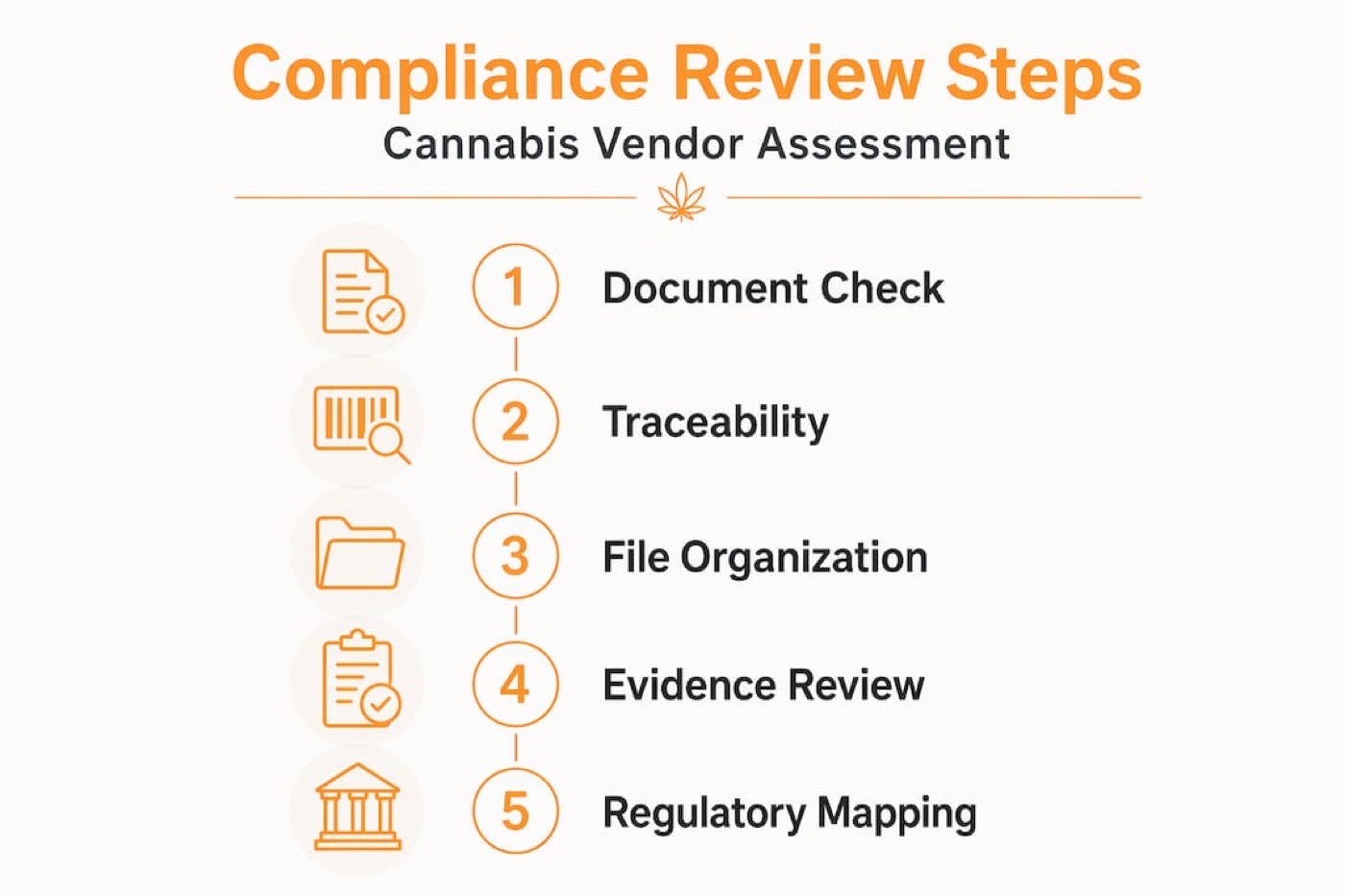
Common compliance gaps that regulators catch first
The most expensive vendor compliance failures are not the ones involving outright fraud. They are the ones involving poor documentation discipline that the vendor could have fixed for almost nothing.
Vendors most commonly fail compliance reviews not because they lack policies, but because they cannot demonstrate consistency and traceability across multiple product lots. A vendor can have a beautifully written SOP and still be unable to show you which batch of extract corresponds to which COA. That is a defensibility gap.
The most frequent red flags Cannabisbusinessminds tracks across regulatory inspection data include:
- Single COA submissions without batch specificity, presented as if one document covers all product lots
- Expired or unverified lab accreditations, where the vendor certified a lab that has since lost its ISO/IEC 17025 status
- Late or missing seed-to-sale uploads, particularly around testing result submission windows, which reflect directly on operational integrity
- Undocumented SOP changes, where a vendor updated a manufacturing process without version control or a change management record
- Improper retail promotion activity, where vendor representatives provide compensation or product incentives at dispensary events in states that prohibit it
“Vendor due diligence is a governance activity that must begin before contract drafting, with clear definitions of vendor roles, data outputs, and monitoring plans — not after a compliance gap is discovered.” (JD Supra, Rethinking Vendor Due Diligence)
The practical implication of that framing is significant. If your vendor compliance review starts at contract renewal rather than at contract inception, you are already behind. The cannabis financial due diligence process should trigger vendor qualification requirements before the first purchase order is issued.
Poor audit trail controls deserve particular attention. When an electronic record has been edited and no change log exists, regulators treat the entire document as unreliable. That affects not just the vendor file, but potentially your own records if you incorporated that vendor data into your compliance submissions.
Verification and ongoing vendor compliance monitoring
A vendor compliance review is not a one-time event. Third-party risk management requires ongoing monitoring of licenses, certifications, and insurance throughout the vendor relationship, not just at onboarding. The compliance officer who reviewed a vendor file in January and filed it away has done half the job.
The table below shows the difference between a one-time review and a sustained compliance monitoring program:
| Activity | One-Time Review | Ongoing Monitoring Program |
|---|---|---|
| COA verification | Reviewed at onboarding | Verified per shipment or quarterly |
| Lab accreditation check | Confirmed at qualification | Monitored for expiration or lapses |
| Seed-to-sale reconciliation | Not included | Monthly variance review against inventory |
| Corrective action tracking | Not applicable | CAPA log maintained and reviewed |
| Regulatory change response | Ad hoc | Annual QMS refresh tied to regulatory schedule |
Reconciliation is where the compliance process intersects directly with finance. Three-way reconciliation between seed-to-sale data, physical inventory counts, and the general ledger identifies variances that a documentation-only review will miss. A vendor who is consistently shipping short of the invoiced quantity, or whose product is failing internal QC after passing vendor COAs, will show up in the numbers before they show up in the paperwork.
Corrective Action and Preventive Action (CAPA) tracking closes the loop. When a vendor compliance gap is identified, document the finding, the required correction, the responsible party, and the verification deadline. An open CAPA with no resolution date is a compliance liability.
Pro Tip: Schedule vendor requalification reviews on a calendar tied to state regulatory publication cycles. When your state amends cannabis testing rules or introduces new contaminant panels, that is the trigger to pull every active vendor file and verify alignment. Do not wait for an inspection to find the gap.
Technology adoption matters here. Automated alerts for expiring accreditations, integrated seed-to-sale platforms with built-in upload validation, and digital audit trail systems reduce the manual overhead and the error rate. External audits from qualified third parties give you an independent data point that internal reviews cannot provide. The cannabis audit trail requirements in most states now functionally require a digital document control system rather than paper files.
My take on what actually separates compliant vendors from risky ones
I have worked through enough cannabis compliance reviews to say this plainly: the vendors who fail are rarely the ones with bad intentions. They are the ones who built their compliance documentation around passing an initial review rather than surviving ongoing scrutiny.
The tell is always the COA file. When I ask for three batches and the vendor sends me three documents that are visually identical except for a date change, I know the documentation process is not connected to the actual product batches. That is not fraud in most cases. It is sloppy documentation that becomes a regulatory exposure the moment a state inspector asks for lot traceability.
What I have found is that vendor due diligence as a governance activity is not how most cannabis operations treat it. They treat it like a procurement checklist. The compliance officer who positions themselves as a risk manager rather than a document collector brings fundamentally different questions to a vendor review. They ask: what breaks when volume triples? What happens to their documentation controls when two lab analysts quit? Those questions surface risk that a static document review will never catch.
The finance side of this is underappreciated. Vendor compliance gaps create direct cost accounting exposure. If your vendor’s COAs are not batch-specific and traceable, your inventory costing methodology has no defensible cost basis for the goods you received. That matters under any cost accounting framework, and it gets amplified in the 280E environment where the IRS scrutinizes cost of goods sold positions carefully.
My practical position: build your vendor compliance review into your monthly close process. Not as a separate compliance function. As part of reconciling what you bought, what you received, and what you can prove you received at that specification. The compliance officer and the CFO should be looking at the same data.
— JN
Build compliance into your vendor and financial controls
Vendor compliance reviews do not exist in isolation from your financial operations. When vendor COAs lack batch traceability, your cannabis inventory costing methodology loses its evidentiary foundation. When seed-to-sale data does not reconcile with your general ledger, cost of goods sold positions become difficult to defend. Cannabisbusinessminds covers the full intersection of compliance, inventory control, and cost accounting for cannabis finance professionals. Explore the compliance officer’s role in vendor oversight and review the cannabis compliance baselines framework built for 2026 regulatory requirements.
FAQ
What documents are required in a cannabis vendor compliance file?
A complete vendor compliance file includes batch-specific Certificates of Analysis for at least three recent lots, ISO/IEC 17025 lab accreditation certificates, SOPs covering the vendor’s scope of work, and traceability documentation connecting product to seed-to-sale records. Audit-ready vendor qualification files must show how the vendor was qualified and how quality release decisions were supported by records.
How often should cannabis vendor compliance be reviewed?
Annual QMS reviews are the baseline, but ad-hoc reviews should be triggered by regulatory changes, vendor ownership changes, or failed internal quality checks. Ongoing monitoring of licenses, accreditations, and insurance is required throughout the vendor relationship, not just at onboarding.
What is the most common reason cannabis vendors fail compliance reviews?
Vendors most often fail due to poor evidence defensibility, specifically the inability to demonstrate COA consistency and traceability across multiple product batches, rather than an absence of written policies.
What are the seed-to-sale upload requirements for vendor testing data?
Requirements vary by state. Massachusetts, for example, requires test results uploaded within 72 hours of receipt into the seed-to-sale system. Delays in uploads are treated as operational integrity failures during regulatory inspections.
How does vendor compliance connect to cannabis cost accounting?
When vendor COAs lack batch traceability, the cost basis for received inventory becomes indefensible under any structured cost accounting methodology. Three-way reconciliation between seed-to-sale data, physical inventory, and the general ledger is the mechanism that ties vendor compliance directly to financial record integrity.
Recommended
- Master cannabis inventory control: a compliance guide – Cannabis Business Minds
- Why legal compliance is critical for U.S. cannabis finance – Cannabis Business Minds
- 7 Essential Cannabis Dispensary Compliance Tips for Success – Cannabis Business Minds
- Data privacy compliance guide for cannabis businesses – Cannabis Business Minds
This article is general education, not tax, legal or accounting advice. Cannabis rules change quickly; confirm how they apply to you with a qualified cannabis CPA or attorney.