Why Cannabis Businesses Need Bookkeeping: Complete Guide

2026 update: what rescheduling changed for 280E (reviewed October 2026)
Effective April 22, 2026, a DOJ/DEA final order moved marijuana covered by a qualifying state medical license (and FDA-approved marijuana drugs) to Schedule III. Section 280E only applies to Schedule I and II substances, so state-licensed medical cannabis activity is generally no longer subject to 280E going forward. Adult-use cannabis remains in Schedule I and fully subject to 280E. The DEA proceeding to reschedule all marijuana was temporarily stayed in October 2026, and Treasury/IRS guidance on transition years and mixed medical/adult-use businesses is still pending.
This article was written before the order took effect. Check where your business stands in about a minute.
Did you know that cannabis businesses can face effective tax rates of up to 80 percent of their gross revenue without careful financial planning? Meticulous bookkeeping is more than paperwork for these companies. It is their foundation for staying compliant and protecting profits in a complex regulatory environment. Mastering proper record-keeping methods, understanding tax rules, and sidestepping common mistakes could be the key to a cannabis business’s survival and success.
Key Takeaways
| Point | Details |
|---|---|
| Effective Bookkeeping is Crucial | Cannabis businesses must maintain meticulous financial records for compliance and operational success in a heavily regulated industry. |
| Section 280E Impacts Profitability | This tax regulation prohibits most business deductions, complicating financial management and necessitating precise COGS calculations. |
| Detailed Documentation Prevents Audit Risks | Robust documentation is essential for defending against IRS audits and ensuring compliance, requiring unique bookkeeping strategies. |
| Avoid Common Bookkeeping Mistakes | Misclassifying expenses and inadequate financial practices can result in severe regulatory penalties; proactive management is essential. |
Defining Bookkeeping for Cannabis Businesses
Bookkeeping in the cannabis industry isn’t just about tracking dollars and cents – it’s a critical compliance strategy that can make or break your business’s financial health. According to The Canna CPAs, cannabis startups face unique financial documentation requirements that demand meticulous record-keeping and strict separation of personal and business finances.
At its core, cannabis bookkeeping involves maintaining comprehensive financial records that satisfy both standard accounting practices and the industry’s complex regulatory landscape. This means going beyond traditional bookkeeping to create detailed documentation that supports seed-to-sale tracking, cash transaction reporting, and potential audit requirements. As N Star Finance highlights, cannabis operations often operate with significant banking limitations, making precise financial record management essential.
Key aspects of effective cannabis business bookkeeping include:
- Rigorous documentation of all financial transactions
- Precise tracking of cash flow and inventory
- Comprehensive expense categorization
- Detailed record-keeping for tax and compliance purposes
- Maintaining clean, auditable financial statements
Successful cannabis bookkeeping requires understanding that your financial records are more than just numbers – they’re a strategic tool for navigating one of the most heavily regulated industries in modern business.
Legal Requirements: Section 280E and IRS Rules
Section 280E is the single most complex tax regulation facing cannabis businesses, creating a unique financial challenge that can dramatically impact profitability. According to Bloomberg Tax Insights, this Internal Revenue Code provision fundamentally restricts cannabis businesses from deducting most ordinary business expenses, allowing only Cost of Goods Sold (COGS) deductions.
The core issue stems from cannabis’s federal classification as a Schedule I substance. As detailed in Congressional Research Service reports, federal law prohibits deductions and credits for businesses involved in trafficking controlled substances. This means cannabis companies face potential tax rates that can exceed their actual economic profits, creating a significant financial burden that traditional businesses do not experience.
Key implications of Section 280E include:
- Elimination of standard business expense deductions
- Strict limitations on reducing taxable income
- Requirement to calculate COGS meticulously
- Potential for effective tax rates exceeding 70-80% of gross revenue
- Complex accounting strategies needed to maximize allowable deductions
Successful navigation of Section 280E requires working with tax professionals who understand both cannabis regulations and IRS rules. Businesses must develop sophisticated accounting approaches that maximize allowable COGS calculations while maintaining strict compliance with federal tax guidelines.
Financial Tracking: Cost of Goods Sold, Expenses
Navigating Cost of Goods Sold (COGS) is a critical financial strategy for cannabis businesses, especially given the strict limitations imposed by Section 280E. According to The Canna CPAs, cannabis cultivators can only deduct direct production costs, which means meticulously tracking expenses like raw materials, labor, equipment depreciation, and cultivation-related utilities.
The COGS calculation is more than just a financial exercise – it’s a crucial compliance mechanism. As detailed in Congressional Research Service reports, proper COGS accounting under Section 471 requires comprehensive documentation that tracks beginning inventory, purchases, production costs, and ending inventory. This precise approach isn’t optional; it’s a regulatory requirement that can significantly impact a cannabis business’s tax liability.
Key components of accurate COGS tracking include:
- Direct labor costs for cultivation and production
- Raw material expenses
- Equipment depreciation specific to production
- Utilities directly related to cultivation
- Packaging and direct production supplies
- Precise inventory management and documentation
Businesses must recognize that COGS isn’t just an accounting line item – it’s their primary tool for managing tax exposure in an industry where standard business expense deductions are prohibited. Thorough, transparent COGS documentation can mean the difference between financial survival and substantial tax penalties.
Managing IRS Audit Risk and Compliance Documentation
IRS audits are a significant threat for cannabis businesses, making exceptional documentation the primary defense against potentially devastating tax consequences. According to Aura Tax Insights, businesses must strategically structure their charts of accounts to clearly separate Cost of Goods Sold (COGS) from non-deductible expenses and implement robust inventory control systems that track production costs from seed-to-sale.
The documentation requirements go far beyond typical business record-keeping. As Industry Research highlights, cannabis businesses must maintain separate ledgers, detailed inventory tracking, comprehensive labor records, precise overhead allocations, and regular physical inventory counts. These meticulous records serve as critical evidence to support COGS claims and defend tax positions during potential IRS examinations.
Key strategies for audit-proof documentation include:
- Maintaining separate financial ledgers for different business activities
- Implementing seed-to-sale tracking systems
- Documenting all production and inventory costs
- Retaining third-party verification of financial allocations
- Creating clear audit trails for every financial transaction
- Conducting regular internal financial reviews
Successful cannabis businesses understand that documentation is not just about compliance – it’s a strategic shield against potential financial and legal risks. Proactive, transparent record-keeping can mean the difference between surviving an audit and facing potentially catastrophic financial penalties.
Common Bookkeeping Mistakes in Cannabis Operations
Financial mismanagement can quickly derail a cannabis business, transforming a promising operation into a regulatory nightmare. According to The Canna CPAs, many cannabis startups stumble by committing fundamental bookkeeping errors that compromise their financial integrity and regulatory compliance.
One of the most critical areas of potential error involves expense classification under Section 280E. The Canna CPAs emphasize that misclassifying expenses can trigger severe tax consequences. Common mistakes include incorrectly claiming non-production expenses like rent, utilities, marketing, administrative fees, and payroll for non-production staff as deductible, when they are actually non-deductible under strict IRS guidelines.
Key bookkeeping mistakes cannabis businesses must avoid include:
- Mixing personal and business finances
- Failing to reconcile accounts regularly
- Overlooking small expenses
- Missing critical tax filing deadlines
- Relying on inaccurate or incomplete financial data
- Neglecting comprehensive cash flow management
- Improper expense classification under Section 280E
- Failing to maintain detailed financial documentation
Successful cannabis financial management requires a proactive approach.
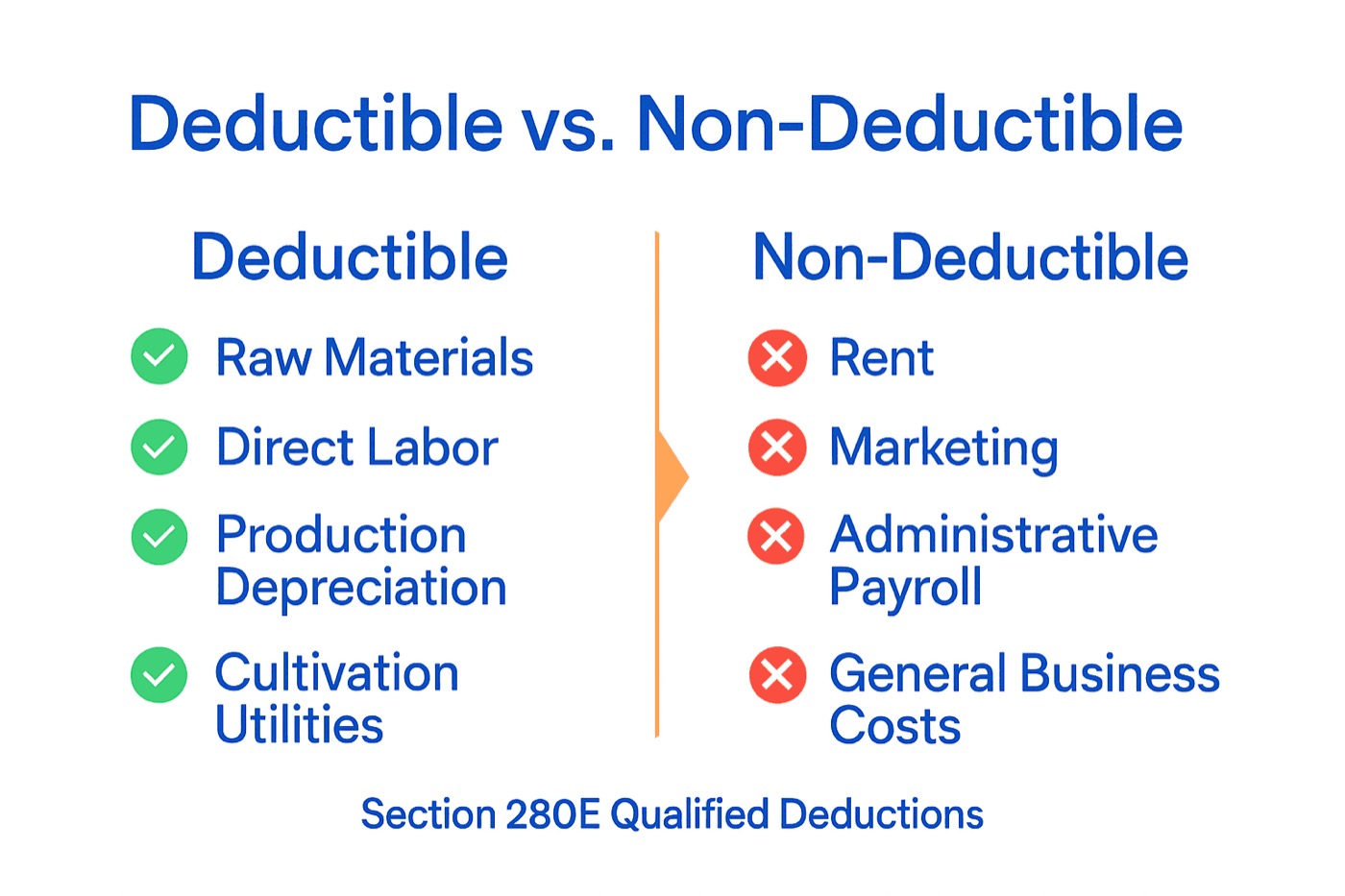
Here’s a comparison of deductible versus non-deductible expenses under Section 280E:
| Expense Category | Deductible (COGS) | Non-Deductible |
|---|---|---|
| Raw Materials | Yes | No |
| Direct Labor (Production) | Yes | No |
| Production Equipment Dep. | Yes | No |
| Utilities (Cultivation) | Yes | No |
| Rent (Retail or Office) | No | Yes |
| Marketing & Advertising | No | Yes |
| Admin/Office Payroll | No | Yes |
| General Business Expenses | No | Yes |
 Investing in robust accounting practices and professional guidance can mean the difference between sustainable growth and potential financial collapse.
Frequently Asked Questions
What is cannabis bookkeeping and why is it important?
Cannabis bookkeeping is the process of maintaining comprehensive financial records tailored to the unique compliance requirements of the cannabis industry. It’s crucial for ensuring regulatory compliance, managing finances effectively, and maximizing profitability under stringent tax laws like Section 280E.
How does Section 280E affect cannabis businesses’ bookkeeping?
Section 280E restricts cannabis businesses from deducting most ordinary business expenses, allowing only the deduction of Cost of Goods Sold (COGS). This significantly impacts financial management and necessitates meticulous tracking of production costs to mitigate tax liabilities.
What are common bookkeeping mistakes cannabis businesses should avoid?
Common mistakes include mixing personal and business finances, failing to properly classify expenses under Section 280E, overlooking small expenses, and neglecting to reconcile accounts regularly, all of which can lead to severe tax consequences and regulatory issues.
How can cannabis businesses prepare for potential IRS audits?
Cannabis businesses can prepare for IRS audits by maintaining exceptional documentation, such as separate ledgers, detailed inventory records, and clear audit trails for financial transactions. Implementing robust accounting practices is essential to defend against tax liabilities during audits.
Recommended
This article is general education, not tax, legal or accounting advice. Cannabis rules change quickly; confirm how they apply to you with a qualified cannabis CPA or attorney.