Cannabis UBTI Explained: Tax Rules for Exempt Entities

2026 update: what rescheduling changed for 280E (reviewed October 2026)
Effective April 22, 2026, a DOJ/DEA final order moved marijuana covered by a qualifying state medical license (and FDA-approved marijuana drugs) to Schedule III. Section 280E only applies to Schedule I and II substances, so state-licensed medical cannabis activity is generally no longer subject to 280E going forward. Adult-use cannabis remains in Schedule I and fully subject to 280E. The DEA proceeding to reschedule all marijuana was temporarily stayed in October 2026, and Treasury/IRS guidance on transition years and mixed medical/adult-use businesses is still pending.
Check where your business stands in about a minute.
Unrelated business taxable income (UBTI) is the gross income a tax-exempt organization earns from a trade or business not substantially related to its exempt purpose, minus directly connected deductions, and it carries real tax consequences for cannabis-adjacent nonprofits and cooperatives. Most cannabis finance professionals conflate UBTI with IRC Section 280E, and that confusion produces material compliance errors. These are two distinct tax regimes targeting two distinct entity types. Understanding what is unrelated business taxable income in the cannabis context means knowing exactly which rule applies to which organization, and why getting that wrong costs money.
What is unrelated business taxable income under IRS rules?
UBTI is defined under IRC §§ 511 through 514 as income from any trade or business that a tax-exempt organization regularly carries on and that is not substantially related to its exempt purpose. The IRS applies a three-part test to determine whether income qualifies as UBTI: the activity must constitute a trade or business, it must be regularly carried on, and it must not be substantially related to the organization’s tax-exempt mission.
The calculation follows a straightforward structure. Start with gross income from the unrelated activity, then subtract deductions directly connected to generating that income. The result is UBTI, taxed at a flat 21% corporate rate. That rate matters because it applies regardless of the organization’s overall exempt status. A cannabis-focused nonprofit running a retail operation on the side does not get a pass on that income.

Tax-exempt organizations report UBTI on IRS Form 990-T, which is due by the fourth month after the close of the fiscal year. Estimated tax payments apply when UBTI liability exceeds $500 for the year. The IRS treats this filing obligation as non-negotiable, and failure to file triggers penalties that compound quickly.
Example calculation:
| Line Item | Amount |
|---|---|
| Gross income from unrelated activity | $200,000 |
| Directly connected deductions | ($80,000) |
| UBTI (taxable base) | $120,000 |
| Federal tax at 21% | $25,200 |
The three-part test is where most organizations trip up. “Regularly carried on” means the activity competes with for-profit businesses in frequency and continuity, not just occasionally. A cannabis research nonprofit that sells branded merchandise year-round faces UBTI exposure. One that runs a single annual fundraiser likely does not.
How does UBTI apply to cannabis organizations versus for-profit operators?
UBTI applies exclusively to tax-exempt organizations under IRC § 501©. It does not apply to for-profit cannabis businesses. That distinction is the most important thing to get right before any cannabis tax planning conversation begins.
For-profit cannabis operators face a completely different federal tax problem: IRC Section 280E. Under 280E, any business trafficking in Schedule I or Schedule II controlled substances cannot deduct ordinary business expenses, only cost of goods sold. The result is effective federal rates above 70% for many cannabis operators, because rent, payroll, and marketing expenses are all disallowed. That is the primary tax burden for dispensaries, cultivators, and processors.
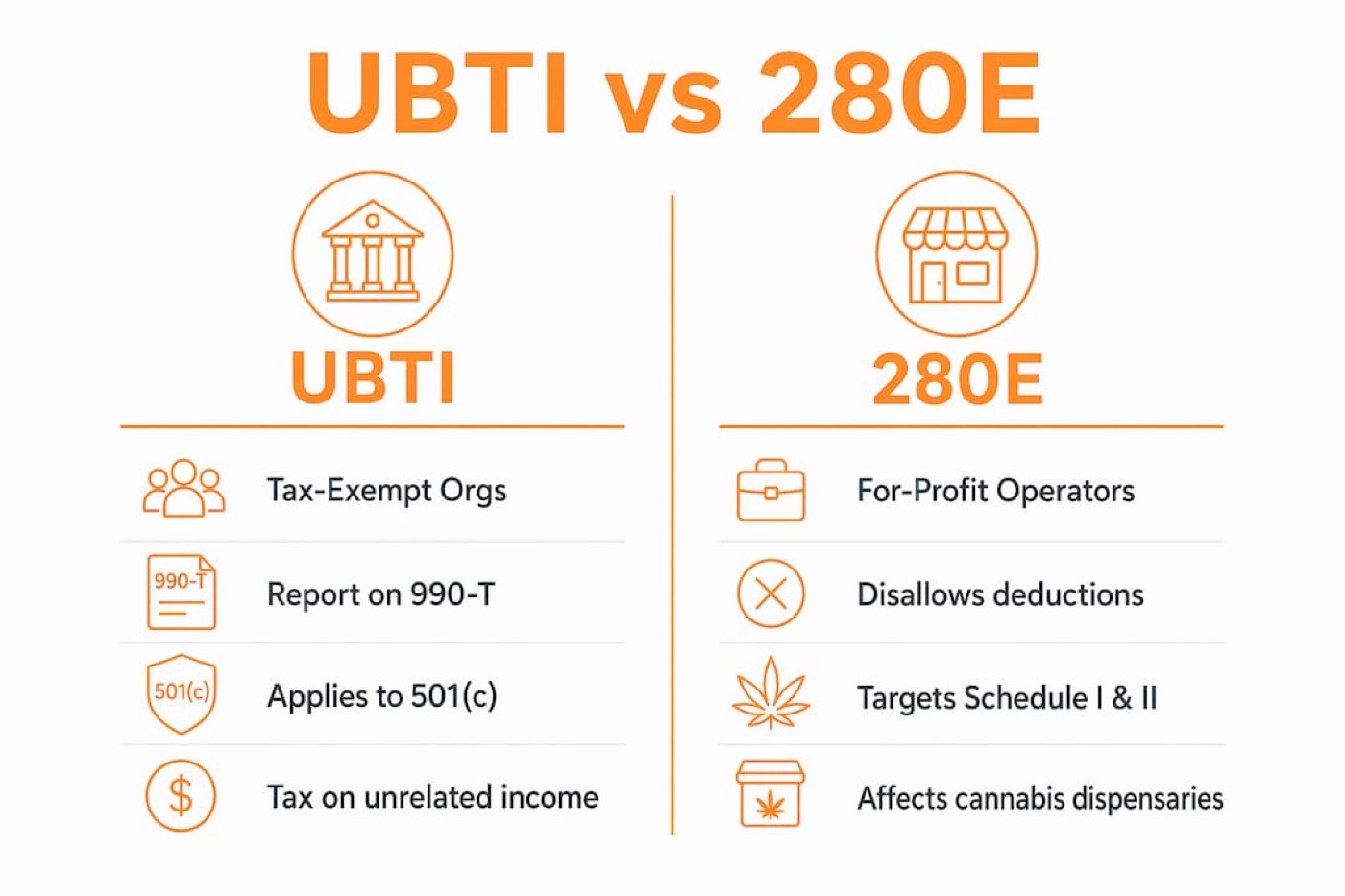
Where it gets grey is with hybrid entities. Consider a cannabis-focused 501©(3) that conducts research on medical cannabis efficacy. If that organization also sells cannabis products directly to patients, the sales revenue likely constitutes UBTI. The research mission is the exempt purpose. The retail sales are the unrelated business. The scope confusion between UBTI and 280E leads to compliance errors that affect both the tax filing and the entity’s exempt status.
Key distinctions to keep straight:
- UBTI applies to 501© organizations earning income outside their exempt purpose
- 280E applies to any entity, including for-profits, trafficking Schedule I or II substances
- A tax-exempt cannabis organization could face both regimes simultaneously if it sells cannabis products
- For-profit cannabis businesses have no UBTI exposure, only 280E and standard corporate tax rules
- Misclassifying which rule applies leads to either over-reporting or under-reporting taxable income
The practical implication: a cannabis cooperative structured as a nonprofit needs to analyze every revenue stream against the UBTI three-part test. A dispensary structured as an LLC or C-corp needs to focus entirely on 280E and standard income tax rules. These are not interchangeable frameworks.
How did the 2026 rescheduling change 280E and why UBTI is unaffected
In April 2026, qualifying medical cannabis products were rescheduled from Schedule I to Schedule III under the Controlled Substances Act. The direct tax consequence: 280E no longer applies to businesses whose cannabis activities involve only Schedule III medical products. Those operators can now deduct ordinary and necessary business expenses, including rent, wages, and utilities, against their cannabis revenue.
The Treasury issued a transition rule stating that the entire taxable year in which rescheduling occurred is treated as exempt from 280E for qualifying medical cannabis activities. That simplifies the mid-year accounting problem that many operators anticipated. You do not need to split the year at the rescheduling date for qualifying medical operations.
Recreational cannabis is a different story. Section 280E still applies fully to adult-use cannabis as of June 2026. Recreational products remain Schedule I substances. Operators running both medical and adult-use lines must segregate those activities rigorously, because the IRS will not accept blended expense allocations.
UBTI rules are entirely unaffected by the rescheduling. The rescheduling addressed 280E’s application to Schedule I substances. UBTI is a separate statutory framework under IRC §§ 511 to 514 that governs tax-exempt organizations. No change to the Controlled Substances Act scheduling touches that framework. A cannabis nonprofit’s UBTI exposure in 2026 is calculated exactly the same way it was in 2024.
Pro Tip: If your organization operates both medical and adult-use cannabis lines, build separate cost centers for each from day one. The IRS expects allocation on a reasonable basis, and “we estimated it” is not a defensible methodology under audit.
Key post-rescheduling considerations for finance teams:
- Confirm whether all cannabis products sold qualify as Schedule III medical cannabis under the new DEA definition
- Do not assume 280E relief applies to any recreational revenue, even if sold in the same facility
- Review prior year accrued liabilities under 280E. No retrospective relief mechanism exists for prior tax years as of mid-2026
- Update tax provision models to reflect deductibility of operating expenses for qualifying medical lines
- Maintain UBTI analysis separately from 280E analysis for any tax-exempt entities in your structure
Common compliance challenges for cannabis organizations under UBTI and 280E
The hardest compliance problem in cannabis taxation right now is expense allocation. For tax-exempt organizations with mixed activities, IRS rules require that deductions be allocated on a reasonable basis between exempt-related and unrelated business activities. For for-profit operators with mixed medical and adult-use lines, allocation between Schedule I and Schedule III activities is mandatory and subject to IRS audit scrutiny.
These two allocation problems are structurally similar but legally distinct. Getting them confused in your methodology creates a compliance gap that survives initial filing and surfaces during audit.
The following table compares the two compliance frameworks:
| Factor | UBTI (Tax-Exempt Orgs) | 280E (For-Profit Operators) |
|---|---|---|
| Applies to | 501© organizations | All cannabis trafficking entities |
| Tax rate | 21% flat on UBTI | Standard corporate rate on inflated taxable income |
| Deductions allowed | Directly connected to unrelated activity | COGS only (Schedule I/II activities) |
| Reporting form | IRS Form 990-T | Standard corporate return (1120 or 1065) |
| Post-rescheduling change | None | 280E removed for qualifying medical cannabis |
| Allocation required | Exempt vs. unrelated activities | Medical vs. recreational activities |
Documentation is the controlling variable in both frameworks. The IRS does not accept reconstructed records. Contemporaneous logs of revenue by product line, time allocation for employees serving multiple functions, and facility usage by activity type are the minimum standard. For cannabis organizations, the audit risk is elevated because the industry is already under heightened IRS scrutiny.
Pro Tip: For mixed-use facilities, document square footage allocation by activity and review it quarterly. If your medical and recreational operations share a grow room, that allocation needs to be defensible on paper before the audit notice arrives, not after.
Historical 280E liabilities also remain a live issue. Finance leaders should not assume that 2026 rescheduling retroactively clears prior year positions. Amended returns are possible in limited circumstances, but no formal retrospective relief mechanism has been established. Carry those accrued liabilities on the books until the IRS issues definitive guidance.
How finance professionals should build UBTI and 280E into tax planning
Medical cannabis tax planning in 2026 shifts from pure defense against 280E to proactive optimization of deductions and credits. That shift requires updated models, not just updated rates.
Finance teams should address the following in their 2026 tax planning cycle:
- Rebuild tax forecasting models to reflect deductible operating expenses for qualifying medical cannabis activities. Prior models assumed zero deductibility for most expenses. Those assumptions are now wrong for medical lines.
- Evaluate R&D tax credit eligibility. Medical cannabis firms can now classify certain development costs as eligible for federal R&D credits. This is a material change from prior years and requires coordination between tax and operations teams.
- Track unrelated business income streams separately if your entity includes any tax-exempt organization in its structure. UBTI reporting on Form 990-T is a separate obligation from the entity’s primary tax return.
- Prepare allocation methodologies in writing before filing season. The IRS expects documented, reasonable allocation between medical and recreational activities, and between exempt and unrelated business activities for nonprofits.
- Model cash flow impact of 280E relief. For qualifying medical operators, the ability to deduct operating expenses reduces effective tax rates significantly. That change in after-tax cash flow affects working capital planning, debt service capacity, and distribution decisions.
- Coordinate across tax, accounting, and compliance functions. The 2026 changes create interdependencies between departments that did not exist under the prior flat-280E regime. A decision made in operations about product classification has direct tax consequences.
The cannabis tax compliance function in 2026 is more complex than it was in 2024, not less. The addition of deductibility for medical lines adds planning opportunity but also adds audit surface area. Every deduction claimed on a medical cannabis return is a potential audit trigger until the IRS establishes settled examination standards.
The conflation problem is the real risk
Here is what I see consistently in cannabis finance engagements: practitioners who came up through nonprofit accounting apply UBTI frameworks to for-profit dispensaries, and practitioners who came up through cannabis retail apply 280E logic to nonprofit cannabis research organizations. Both errors produce materially incorrect tax positions.
The confusion between UBTI and 280E is not a theoretical problem. It shows up in tax provisions, in estimated tax payments, and in audit responses. A for-profit dispensary that treats its tax liability as a UBTI calculation will understate its 280E exposure. A cannabis nonprofit that applies 280E logic to its unrelated business income will misfile Form 990-T and potentially jeopardize its exempt status.
The 2026 rescheduling made this more complicated, not simpler. Now you have a for-profit operator that may face 280E on recreational revenue and standard corporate tax on medical revenue, and a nonprofit that faces UBTI on any cannabis sales regardless of rescheduling. Three different tax treatments, potentially in the same organization, in the same tax year.
My position: any cannabis finance professional who cannot articulate the difference between UBTI and 280E in a single sentence should not be signing cannabis tax returns. The distinction is foundational. The IRS knows it. Your clients need you to know it too.
The area where I expect the most audit activity in the next two years is expense allocation in mixed-use operations. The IRS has the statutory authority, the examination resources, and now the motivation to scrutinize how cannabis operators are splitting medical and recreational expenses. Operators who built their allocation methodology on a spreadsheet in April 2026 are not prepared for that scrutiny.
— JN
Go deeper on cannabis tax exposure with Cannabisbusinessminds
Cannabis finance professionals dealing with UBTI and 280E complexity need more than a definitional overview. They need frameworks for cost allocation, inventory accounting, and tax exposure modeling that hold up under IRS examination.

Cannabisbusinessminds publishes detailed technical resources built specifically for cannabis accountants and finance teams. The cannabis inventory costing guide covers the mechanics of COGS allocation that directly affects 280E calculations. The cost accounting guide walks through the methodologies that support defensible expense allocation between medical and adult-use lines. If you are building or reviewing a cannabis tax position in 2026, these resources are the starting point, not the finish line.
FAQ
What is UBTI in the cannabis context?
UBTI is the taxable income a tax-exempt organization generates from a business activity not substantially related to its exempt purpose, taxed at 21% under IRC §§ 511 to 514. In the cannabis context, it applies to nonprofits or cooperatives that earn revenue from cannabis sales or services outside their core exempt mission.
Does 280E or UBTI apply to a cannabis dispensary?
IRC Section 280E applies to for-profit cannabis dispensaries trafficking Schedule I or II substances. UBTI applies only to tax-exempt organizations. A standard dispensary structured as an LLC or corporation has no UBTI exposure.
Did the 2026 rescheduling eliminate 280E for all cannabis businesses?
No. The April 2026 rescheduling removed 280E restrictions only for qualifying medical cannabis activities reclassified as Schedule III. Recreational cannabis remains Schedule I, and 280E applies in full to adult-use operations.
How does a tax-exempt cannabis organization report UBTI?
Tax-exempt organizations report UBTI on IRS Form 990-T, due by the fourth month after the fiscal year closes. The 21% flat tax applies to the net UBTI after directly connected deductions are subtracted from gross unrelated business income.
Can a cannabis organization face both UBTI and 280E?
Yes. A tax-exempt cannabis organization that sells cannabis products could face UBTI on those sales and, if the products involve Schedule I substances, potentially 280E as well. These are independent statutory frameworks and must be analyzed separately for each revenue stream.
Recommended
- Cannabis Tax Basis: What Every Finance Pro Must Know – Cannabis Business Minds
- Explaining non-deductible cannabis expenses: A U.S. guide – Cannabis Business Minds
- Cannabis Tax Residency Explained for Business Owners – Cannabis Business Minds
- Understanding indirect tax on cannabis: a guide for U.S. operators – Cannabis Business Minds
This article is general education, not tax, legal or accounting advice. Cannabis rules change quickly; confirm how they apply to you with a qualified cannabis CPA or attorney.