Why Conduct Forensic Audits in Cannabis: 2026 Guide
2026 update: what rescheduling changed for 280E (reviewed October 2026)
Effective April 22, 2026, a DOJ/DEA final order moved marijuana covered by a qualifying state medical license (and FDA-approved marijuana drugs) to Schedule III. Section 280E only applies to Schedule I and II substances, so state-licensed medical cannabis activity is generally no longer subject to 280E going forward. Adult-use cannabis remains in Schedule I and fully subject to 280E. The DEA proceeding to reschedule all marijuana was temporarily stayed in October 2026, and Treasury/IRS guidance on transition years and mixed medical/adult-use businesses is still pending.
Check where your business stands in about a minute.
Most cannabis operators hear “forensic audit” and assume someone is accusing them of fraud. That assumption is wrong, and it’s costing businesses. The real question of why conduct forensic audits cannabis operators should be asking isn’t about guilt. It’s about whether your records can survive IRS scrutiny under IRC §280E and §471, whether your seed-to-sale data reconciles with your books, and whether a gap in your documentation would surface during a regulatory inspection. Forensic audits in cannabis are compliance infrastructure. The sooner you treat them that way, the fewer surprises you’ll face.
Table of Contents
- Why forensic audits are unavoidable in cannabis finance
- What forensic audits actually examine in cannabis
- Triggers and timing for cannabis forensic audits
- Operational and legal benefits of forensic audits
- Practical considerations when conducting cannabis forensic audits
- My take on forensic audits as a strategic asset
- Build your forensic audit readiness with Cannabisbusinessminds
- FAQ
Why forensic audits are unavoidable in cannabis finance
The cannabis industry operates under federal tax rules that penalize normal deductions. IRC §280E disallows deductions for ordinary business expenses, leaving COGS as the primary lever for reducing taxable income. That makes inventory valuation accuracy the single most scrutinized number on your return.
The IRS has increased the sophistication of its cannabis audit teams, using AI-driven analytics to flag inconsistencies in COGS reporting, inventory counts, and cost allocation. The gap between GAAP financial reporting and cannabis operators’ actual books is precisely where GAAP compliance challenges become tax liabilities.
Several regulatory pressures combine to make forensic-level scrutiny standard rather than exceptional:
- IRC §280E exposure: Any misallocation of indirect costs to COGS inflates deductions and creates audit targets.
- IRC §471 complexity: Changes to inventory accounting methods require consistent application and documentation that withstands reconstruction.
- State seed-to-sale tracking: Regulators treat state tracking data as ground truth. If your POS and your state tracking system disagree, the state data wins.
- Multi-entity structures: Management fees, intercompany loans, and shared services between related entities create transfer pricing risk that standard audits rarely probe deeply enough.
- Cash-intensive operations: High cash volumes attract scrutiny around revenue completeness and source-of-funds documentation.
Pro Tip: If your COGS allocation methodology isn’t written down in a policy document with supporting cost studies, you don’t have a methodology. You have a number.
The need for forensic audits isn’t created by wrongdoing. It’s created by complexity. And cannabis finance is structurally complex in ways that make standard review insufficient.
What forensic audits actually examine in cannabis
Understanding what cannabis forensic accounting covers is where most operators develop a more accurate picture. This is not a fraud investigation with subpoenas and depositions by default. It’s a structured financial reconstruction exercise with evidentiary standards.
A forensic audit in cannabis typically works through these core areas:
- Inventory count verification: Comparing physical counts against POS records, state tracking data, and the general ledger across multiple time periods. Discrepancies between these three sources are the primary audit finding.
- COGS substantiation: Testing whether the costs flowing into COGS have proper allocation logic and contemporaneous support, including invoices, labor records, and overhead allocation schedules.
- Record durability testing: Cannabis financial systems store records across multiple locations. Fragmented recordkeeping across disparate systems requires forensic processes that test whether audit trails can be fully reconstructed with timestamps and change histories.
- POS-to-tracking reconciliation: Any variance between what the POS reports sold and what the state tracking system shows transferred raises both tax and licensing questions.
- Fund flow analysis: Tracing intercompany transactions, owner distributions, management fees, and compensation to confirm proper tax treatment and arms-length documentation.
- Internal control evaluation: Identifying segregation of duties failures, approval gaps, and system access issues that create both compliance and misappropriation risk.
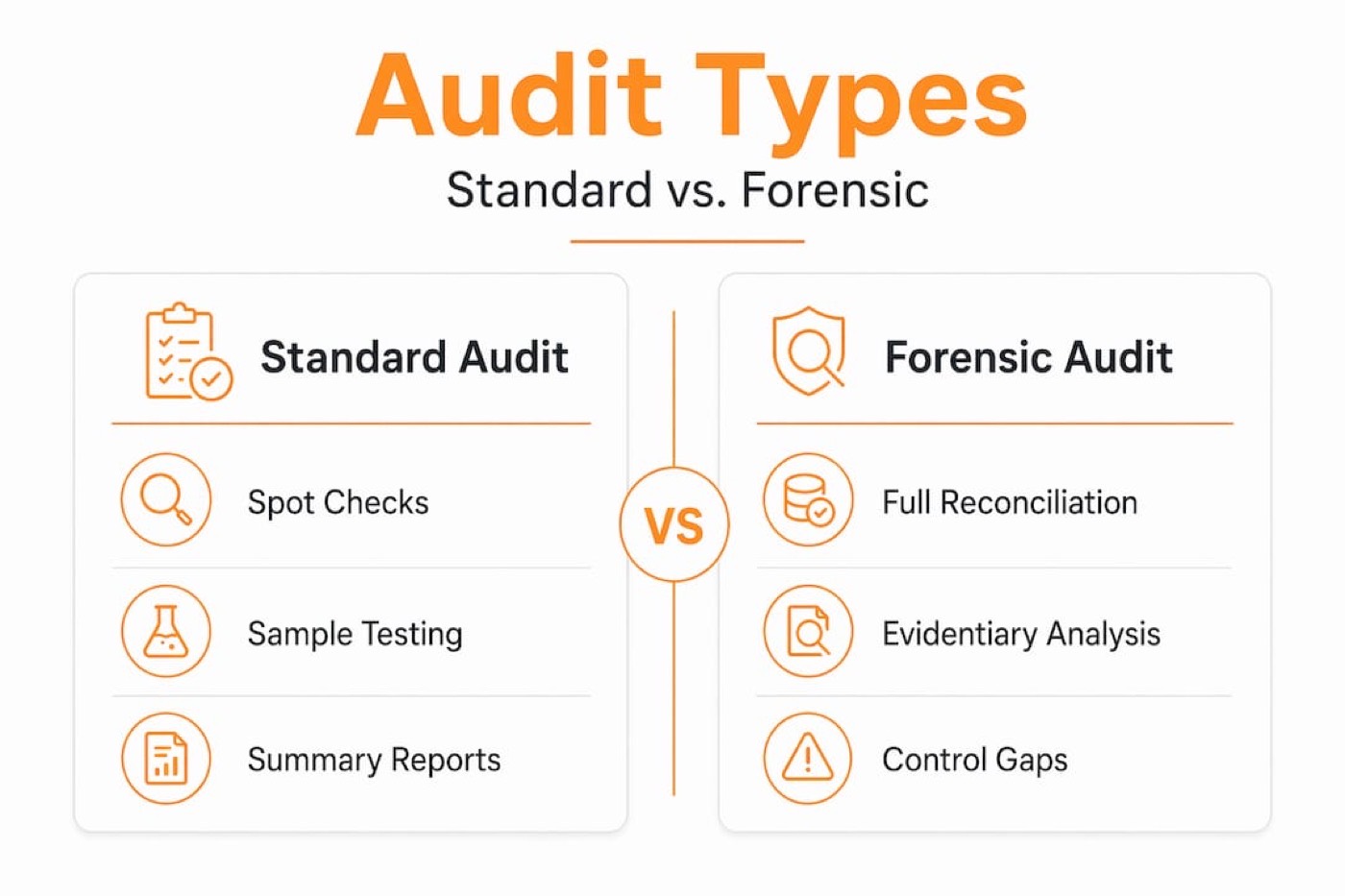
The table below compares what a standard financial audit covers versus what forensic audits in cannabis add:
| Area | Standard Audit | Forensic Audit |
|---|---|---|
| Inventory | Spot-check counts | Full count reconciliation across all data sources |
| COGS | Tests balance accuracy | Tests allocation logic, timing, and documentary support |
| Transactions | Samples for accuracy | Traces fund flows, related-party terms, and ownership |
| Controls | Notes weaknesses | Tests exploitability and prior incident evidence |
| Records | Reviews current files | Tests reconstruction capability and change history |
| Seed-to-sale | Not typically examined | Full reconciliation to state tracking data |
Pro Tip: Even when no fraud is found, forensic work uncovers control weaknesses and governance gaps that would otherwise surface during a regulatory inspection.
The role of forensic accounting in cannabis is ultimately to produce analysis that meets an evidentiary standard. Whether the audience is the IRS, a state regulator, an investor, or a court, the output needs to be defensible under cross-examination.
Triggers and timing for cannabis forensic audits
Forensic accounting investigations generally start due to unresolved financial discrepancies or incomplete documentation, not necessarily confirmed misconduct. That distinction matters operationally.
Common triggers that should prompt a forensic audit in cannabis:
- Inventory variances that don’t close: If your month-end inventory reconciliation consistently shows unexplained shrinkage, write-offs, or count discrepancies above 1-2%, that’s a forensic trigger, not a bookkeeping cleanup item.
- Documentation gaps in prior periods: Missing vendor invoices, incomplete labor records, or inconsistent overhead allocation from periods under IRS examination require forensic reconstruction, not just re-entry.
- Pre-M&A due diligence: Buyers acquiring cannabis operations are increasingly requiring forensic-level financial review, not just compiled or reviewed financials. The seller’s 280E tax position and COGS methodology are acquisition risks.
- Regulatory inspection notices: A state compliance inspection that flags seed-to-sale discrepancies should trigger internal forensic review immediately. Waiting for a formal finding is the worst possible timing.
- Investor or lender scrutiny: Private equity and institutional lenders entering cannabis deals now require auditable financial statements with supporting cost studies. Standard bookkeeping doesn’t satisfy that requirement.
“Early forensic involvement reduces financial and reputational risks. Discrepancies clarified before enforcement action preserves options that disappear once regulators formally assert findings.”
The single biggest mistake operators make is treating forensic audits as reactive tools. Early forensic accounting preserves evidence, clarifies uncertainty, and reduces exposure before it escalates. Once the IRS issues a Notice of Deficiency or a state regulator suspends a license, the cost of forensic reconstruction multiplies significantly.
Operational and legal benefits of forensic audits

The benefits of forensic audits extend well beyond surviving an IRS examination. For cannabis operators thinking about growth, investment, or simply sustainable operations, forensic audits function as a financial health assessment with legal defensibility built in.
Here’s where the operational value concentrates:
- 280E defense strength: Contemporaneous, transaction-level support is the standard that survives 280E scrutiny. Records created at the time costs are incurred are more defensible than reconstructed documentation. Forensic audits verify whether your current records meet that standard before the IRS asks.
- Seed-to-sale reconciliation quality: Cannabis audit readiness depends on whether inventory and COGS documentation consistently reconciles across POS, state tracking, and the general ledger. Forensic audits establish whether that reconciliation holds under stress-testing.
- System gap exposure: Most compliance failures in cannabis stem from documentation and systems quality rather than malicious intent. Forensic audits surface exactly where your systems create gaps before regulators do.
- Investor confidence: A cannabis business that has completed a forensic audit and addressed findings presents a materially lower risk profile to investors and lenders than one that hasn’t. That translates directly to valuation and deal terms.
- Governance documentation: Forensic audit outcomes create a record of internal control improvements that demonstrates regulatory good faith. Regulators weigh that history when deciding how to respond to future issues.
Pro Tip: Completing a forensic audit before a licensing renewal or state inspection gives your compliance officer concrete documentation of corrective actions taken. That record carries real weight with regulators.
Understanding the role of audits in cannabis across these dimensions reframes forensic work from a cost center to a risk reduction investment. The math changes significantly when you compare forensic audit fees against IRS penalty assessments or license suspension costs.
Practical considerations when conducting cannabis forensic audits
Getting real value from a forensic audit requires more than hiring a forensic accountant and handing over your files. The preparation quality and integration of findings into your compliance program determine whether you see lasting benefit.
-
Establish contemporaneous recordkeeping before the audit starts. This means transaction-level documentation created at the time of the transaction: vendor invoices matched to purchase orders, labor time records with cost center coding, and overhead allocation schedules reviewed monthly. Cannabis businesses that maintain compliant audit trails from the start spend significantly less on forensic reconstruction.
-
Reconcile your POS and seed-to-sale systems before the forensic accountant arrives. Known discrepancies that you’ve already identified and documented are managed risk. Unknown discrepancies discovered during a forensic review are findings. The difference matters for how results are framed and reported.
-
Formalize intercompany agreements and compensation policies in writing. Related-party transactions without executed agreements are automatic scrutiny targets. Management fees, consulting arrangements, and owner compensation need market-rate documentation and written terms.
-
Run internal control reviews quarterly, not annually. Control weaknesses compound over time. A segregation-of-duties gap that exists for twelve months creates a much larger forensic reconstruction burden than one caught at three months. Regular cannabis recordkeeping reviews reduce forensic scope significantly.
-
Integrate forensic findings into your accounting policies and system configurations. A forensic audit that produces a findings report without triggering policy changes and system updates generates no lasting benefit. The output should feed directly into updated chart of accounts structure, COGS allocation methodologies, and system access controls.
The forensic accountant you hire matters as much as the process. They need specific cannabis industry experience, familiarity with 280E litigation history, and a working knowledge of your state’s seed-to-sale platform. General forensic accounting experience is insufficient for the regulatory complexity cannabis operators face.
My take on forensic audits as a strategic asset
In my experience, the operators who fear forensic audits are almost always the ones who know their records won’t hold up. And I understand that instinct. When you’ve been operating with the tools available and making reasonable judgments under time pressure, an outside expert reconstructing your financials feels threatening.
But here’s what I’ve consistently seen: forensic audits rarely surface fraud in well-intentioned businesses. What they surface are system failures and documentation habits that create the appearance of problems that don’t exist. That’s a fundamentally different, and fixable, situation.
I’ve watched businesses lose IRS examinations not because they did anything wrong, but because they couldn’t reconstruct what they did right. Their COGS allocations were reasonable. Their inventory counts were honest. But the records weren’t contemporaneous, the methodologies weren’t documented, and the seed-to-sale data didn’t reconcile cleanly. The forensic work happened too late to fix anything.
The operators I’ve seen benefit most from forensic audits treated them as diagnostic tools before the stakes got high. They used the findings to formalize policies, upgrade systems, and create the kind of documentation that makes IRS scrutiny manageable rather than catastrophic.
An audit-ready mindset doesn’t happen by accident. It’s built through the kind of systematic review that forensic accounting provides. The question isn’t whether your business will face scrutiny. In cannabis, it’s when.
— JN
Build your forensic audit readiness with Cannabisbusinessminds
Whether you’re preparing for an IRS examination, approaching a licensing renewal, or conducting pre-transaction due diligence, having the right framework for cannabis forensic accounting makes the difference between a manageable process and a disruptive one.

Cannabisbusinessminds provides specialized resources built specifically for cannabis finance professionals. From the cost accounting guide that covers COGS allocation methodologies under IRC §471 to the cannabis accounting resources covering system integration and compliance support, the platform delivers the technical depth cannabis operators and their financial teams actually need. You’ll also find guidance on audit readiness that covers exactly how to prepare your records and systems before a forensic review begins. If your compliance infrastructure needs strengthening, these resources give you a concrete starting point.
FAQ
What is cannabis forensic accounting?
Cannabis forensic accounting is a structured financial investigation process that reconstructs transactions, validates records, and tests internal controls to an evidentiary standard, primarily to support tax compliance, regulatory defense, and litigation. It extends well beyond fraud detection to cover COGS substantiation, inventory reconciliation, and seed-to-sale data validation.
When should a cannabis business conduct a forensic audit?
A cannabis business should consider a forensic audit when it faces unresolved inventory discrepancies, incomplete documentation in periods under IRS review, pre-M&A due diligence requirements, or regulatory inspection notices. Proactive forensic review before these triggers arise consistently produces better outcomes than reactive engagement.
How does a forensic audit help with IRC §280E compliance?
A forensic audit tests whether your COGS allocations are supported by contemporaneous records with proper allocation logic, which is the specific standard the IRS applies under §280E scrutiny. It identifies documentation gaps and methodology inconsistencies before they become deficiency assessments.
What triggers a forensic accounting investigation in cannabis?
Investigations typically begin due to unresolved financial discrepancies, incomplete documentation, or inconsistencies between POS and state seed-to-sale tracking data. They are not exclusively triggered by suspected fraud. Investor due diligence and regulatory inspections are increasingly common triggers as well.
How are forensic audits different from standard financial audits in cannabis?
Standard audits test balance accuracy and sample transactions for completeness. Forensic audits reconstruct transaction flows, test record durability across systems, reconcile seed-to-sale data, and evaluate whether documentation would survive adversarial scrutiny, such as an IRS examination or regulatory enforcement action.
Recommended
- Role of Audits in Cannabis: Complete Industry Guide – Cannabis Business Minds
- Complete Guide to Why Cannabis Audits Matter – Cannabis Business Minds
- Cannabis Audit Trail Explained: Compliance Essentials – Cannabis Business Minds
- Cannabis Chart Audit: Ensuring Compliance and Accuracy – Cannabis Business Minds
This article is general education, not tax, legal or accounting advice. Cannabis rules change quickly; confirm how they apply to you with a qualified cannabis CPA or attorney.