What Is Tax Compliance Monitoring for Cannabis Businesses
2026 update: what rescheduling changed for 280E (reviewed October 2026)
Effective April 22, 2026, a DOJ/DEA final order moved marijuana covered by a qualifying state medical license (and FDA-approved marijuana drugs) to Schedule III. Section 280E only applies to Schedule I and II substances, so state-licensed medical cannabis activity is generally no longer subject to 280E going forward. Adult-use cannabis remains in Schedule I and fully subject to 280E. The DEA proceeding to reschedule all marijuana was temporarily stayed in October 2026, and Treasury/IRS guidance on transition years and mixed medical/adult-use businesses is still pending.
Check where your business stands in about a minute.
Tax compliance monitoring is not a periodic review you schedule once a quarter. It is a continuous, automated oversight process that tracks every tax-relevant transaction and flags deviations before they become filed errors, penalties, or audit triggers. For cannabis businesses operating under Section 280E, multi-state excise tax regimes, and constantly shifting state regulations, this distinction is not academic. Missing a rate change or filing a mismatched return in California or Colorado can cost you far more than the tax itself. Here is what the process actually looks like and why it matters for your operation right now.
Table of Contents
- What is tax compliance monitoring and how it differs from audits
- Core tax compliance measures and strategies for cannabis operators
- Technology and automation tools for real-time monitoring
- Practical implementation steps for monitoring programs
- Continuous monitoring vs. traditional approaches: side-by-side
- My take on monitoring programs in cannabis finance
- Build your cannabis tax compliance program with the right tools
- FAQ
What is tax compliance monitoring and how it differs from audits
Most cannabis finance teams still operate on an audit-based mental model: pull reports at period close, review for obvious errors, file, and wait. That is a point-in-time assessment. Tax compliance monitoring is something fundamentally different.
Continuous monitoring is an ongoing, proactive process designed to keep operations within regulatory and tax policy boundaries at all times, not just at the moment of filing. The distinction matters because cannabis tax environments generate errors continuously, not seasonally. A product reclassification, a new municipal excise rate, or a POS system update can create mismatches that compound across hundreds of daily transactions before anyone notices.
The core components of a monitoring program break down this way:
- Data integration: Pulling transaction data from POS systems, ERP platforms, and accounting software into a single, unified view.
- Automated controls: Rule-based checks that run on a defined cadence, validating that tax calculations match current rate tables and product classifications.
- Real-time alerts: Triggered notifications when a transaction or batch falls outside expected thresholds, for example, effective tax rates deviating from jurisdiction baselines.
- Audit trail maintenance: Timestamped logs that document every calculation, override, and correction for exam readiness.
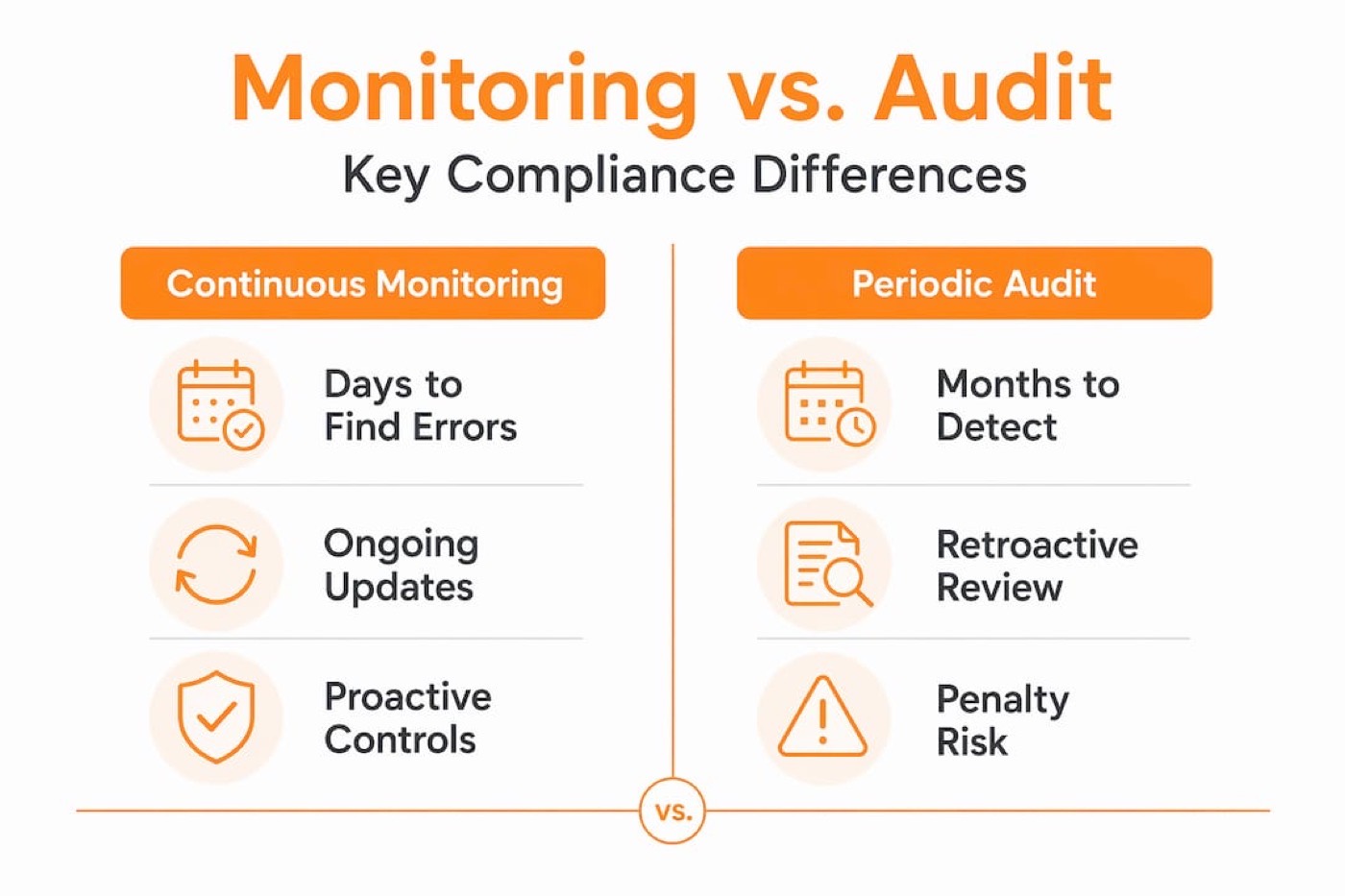
A periodic audit finds what went wrong six months ago. Monitoring catches the drift within days, sometimes hours.
Pro Tip: Set your alert thresholds based on jurisdictional penalty triggers, not internal comfort levels. California’s cannabis excise tax carries steep underpayment penalties. Your threshold should reflect the statutory exposure, not a round number someone picked.
Core tax compliance measures and strategies for cannabis operators
Cannabis businesses face tax rate structures that most ERPs were not built to handle out of the box. You are dealing with state excise taxes calculated on retail price or wholesale cost depending on the state, local add-on rates, sales tax that may or may not layer on top, and a federal tax environment under Section 280E that disallows most ordinary deductions. Effective tax compliance strategies layer multiple controls to address this complexity.
The following sequence represents how a functioning monitoring program operates:
- Master data validation: Every SKU, product category, and customer class must map correctly to the applicable tax rate. Monitoring starts by running automated checks that confirm these mappings are current after any product database update.
- Rate logic verification: Tax engines should cross-reference against current rate tables from each jurisdiction where you have nexus. A static rate table updated annually is a liability in states that adjust excise rates mid-year.
- Transaction anomaly detection: Statistical controls identify transactions where calculated tax deviates materially from the expected range for that product type, location, and price point.
- Filing reconciliation checks: Before submission, monitoring tools compare the aggregate tax liability in your return to the sum of transaction-level calculations. Unexplained variances above a set dollar threshold should require sign-off.
- Regulatory change tracking: Your monitoring program needs a feed that captures rate changes, new exemptions, and amended filing requirements. Tax law changes propagate system-wide only when connected directly to your tax calculation engine before transactions are finalized.
| Monitoring approach | Frequency | Trigger type | Risk addressed |
|---|---|---|---|
| Master data validation | Daily | Automated batch | Product misclassification |
| Rate logic check | Real-time | Transaction-level | Rate table staleness |
| Anomaly detection | Continuous | Statistical threshold | Calculation errors |
| Filing reconciliation | Pre-filing | Manual + automated | Return inaccuracies |
| Regulatory change feed | Ongoing | External data feed | Missed law changes |
Pro Tip: Do not rely on your software vendor to push regulatory updates. Build an internal calendar of jurisdictional review dates and assign ownership to a specific person. Vendors lag. Your filing deadline does not.
The practical challenge for cannabis operators is that high-tax rate environments magnify the cost of every error. A 1% miscalculation on a $10 million revenue base is $100,000 in potential exposure before penalties and interest. The monitoring controls need to match the scale of that risk.

Technology and automation tools for real-time monitoring
The case for automation is not about convenience. Manual monitoring is simply not scalable across multi-jurisdictional cannabis operations. A dispensary group operating in five states processes thousands of taxable transactions daily. Human review of transaction-level tax data at that volume is not realistic.
The technology stack supporting effective monitoring includes several components:
- Tax calculation engines (such as Avalara or Vertex) that apply current rate logic at the point of transaction, not retrospectively.
- API connectors linking your POS, ERP, and accounting platforms so data flows without manual export and re-import, which is a primary source of reconciliation errors.
- Continuous control libraries running frequent transaction validations across three tiers: configuration checks on your system settings, high-frequency checks on individual transactions, and outcome checks comparing calculated liabilities to filed amounts.
- AI-driven anomaly detection that flags unusual filing patterns or transaction clusters for human review. Tax authorities increasingly use AI to scrutinize cannabis operator production and sales patterns. Having the same analytical capability on your side is no longer optional.
The risk of over-relying on technology without human oversight is real. Automated controls can produce false positives that create alert fatigue, causing staff to dismiss genuine flags. They can also encode stale logic if no one owns the rule maintenance process. Technology reduces the volume of errors humans need to catch. It does not replace the judgment required to evaluate ambiguous transactions or interpret new regulatory guidance.
Pro Tip: Review your continuous control library quarterly. Rules become outdated as product lines expand, regulations change, and business structures evolve. An alert that was tuned for a single-dispensary operation will fire incorrectly for a vertically integrated license holder.
Practical implementation steps for monitoring programs
Building a monitoring program from scratch is less daunting when you start narrow and expand. The mistake most cannabis operators make is trying to cover everything simultaneously, which produces a sprawling, unmaintained system that no one trusts.
-
Map your jurisdictional obligations. List every state, county, and municipality where you have nexus. Document the applicable tax types (state excise, local excise, sales tax, cultivation tax), rates, filing frequencies, and payment methods. This becomes your risk inventory.
-
Prioritize controls by exposure. Not all tax risks are equal. Start with the obligations that carry the highest penalty exposure or where you have had prior issues. Cannabis sales tax and state excise tax almost always top this list given the penalty structures in markets like California, Illinois, and Michigan.
-
Assign ownership. Every control needs a named owner responsible for reviewing alerts, investigating exceptions, and escalating unresolved items. Monitoring programs that lack clear ownership degrade quickly. Alerts pile up unacknowledged, defeating the purpose of the system.
-
Build remediation workflows. When a control flags an issue, the response process should be predefined. Who reviews it? What documentation is required? What is the escalation path if the issue represents a material misstatement in a prior filing? Map this before the first alert fires.
-
Integrate into close and filing cycles. Monitoring checkpoints should sit at the beginning of your period close, not after the fact. Catching a tax data deviation before the ledger closes is worth significantly more than finding it post-filing.
-
Document everything. The best programs create a centralized source of truth fed automatically from ERP, accounting, and tax engines. Fragmented spreadsheets are not defensible in an exam. A documented, system-generated audit trail is.
Common pitfalls include treating the initial setup as a one-time project, failing to update rate tables when regulatory changes occur, and using monitoring reports as a compliance checkbox rather than an active management tool.
Continuous monitoring vs. traditional approaches: side-by-side
The practical argument for continuous monitoring over periodic reviews is not theoretical. It is financial.
Monthly oversight models allow issue detection within days, saving material resources on penalty mitigation compared to annual reviews that surface errors after filing deadlines have passed. For cannabis operators who cannot deduct penalties under Section 280E, every dollar of avoidable penalty is a pure after-tax loss.
| Factor | Continuous monitoring | Periodic audit/review |
|---|---|---|
| Error detection speed | Days | Months or post-filing |
| Penalty exposure | Substantially reduced | Higher due to late discovery |
| Regulatory change response | Immediate, system-driven | Dependent on review schedule |
| Audit readiness | Maintained continuously | Requires preparation sprint |
| Data quality | Centralized, validated | Often fragmented |
| Regulator relationship | Demonstrable good faith | Reactive posture |
| Cost of issues | Lower (early remediation) | Higher (compound interest, penalties) |
Robust compliance governance also improves forecasting accuracy and supports strategic growth decisions. When your tax data is reliable in real time, your financial projections are more accurate, your banking relationships are stronger, and your license renewal conversations with regulators carry more weight.
The importance of tax monitoring goes beyond penalty avoidance. It is the foundation of reliable financial reporting in an industry where every number is scrutinized by regulators, investors, and acquisition due diligence teams alike.
My take on monitoring programs in cannabis finance
I have reviewed enough cannabis finance operations to say this clearly: most compliance programs are compliance theater. Someone built a checklist, assigned it to a junior accountant, and called it a monitoring program. The alerts exist. Nobody reads them.
What I have found actually separates functional monitoring from decoration is ownership accountability. When a control fires an alert and nobody can tell me who was responsible for investigating it last quarter, the program is not working. The technology is usually fine. The governance is not.
The other misconception I see constantly is the belief that tax compliance is a finance-only concern. It is not. Incorrect tax treatment starts at the point of product classification, pricing decisions, and license structure. Those decisions live in operations, legal, and executive strategy. Monitoring programs that sit exclusively inside the accounting department miss upstream errors that are harder and more expensive to unwind.
What I have seen work is treating the monitoring output as a business intelligence tool, not just a compliance check. When your real-time tax data tells you that effective tax rates are climbing in a specific jurisdiction, that is a pricing and margin signal, not just a filing issue.
Tax authorities are not waiting for annual audits anymore. AI-driven scrutiny is continuous. Your monitoring posture needs to match that reality.
— JN
Build your cannabis tax compliance program with the right tools
If the monitoring framework above describes what you need but not what you currently have, the gap is rarely technical. It is usually a combination of the right software, the right CPA expertise, and the right internal structure working together.

Cannabisbusinessminds has assembled a detailed comparison of the best tax solutions for dispensaries that addresses exactly this gap, with side-by-side analysis of tools built for the regulatory complexity cannabis operators face. If you are evaluating how CPAs fit into your compliance structure, the resource on the role of CPAs in cannabis compliance breaks down where human oversight adds the most value. For operators building out the financial infrastructure around compliance, the cannabis financial planning guide covers how monitoring integrates with broader budgeting and forecasting practice. The site also covers cannabis tax strategy in depth, including how compliance positions directly affect profitability margins.
FAQ
What is tax compliance monitoring in simple terms?
Tax compliance monitoring is a continuous process of automated checks and controls that verify your tax calculations, filings, and payments remain accurate and current across all jurisdictions where you operate, rather than waiting for a periodic audit to surface problems.
How does continuous monitoring reduce audit risk for cannabis businesses?
Early issue detection allows businesses to correct errors before they appear in filed returns, which significantly reduces the discrepancies that trigger regulatory scrutiny, especially important given that tax authorities now use AI analytics to flag cannabis operators with unusual patterns.
What tax compliance measures should cannabis operators prioritize first?
Start with master data validation and rate logic checks on your highest-volume, highest-tax-rate transaction types, typically state and local excise taxes, since these carry the steepest penalty exposure and are most affected by regulatory changes.
How often should a cannabis business review its monitoring controls?
At minimum, review your control library and rate tables quarterly, and immediately following any regulatory announcement affecting jurisdictions where you have nexus. Static monitoring rules become liabilities as fast as the rules they were designed to check.
Does monitoring replace the need for a tax CPA in cannabis?
No. Automated monitoring reduces the volume of errors that require professional resolution, but it does not replace judgment on ambiguous transactions, multi-entity structuring questions, or the interpretation of new regulatory guidance specific to cannabis tax law.
Recommended
- What Is Tax Compliance for Cannabis Businesses – Cannabis Business Minds
- What Is Cannabis Compliance: Impact on U.S. Businesses – Cannabis Business Minds
- Why Tax Compliance Matters: Complete Cannabis Guide – Cannabis Business Minds
- Why Cannabis Tax Compliance Matters for U.S. Businesses – Cannabis Business Minds
This article is general education, not tax, legal or accounting advice. Cannabis rules change quickly; confirm how they apply to you with a qualified cannabis CPA or attorney.