Does Your Cannabis Business Need a CFO in 2026?
2026 update: what rescheduling changed for 280E (reviewed October 2026)
Effective April 22, 2026, a DOJ/DEA final order moved marijuana covered by a qualifying state medical license (and FDA-approved marijuana drugs) to Schedule III. Section 280E only applies to Schedule I and II substances, so state-licensed medical cannabis activity is generally no longer subject to 280E going forward. Adult-use cannabis remains in Schedule I and fully subject to 280E. The DEA proceeding to reschedule all marijuana was temporarily stayed in October 2026, and Treasury/IRS guidance on transition years and mixed medical/adult-use businesses is still pending.
Check where your business stands in about a minute.
A cannabis CFO is a strategic financial leader who manages tax optimization, capital structure, regulatory compliance, and growth planning at the executive level. This role is categorically different from a controller or bookkeeper. If your cannabis business is raising capital, expanding across state lines, or trying to minimize exposure under IRC Section 280E, you need CFO-level oversight. The question is not whether the role matters. The question is when your operation reaches the point where the absence of that leadership starts costing you more than the hire.
Does your cannabis business need a CFO right now?
The honest answer depends on where your business sits in its growth cycle. Most operators don’t need a full-time CFO on day one. But specific triggers make CFO engagement non-negotiable.
The clearest signals are growth activities. Capital raises, M&A, and multistate expansion all require someone who can build financial models, present to investors, and structure deals. A controller cannot do that work. According to High Rock Accounting, CFO-level oversight is required when pursuing capital raises, M&A, expansion, or multi-year strategic planning. That distinction matters because misassigning the role creates gaps at exactly the moments when financial leadership is most visible.

Revenue complexity is the second trigger. Once your operation runs multiple licenses, product lines, or retail locations, your financial reporting becomes a compliance exercise as much as a management tool. State regulators, investors, and lenders all expect financial statements that reflect cannabis-specific accounting treatment.
Here is what typically signals CFO readiness:
- Pursuing a capital raise or institutional debt
- Planning a merger, acquisition, or license transfer
- Expanding into a second or third state
- Building a 3–5 year financial model for strategic planning
- Facing an audit or regulatory review with no documented internal controls
- Running cash-heavy operations with no formal treasury or banking strategy
Pro Tip: If your controller is being asked to present to investors or build capital structure models, you have already outgrown the controller role. That work belongs to a CFO.
What are the core CFO responsibilities in cannabis?
Cannabis CFOs carry a heavier compliance burden than their counterparts in most other industries. The regulatory environment, banking restrictions, and federal tax treatment under IRC Section 280E create a set of responsibilities that generalist finance leaders are not equipped to handle.
The most consequential responsibility is 280E management. IRC Section 280E disallows deductions for ordinary business expenses for any business trafficking in Schedule I or II controlled substances. Cannabis operators are left with COGS as the primary lever for reducing taxable income. COGS optimization under 280E can yield $0.40–$0.50 in tax savings per dollar reclassified. That figure represents the difference between a profitable operation and one that is technically profitable but cash-starved from federal tax liability.
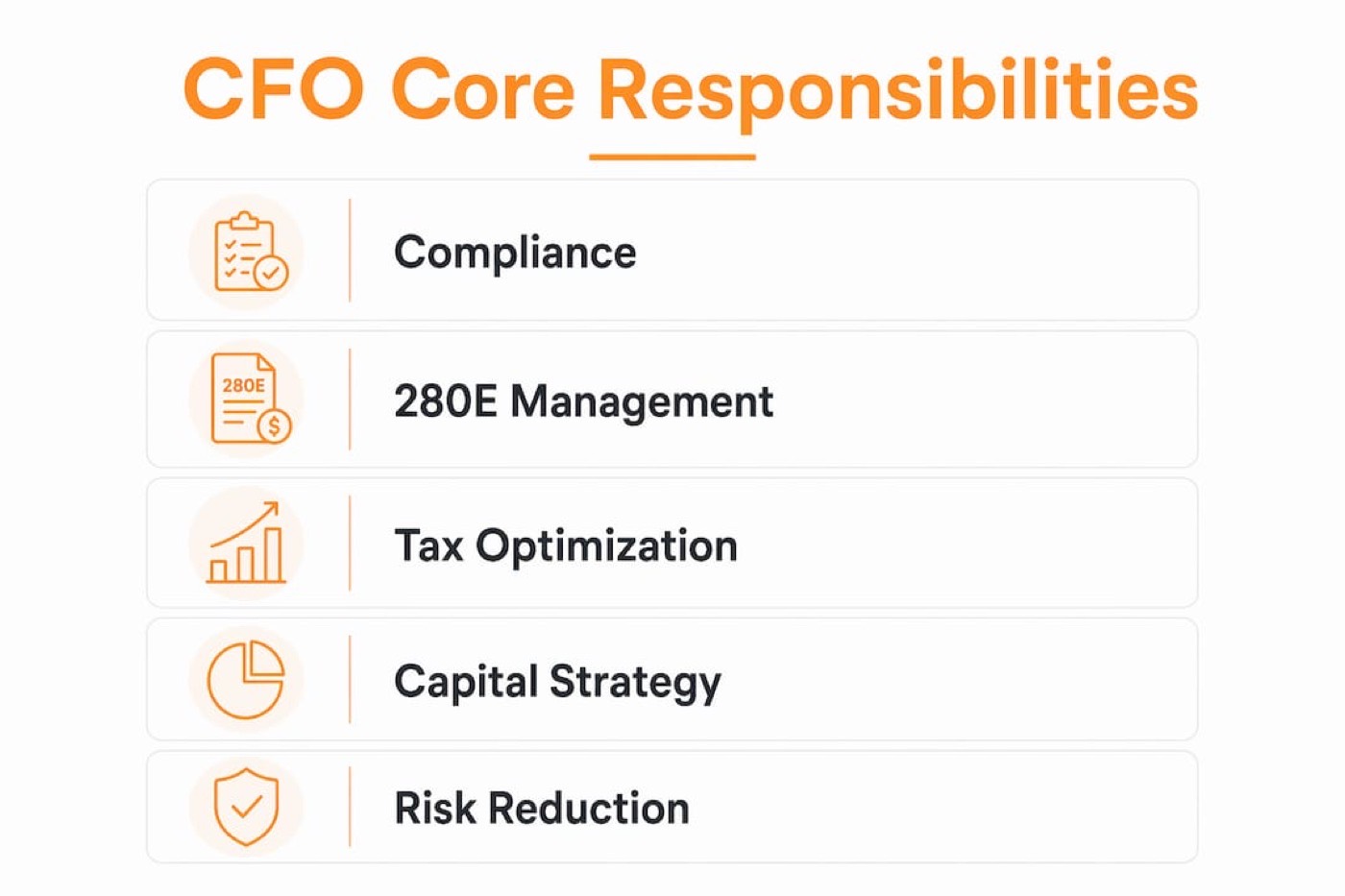
The CFO’s job is to build and defend the cost allocation methodology that maximizes COGS without triggering audit exposure. That requires cannabis-specific cost accounting knowledge, not general GAAP expertise.
Here are the core CFO responsibilities specific to cannabis operations:
- 280E tax strategy and COGS allocation — Designing and documenting cost allocation methods that withstand IRS scrutiny while reducing taxable income.
- Audit readiness — Maintaining documentation standards year-round so that a state or federal audit does not become a crisis. Audit readiness is a continuous process, not a pre-audit scramble.
- Banking and cash management — Cannabis businesses face restricted banking access. The CFO builds internal controls around cash handling, reconciliation, and limited depository relationships.
- State-specific financial reporting — Each state has its own seed-to-sale tracking, licensing, and financial reporting requirements. The CFO coordinates compliance across all active jurisdictions.
- Investor and lender relations — Cannabis CFOs serve as the company’s face to investors and banks, providing the credibility and financial discipline needed to access capital in a restricted environment.
“Without cannabis-specific expertise, tax compliance risks and penalties increase significantly.” — Northstar Financial Advisory
The specialized finance leadership a CFO provides directly reduces legal and financial risk through documented internal controls and audit-ready records.
Full-time vs. fractional CFO: which model fits?
This is where most operators get stuck. The full-time CFO is the obvious answer, but it is not always the right one.
| Factor | Full-Time CFO | Fractional CFO |
|---|---|---|
| Annual cost | $150,000+ plus benefits | Scalable, engagement-based |
| Availability | Dedicated, on-site | Part-time, project-based |
| Best for | Large multistate operators | Early growth, fundraising, transitions |
| Strategic depth | High | High (senior-level expertise) |
| Overhead commitment | Fixed | Variable |
Full-time CFO salaries often exceed $150,000 plus benefits. For most single-state operators or businesses in early growth stages, that overhead is not justified by the volume of strategic work available. Fractional CFOs deliver the same senior-level expertise at a cost structure that scales with your actual needs.
Fractional CFO engagements typically cover financial strategy, audit readiness, tax optimization, and capital access consulting. These are not watered-down services. The fractional model works because most growing cannabis businesses need CFO-level thinking for specific projects, not 40 hours per week of executive presence.
The most common misconception is that a strong controller can absorb CFO responsibilities. Controllers ensure historical financial integrity. CFOs focus outward on strategy, capital structure, and growth. These roles are complementary, not interchangeable. Collapsing them into one position creates blind spots in exactly the areas where cannabis businesses are most exposed.
Pro Tip: Fractional CFO engagements are particularly effective during fundraising rounds and license expansion phases. Bring one in before you need the capital, not after you’ve already started conversations with investors.
How to evaluate and prepare for cfo-level engagement
Before you get on a call with a prospective CFO, get your house in order. The quality of the engagement depends on what you bring to the table.
Most specialized CFO firms, including Green Bean CFO, offer free 30-minute strategy calls to assess compliance and audit readiness. Those calls are only useful if you arrive prepared. Clients should bring financial records, tax returns, and operational summaries to initial consultations.
Here is what to prepare before engaging any CFO-level resource:
- Last two to three years of federal and state tax returns
- Current chart of accounts and general ledger
- Existing cost allocation methodology (or documentation of the absence of one)
- Seed-to-sale reconciliation reports from your state tracking system
- Any prior audit findings or IRS correspondence
- Current banking relationships and cash management procedures
- A clear statement of your 3-year growth objectives
The second preparation issue is timing. Waiting until tax season to seek CFO guidance is a major cause of avoidable tax exposure. Financial management is a continuous need. A CFO engaged in January cannot retroactively fix the cost allocation decisions made in the prior fiscal year. The tax savings available under 280E require year-round positioning, not a last-minute review.
When evaluating prospective CFOs, cannabis-specific experience is non-negotiable. Ask directly about their 280E methodology, their experience with your state’s seed-to-sale system, and their track record with cannabis audits. A generalist with strong credentials is still a generalist. The cannabis accounting needs of your operation require someone who has already worked through the specific compliance challenges you face.
Also ask about business finance management triggers they have seen in comparable operations. A CFO who can articulate when other cannabis businesses needed to escalate financial oversight will give you a clearer picture of where you stand.
The timing problem most cannabis operators get wrong
Most cannabis operators I have seen engage CFO-level help too late. They hire a controller, the controller gets stretched into strategic work, and by the time the operator realizes the gap, they are already in a fundraising process or an audit with inadequate documentation.
The controller-CFO confusion is the most expensive mistake in cannabis finance. It is not that operators don’t value the CFO role. It is that they underestimate how different the work actually is. A controller who is excellent at closing the books is not automatically equipped to build a capital structure, defend a cost allocation methodology to the IRS, or present a 5-year financial model to a private equity group.
The fractional CFO model has changed the calculus here. You no longer need to justify a $150,000 salary to get senior strategic oversight. A fractional engagement lets you access that expertise at the exact moments you need it, which for most growing operators is during fundraising, expansion planning, and audit preparation.
The other timing issue is 280E. Every month you operate without a documented cost allocation methodology is a month of tax exposure you cannot recover. The $0.40–$0.50 savings per reclassified dollar is real, but only if the methodology is in place before the tax year closes. Proactive financial leadership under IRC Section 280E is not optional for a profitable cannabis business. It is the difference between a sustainable margin and a tax bill that erodes your operating capital.
Start the CFO conversation before you think you need it. By the time the need is obvious, the cost of not having acted sooner is already baked in.
— JN
How Cannabisbusinessminds supports your financial leadership needs
Cannabisbusinessminds provides cannabis finance professionals and operators with the technical resources to build CFO-ready financial operations. Whether you are preparing for a capital raise, working through a 280E cost allocation strategy, or building audit-ready records, the platform covers the financial mechanics your leadership team needs.
Start with the cannabis inventory costing guide to understand the cost accounting foundations that every cannabis CFO relies on. For broader financial strategy, the cost accounting cannabis guide covers the methodologies that drive tax optimization under 280E. Cannabisbusinessminds delivers executive-level financial knowledge without the overhead of a full-time engagement.
FAQ
What does a cannabis CFO do differently than a controller?
A controller maintains historical financial accuracy and closes the books. A CFO focuses on forward-looking strategy, capital structure, tax optimization, and investor relations. These roles address different facets of business finance and are not interchangeable.
When should a cannabis business hire a fractional CFO?
Fractional CFO engagement makes sense during capital raises, multistate expansion, fundraising rounds, or when building a multi-year financial plan. It delivers senior strategic expertise at a scalable cost without full-time salary overhead.
How does a CFO reduce cannabis tax liability under 280e?
A cannabis CFO designs and documents COGS allocation methodologies that maximize deductible costs under IRC Section 280E. Proper allocation can yield $0.40–$0.50 in tax savings per dollar reclassified, directly reducing federal tax exposure.
Is a financial advisor the same as a cannabis CFO?
No. A financial advisor typically manages investment portfolios or personal financial planning. A cannabis CFO manages enterprise-level tax strategy, compliance, capital structure, and financial reporting specific to cannabis regulatory requirements.
How do i prepare for an initial CFO strategy consultation?
Bring your last two to three years of tax returns, your current general ledger, any existing cost allocation documentation, seed-to-sale reconciliation reports, and a clear statement of your growth objectives. Arriving prepared makes the consultation immediately productive.
Recommended
- 7 Key Cannabis Accounting Trends for 2025 – Cannabis Business Minds
- Cannabis Financial Reporting Guide for Full Compliance Success – Cannabis Business Minds
- Master Cannabis Accounting Best Practices for 2025 Success – Cannabis Business Minds
- 7 Steps to an Effective Cannabis Business Checklist 2025 – Cannabis Business Minds
This article is general education, not tax, legal or accounting advice. Cannabis rules change quickly; confirm how they apply to you with a qualified cannabis CPA or attorney.