Financial Consolidation Workflow for Cannabis Entities

2026 update: what rescheduling changed for 280E (reviewed October 2026)
Effective April 22, 2026, a DOJ/DEA final order moved marijuana covered by a qualifying state medical license (and FDA-approved marijuana drugs) to Schedule III. Section 280E only applies to Schedule I and II substances, so state-licensed medical cannabis activity is generally no longer subject to 280E going forward. Adult-use cannabis remains in Schedule I and fully subject to 280E. The DEA proceeding to reschedule all marijuana was temporarily stayed in October 2026, and Treasury/IRS guidance on transition years and mixed medical/adult-use businesses is still pending.
Check where your business stands in about a minute.
A financial consolidation workflow for cannabis entities is the structured process of combining financial statements from multiple legal entities into a single, compliant, and audit-ready report that accounts for IRS Section 280E restrictions, METRC inventory data, and state-specific tax positions. This is not a month-end cleanup exercise. It is an operational discipline that determines whether your tax return is defensible and whether your auditors find what they expect. Multi-state cannabis operators spend between $50,000 and $150,000 annually on external audit and regulatory financial reporting. That number drops when your consolidation process is built correctly from the start.
What does a financial consolidation workflow for cannabis entities require?
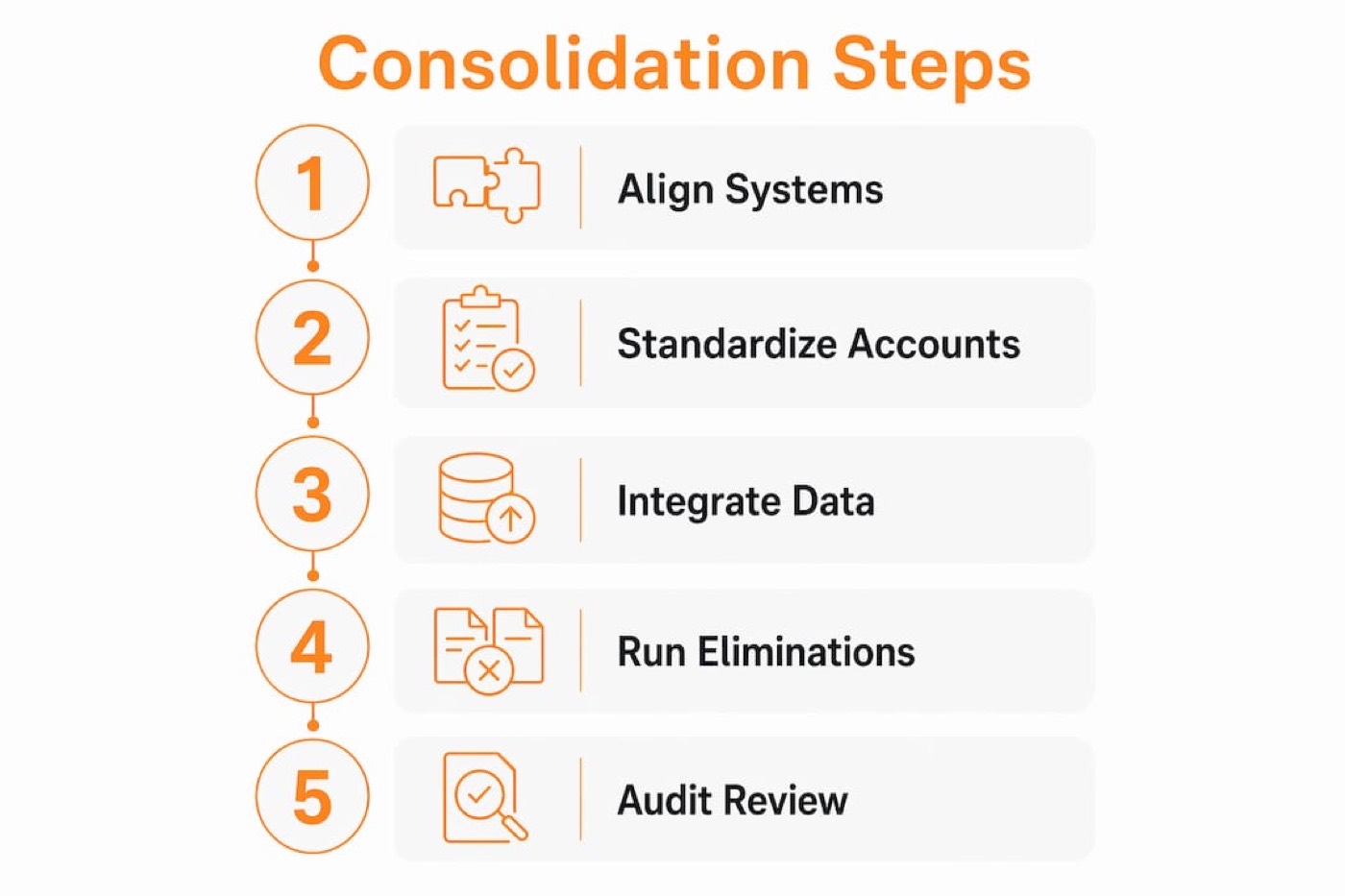
Before you run a single elimination entry, three foundational systems must be aligned: your point-of-sale platform, your seed-to-sale tracking system (METRC), and your general ledger. Poor system integration between POS and METRC feeding the general ledger is the leading cause of audit failures in cannabis operations. Manual month-end corrections cannot fix timing, unit, or cost basis discrepancies that originate at the integration layer.
Standardized chart of accounts across all entities
Every entity in your structure must use the same chart of accounts, mapped to the same department and class codes. A tax-aware chart of accounts with department and class tracking enables structured 280E compliance and eliminates year-end rebuilds. This means COGS, OPEX, and intercompany charges are separated at the transaction level, not reconstructed during close. Cannabisbusinessminds covers the design logic behind cannabis chart of accounts in detail if you need a reference framework.

Prerequisites checklist
Before executing consolidation, confirm the following are in place across all entities:
- Unified chart of accounts with 280E-compliant department and class coding
- Documented intercompany transaction policies with signed agreements between related entities
- Real-time or daily POS-to-METRC reconciliation feeds into the general ledger
- Defined intercompany transfer pricing policies aligned with economic reality
- Technology platform capable of multi-entity reporting with elimination automation (QuickBooks Enterprise, Sage Intacct, or a cannabis-specific ERP)
- DEA registration status confirmed, given the June 22, 2026 federal DEA registration deadline affecting 2026 tax positioning
System integration requirements by function
| Function | Required Integration | Output |
|---|---|---|
| POS (Dutchie, Flowhub, Treez) | METRC + GL sync | Daily sales and cash reconciliation |
| METRC | GL inventory module | Inventory valuation and variance reports |
| Payroll (Gusto, ADP) | GL department coding | 280E labor allocation by function |
| Intercompany billing | GL eliminations module | Documented intercompany charges |
| Banking | GL cash module | Vault-to-deposit reconciliation |
How to execute the consolidation process step by step
The consolidation process for cannabis entities follows a specific sequence. Skipping steps or reordering them creates compounding errors that surface at audit.
-
Collect trial balances from each entity. Pull unadjusted trial balances from every legal entity for the period. Confirm that each trial balance ties to the POS daily sales reports and METRC closing inventory for the same period.
-
Reconcile METRC inventory to the general ledger. Auditors expect a 0.5% variance threshold as the standard for METRC inventory reconciliation. Meeting that threshold requires weekly physical-to-digital reconciliations with documented escalation protocols. Any variance above that threshold must be investigated and documented before consolidation proceeds.
-
Identify and post intercompany transactions. Pull all intercompany invoices, management fees, and cost allocations. Confirm each has a corresponding entry on both sides of the transaction. Undocumented intercompany charges are a primary audit trigger.
-
Post 280E reclassifications. Reclassify expenses to COGS or OPEX based on your documented functional allocation methodology. 280E compliance depends on year-round documented financial controls, not tax-season adjustments. If your allocations are not tied to operational logs and payroll data, they will not hold under examination.
-
Eliminate intercompany balances and transactions. Remove all intercompany receivables, payables, revenues, and expenses. This step requires a complete intercompany matrix showing every entity-to-entity transaction for the period.
-
Prepare the consolidated trial balance. Combine the adjusted entity trial balances after eliminations. Tie the consolidated balance to your consolidating workpaper, which shows each entity column, the elimination column, and the consolidated total.
-
Run the closing checklist and review. Confirm that cash reconciles to bank statements, inventory reconciles to METRC, and all intercompany accounts net to zero. Quarterly retrieval drills that test document retrieval speed for tax-sensitive areas identify gaps before auditors do.
Pro Tip: Build your consolidating workpaper in a format that mirrors what an auditor would request. If you cannot produce a complete intercompany matrix and elimination schedule within 24 hours, your documentation is not audit-ready.
What are the most common challenges in cannabis entity consolidation?
Cannabis consolidation fails in predictable places. Knowing where the breaks occur lets you build controls before the problem surfaces.
Intercompany transfer pricing. Defensible transfer pricing policies must align with economic reality to withstand IRS and state scrutiny. A management fee charged from a holding company to an operating dispensary must reflect actual services rendered at arm’s length rates. Flat-fee arrangements with no supporting service documentation are the first thing an examiner questions.
Timing mismatches across systems and states. A sale recorded in the POS on the last day of the month may not post to METRC until the following day due to system sync delays. Across multiple states with different close dates, these timing gaps compound. The fix is a documented cutoff policy applied consistently across all entities, not a manual journal entry at month-end.
METRC-to-GL data integrity gaps. METRC adjustments, waste entries, and package transfers do not always carry a dollar value. Your GL team must translate every METRC adjustment into a corresponding cost entry. Gaps here produce inventory valuations that do not reconcile to physical counts, which is a direct audit exposure.
280E exposure from undocumented allocations. Year-end close reveals tax position weaknesses when 280E compliance depends on year-round documented financial controls. If your functional allocation percentages are not supported by time studies, job descriptions, and payroll records, the allocation is indefensible.
“Finance and compliance cross-functional evidence mapping links operational logs, payroll data, and accounting cutoffs precisely. Without it, your 280E defense is a number without a story.”
Variances exceeding auditor thresholds. Any METRC-to-GL variance above 0.5% requires a documented root cause analysis. Variances above that threshold that appear repeatedly signal a systemic integration problem, not a one-time error.
Which software tools work best for cannabis multi-entity consolidation?
No single platform handles every layer of cannabis consolidation perfectly. The decision comes down to your entity count, state footprint, and whether you need cannabis-specific compliance modules or are willing to build them in a general ERP.
| Platform | Cannabis-Specific | Multi-Entity Consolidation | METRC Integration | 280E Reporting |
|---|---|---|---|---|
| Sage Intacct | No | Native | Via connector | Manual setup |
| QuickBooks Enterprise | No | Limited | Via connector | Manual setup |
| Wurk | Yes | Limited | Native | Built-in |
| Flowhub (POS only) | Yes | No | Native | No |
| Canix | Yes | Limited | Native | Partial |
Cannabis-specific platforms like Wurk and Canix offer native METRC integration and built-in compliance modules, but their consolidation capabilities are limited for operators with more than three or four entities. Sage Intacct handles multi-entity consolidation natively and produces elimination schedules automatically, but METRC integration requires a third-party connector and 280E reporting requires custom configuration. For operators with five or more entities across multiple states, Sage Intacct with a configured cannabis chart of accounts is the most defensible choice.
Pro Tip: Before selecting a platform, map every data flow from POS to METRC to GL and identify where manual intervention currently occurs. The right platform eliminates those manual touchpoints. If a vendor cannot show you exactly how their system handles METRC adjustments in the GL, that is your answer.
Audit trail generation is non-negotiable. Every platform you evaluate must produce a complete, timestamped log of every journal entry, elimination, and adjustment. For cannabis financial reporting under examination, the audit trail is the evidence.
Why most cannabis consolidations break at the integration layer, not the close
The finance teams I have seen struggle with consolidation are not struggling because they do not know accounting. They struggle because they inherited a technology stack that was assembled reactively, one system at a time, with no design for multi-entity reporting. The POS was chosen for the dispensary floor. METRC was mandated by the state. The GL was whatever the bookkeeper already knew. Nobody mapped the data flows between them until the auditor asked a question nobody could answer.
The fix is not a better close process. It is a deliberate integration architecture built before the first transaction posts. Daily cash reconciliation that monitors POS-to-vault and vault-to-deposit flows prevents month-end surprises. That discipline, applied at the integration layer, is what separates operators who close in five days from those who close in three weeks.
The other thing I would push back on is the idea that 280E compliance is a tax problem. It is a finance controls problem. The allocation methodology has to be documented, repeatable, and tied to operational data every single month. If your finance team is rebuilding the allocation at year-end, you are not compliant. You are reconstructing. Those are not the same thing, and an examiner will know the difference.
Cross-functional collaboration between finance, compliance, and operations is not a soft skill recommendation. It is a structural requirement. The people who know why a METRC adjustment was made are not in accounting. Build the process so that information flows to the GL automatically, or build a protocol that captures it within 24 hours of the adjustment.
— JN
How Cannabisbusinessminds supports your consolidation workflow
Cannabisbusinessminds is built for finance professionals who need cannabis-specific depth, not general accounting theory applied loosely to a regulated industry.

The cannabis inventory costing resource covers the costing methods that feed directly into your consolidation workflow, including how inventory valuation choices affect your 280E position. The cost accounting guide walks through the full cost accounting framework that supports multi-entity reporting and tax compliance. For teams building or rebuilding their accounting function, the cannabis accounting category covers the full range of workflows, from chart of accounts design to consolidated reporting. These resources are written for practitioners, not generalists.
FAQ
What is a financial consolidation workflow for cannabis entities?
A financial consolidation workflow for cannabis entities is the repeatable process of combining individual entity trial balances, eliminating intercompany transactions, and producing a single compliant financial statement that reflects 280E allocations and METRC inventory data accurately.
How does IRS Section 280E affect the consolidation process?
Section 280E disallows deductions for ordinary business expenses in cannabis operations, requiring that every expense be classified as COGS or non-deductible OPEX before consolidation. This classification must be documented and tied to operational data year-round, not reconstructed at close.
What variance threshold should METRC reconciliations meet?
Auditors expect a 0.5% variance threshold for METRC inventory reconciliation. Variances above that level require documented root cause analysis and escalation protocols.
Which software handles multi-entity cannabis consolidation best?
Sage Intacct handles native multi-entity consolidation with elimination schedules, but requires custom configuration for 280E reporting and a third-party connector for METRC. Cannabis-specific platforms like Wurk offer native METRC integration but have limited consolidation depth for larger multi-entity structures.
How often should intercompany transactions be reconciled?
Intercompany transactions should be reconciled monthly at minimum, with documented policies governing transfer pricing and service agreements. For multi-state cannabis compliance, intercompany policies must also account for state-specific nexus and allocation rules.
Recommended
- What is financial consolidation in cannabis: a complete guide – Cannabis Business Minds
- Why Consider Consolidated Returns for Cannabis Groups – Cannabis Business Minds
- Master the Cannabis Banking Workflow for Compliance Success – Cannabis Business Minds
- Cannabis Financial Reporting Guide for Full Compliance Success – Cannabis Business Minds
This article is general education, not tax, legal or accounting advice. Cannabis rules change quickly; confirm how they apply to you with a qualified cannabis CPA or attorney.