Why Choose Accrual Method for Cannabis Businesses

2026 update: what rescheduling changed for 280E (reviewed October 2026)
Effective April 22, 2026, a DOJ/DEA final order moved marijuana covered by a qualifying state medical license (and FDA-approved marijuana drugs) to Schedule III. Section 280E only applies to Schedule I and II substances, so state-licensed medical cannabis activity is generally no longer subject to 280E going forward. Adult-use cannabis remains in Schedule I and fully subject to 280E. The DEA proceeding to reschedule all marijuana was temporarily stayed in October 2026, and Treasury/IRS guidance on transition years and mixed medical/adult-use businesses is still pending.
Check where your business stands in about a minute.
Accrual accounting is the recognized standard for cannabis businesses because it records revenues and expenses when earned or incurred, not when cash changes hands, aligning directly with GAAP, IRC §471, and the IRS requirements that govern how cannabis operators calculate deductible Cost of Goods Sold. Under IRC §280E, most ordinary business deductions are disallowed for cannabis companies. That makes COGS the primary tax lever available, and COGS is only defensible when built on accrual-based inventory accounting. IRS Chief Counsel memo CCA 201504011 confirms this framework. Cash accounting does not produce the cost documentation that survives IRS scrutiny in this industry.
Why choose accrual method for cannabis financial reporting and compliance?
Accrual accounting aligns with GAAP’s matching principle, which requires revenues and expenses to be recognized in the same period. For cannabis operators, this is not optional. Any business seeking investor capital, bank financing, or a state license audit must present GAAP-compliant financial statements that reflect actual operational performance, not cash timing.
Under ASC 330, inventory measurement for cannabis requires the lower of cost or net realizable value, using a consistent cost flow method such as FIFO or weighted average. That cost basis must include direct materials, direct labor, and allocated overhead. Grow facility rent, drying costs, trimming labor, and utilities tied to production all belong in inventory, not on the income statement as period expenses.

Operators who expense overhead as incurred are making a GAAP error. That error understates inventory, overstates expenses, and compresses gross margin on paper. It also creates a mismatch between what the financial statements show and what the seed-to-sale system records, which is exactly the kind of discrepancy that triggers an audit finding.
Accrual-based financials give investors and regulators a balance sheet with accounts receivable, accounts payable, and work-in-process inventory. These accounts reflect the real economic position of the business. Cash basis statements cannot produce this picture, and that gap matters when you are trying to close a financing round or respond to a state regulator’s request for audited financials.
Pro Tip: Build your chart of accounts to separate production overhead from selling, general, and administrative costs from day one. Retroactive reclassification is possible but reduces audit credibility and complicates any IRS method change filing.
How does accrual accounting optimize cannabis tax reporting under IRC §280E?
IRC §280E disallows deductions for ordinary and necessary business expenses when a business traffics in Schedule I or II controlled substances. Cannabis sits squarely in that category at the federal level. The only deduction that survives is COGS, calculated under IRC §471 inventory rules. Accrual accounting is the mechanism that makes a defensible COGS calculation possible.
Here is what that means operationally:
- Direct costs such as seeds, clones, nutrients, and direct cultivation labor are capitalized into inventory as incurred.
- Indirect production costs such as grow facility depreciation, utilities, and production supervisors’ wages are allocated to inventory using a consistent method, typically square footage or direct labor hours.
- Non-production costs such as retail staff wages, marketing, and administrative salaries are classified as 280E-disallowed expenses and kept entirely separate.
- Allocation documentation must tie each cost category to a specific method, applied consistently across periods, with supporting records that survive IRS examination.
The IRS rejects attempts to use IRC §263A uniform capitalization rules to pull otherwise-disallowed costs into inventory. §263A flush language explicitly prevents this. Operators who try to capitalize selling or administrative costs through §263A mechanics are creating a major audit exposure, not a tax strategy.
Changing your accounting method after the fact requires IRS consent under IRC §446(e). A method change under §481(a) produces a one-time income adjustment that can be spread over four years or recognized immediately, depending on whether the change is favorable or unfavorable. The procedural requirements under Revenue Procedure 2011-13 are specific. Getting this wrong is expensive.
Pro Tip: Document your cost allocation methodology in a written accounting policy before your first tax year. Consistent, documented methods are far easier to defend than methods reconstructed after an IRS notice.
Accrual vs. cash accounting for cannabis: which method fits your business?
Cash accounting recognizes income when received and expenses when paid. For most small businesses, that simplicity is a feature. For cannabis operators, it is a liability. Cash basis accounting creates profit volatility tied to payment timing rather than operational performance, which distorts the metrics investors and lenders use to evaluate a business.
The table below shows where the two methods diverge for cannabis-specific scenarios.
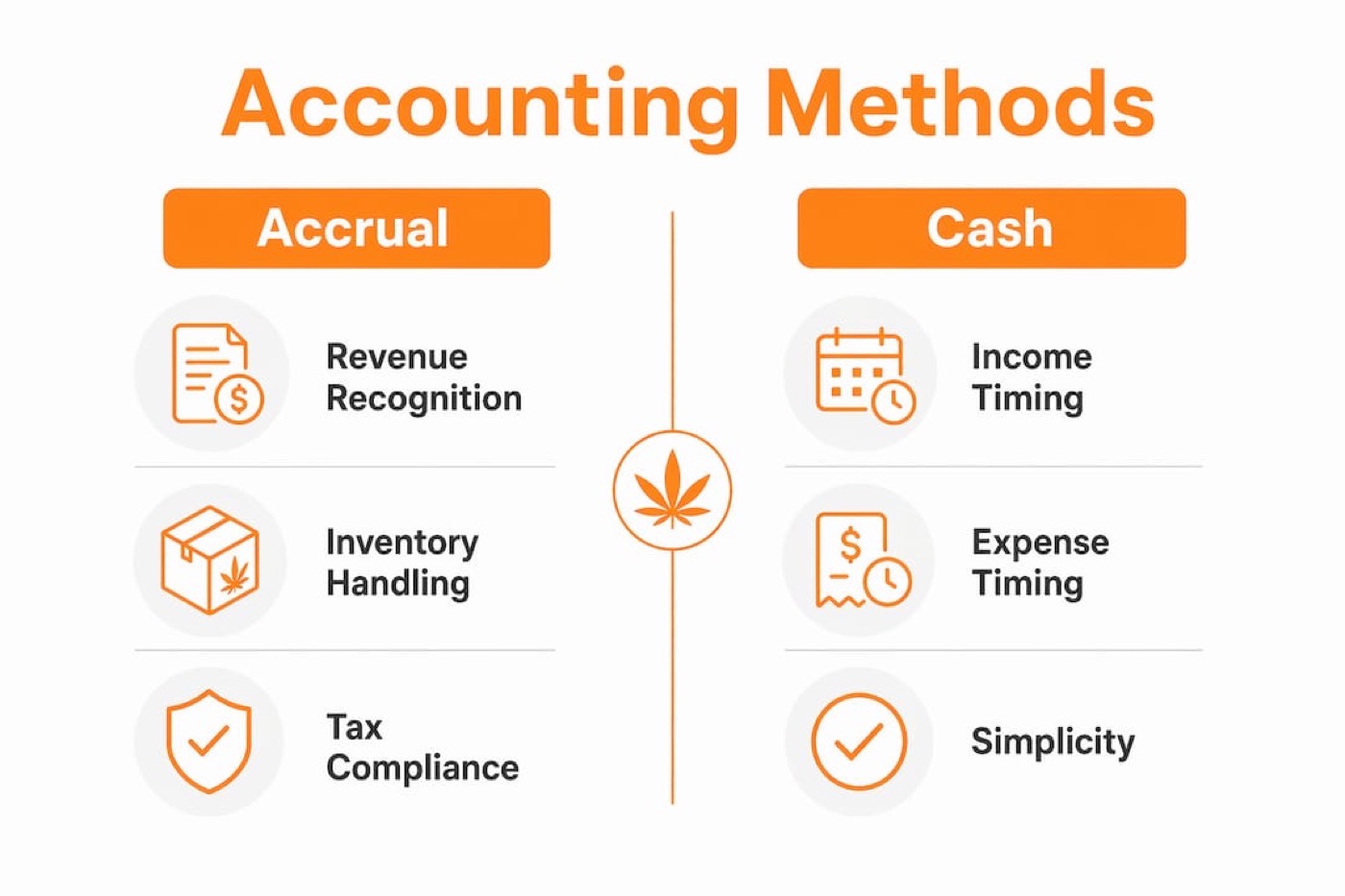
| Factor | Accrual method | Cash method |
|---|---|---|
| Revenue recognition | When sale is earned | When cash is received |
| Inventory valuation | Capitalized at cost (ASC 330) | Not tracked on balance sheet |
| COGS defensibility | Full IRC §471 compliance | Limited; hard to defend under IRS scrutiny |
| 280E optimization | Maximizes deductible COGS | Understates COGS; higher tax exposure |
| Investor/lender readiness | GAAP-compliant balance sheet | Not suitable for institutional financing |
| Audit risk | Lower with proper documentation | Higher; limited cost basis support |
| Required for large operators | Yes, by IRS threshold rules | Only for very small operators |
IRS rules require accrual accounting for businesses that carry inventory and exceed gross receipts thresholds. Most cannabis cultivators, manufacturers, and multi-location dispensaries exceed those thresholds. The choice between accrual and cash is often not a choice at all.
Accrual accounting also supports richer balance sheet accounts: accounts receivable, accounts payable, accrued liabilities, and WIP inventory. These accounts are prerequisites for multi-state cannabis operations managing intercompany transactions, licensing agreements, and management fee structures across entities.
Cash accounting may work for a single-location microbusiness with minimal inventory and no outside investors. For any operator with cultivation, manufacturing, or multi-site retail, accrual is the only method that produces financials worth relying on.
How cannabis producers implement accrual accounting operationally
Getting accrual accounting right in a cannabis operation requires more than a software setting. It requires operational discipline at every stage of the production cycle. These are the steps that matter:
-
Set up WIP inventory tracking from the first plant. Cultivation costs accumulate as work-in-process until harvest. At harvest, those costs transfer to finished goods or raw material inventory. Tracking by stage and batch is the only way to support inventory valuation under GAAP and IRC §471.
-
Build overhead allocation into the chart of accounts before operations begin. Assign each overhead cost center to either production or non-production. Overhead must be correctly allocated from the start. Retrospective changes reduce audit credibility and complicate IRS method change filings.
-
Integrate your accounting system with your seed-to-sale platform. Systems like Metrc generate batch-level production data. That data must reconcile with your general ledger. Discrepancies between Metrc records and your inventory accounts are a primary IRS audit trigger.
-
Maintain detailed timekeeping records. Labor is one of the largest cost inputs in cannabis production. IRS auditors focus on documentation linking costs to production. Time logs that separate cultivation labor from retail or administrative labor are not optional. They are the foundation of your COGS defense.
-
Reconcile inventory accounts monthly. Small operators who undercapitalize cultivation costs overstate expenses and understate inventory, which damages EBITDA multiples and reduces loan collateral value. Monthly reconciliation catches these errors before they compound across quarters.
The operational reality is that cannabis GAAP inventory challenges apply standard manufacturing accounting in a heavily regulated environment. The accounting is not exotic. The regulatory overlay is. Finance professionals who treat cannabis inventory costing like any other manufacturing operation, with full documentation and consistent methods, will be in a defensible position.
Accrual accounting in cannabis: what the numbers actually tell you
Accrual is non-negotiable for any cannabis operator serious about compliance and investor readiness. That is not a position I hold lightly. It comes from watching operators try to reconstruct cost bases after receiving IRS notices, and from seeing what happens to a business’s perceived value when its financials cannot support a quality of earnings review.
The place most operators fall short is not the accounting method itself. It is cost allocation and documentation. Choosing accrual without building the operational infrastructure to support it produces financials that look compliant but do not hold up under examination. The chart of accounts, the overhead allocation policy, the timekeeping system, and the seed-to-sale reconciliation process all have to work together.
Retrofitting accrual after years of cash basis accounting is painful. The §481(a) adjustment can produce a significant taxable income spike in the year of change. Operators who switch under audit pressure have almost no leverage in that negotiation. The time to get this right is before the first tax return is filed, not after the IRS opens an examination.
Proper inventory costing also affects business value directly. A cannabis company with a defensible COGS bridge, clean WIP tracking, and consistent overhead allocation will command a higher EBITDA multiple in an acquisition than one with reconstructed records and inconsistent methods. Buyers and their accountants know the difference immediately.
One more thing: accrual accounting is not a tax loophole. It is the method that lets you claim what you are legally entitled to claim under §471, nothing more. Operators who treat it as a mechanism to manufacture deductions will find the IRS disagrees, and the cannabis cost allocation guide at Cannabisbusinessminds makes that boundary very clear.
— JN
Deepen your cannabis accounting knowledge with Cannabisbusinessminds
Cannabis finance professionals need more than a general understanding of accrual accounting. They need the specific frameworks that hold up under IRS examination and GAAP audit.

Cannabisbusinessminds publishes detailed, practitioner-level resources built for this industry. The cannabis inventory costing guide covers WIP tracking, overhead allocation, and COGS bridge construction with the specificity that federal tax compliance requires. For operators building or rebuilding their accounting infrastructure, the cost accounting cannabis guide provides a complete framework for cost accumulation, period allocation, and audit-ready documentation. These are not introductory overviews. They are working references for finance professionals who need to get this right.
FAQ
Why is accrual accounting required for cannabis businesses?
Most cannabis operators carry inventory and exceed IRS gross receipts thresholds that mandate accrual accounting. Accrual is also required to produce GAAP-compliant financial statements and to calculate a defensible COGS under IRC §471.
How does accrual accounting reduce tax liability under 280E?
Accrual accounting enables cannabis businesses to capitalize direct and allocated indirect production costs into inventory, maximizing deductible COGS under IRC §471. IRC §280E disallows all other ordinary deductions, making a well-documented COGS the primary tax reduction tool available.
Can a cannabis dispensary use cash basis accounting?
A very small single-location dispensary with minimal inventory may technically qualify for cash basis, but the method produces limited COGS documentation and higher tax exposure under 280E. Most dispensaries benefit from accrual accounting for both tax and financial reporting purposes.
What happens if a cannabis business switches from cash to accrual?
Switching requires IRS consent under IRC §446(e) and a §481(a) adjustment to prevent income distortion. The adjustment can create a one-time taxable income increase, and the process is governed by Revenue Procedure 2011-13. Operators should complete this change before an audit, not during one.
What are the most common accrual accounting errors in cannabis operations?
The most frequent errors are expensing production overhead as a period cost instead of capitalizing it into inventory, failing to track WIP by batch and stage, and using inconsistent overhead allocation methods across periods. Each of these errors creates both GAAP misstatements and IRS audit exposure.
Recommended
- The Essential Guide to Accrual Accounting Cannabis – Cannabis Business Minds
- Cannabis Accounting – Cannabis Business Minds
- What Is Cannabis Revenue Recognition? Complete Guide – Cannabis Business Minds
- Cannabis GAAP Overview: Complete Guide for U.S. Businesses – Cannabis Business Minds
This article is general education, not tax, legal or accounting advice. Cannabis rules change quickly; confirm how they apply to you with a qualified cannabis CPA or attorney.