Why Calculate COGS in Cannabis: Tax and Profit Guide
2026 update: what rescheduling changed for 280E (reviewed October 2026)
Effective April 22, 2026, a DOJ/DEA final order moved marijuana covered by a qualifying state medical license (and FDA-approved marijuana drugs) to Schedule III. Section 280E only applies to Schedule I and II substances, so state-licensed medical cannabis activity is generally no longer subject to 280E going forward. Adult-use cannabis remains in Schedule I and fully subject to 280E. The DEA proceeding to reschedule all marijuana was temporarily stayed in October 2026, and Treasury/IRS guidance on transition years and mixed medical/adult-use businesses is still pending.
Check where your business stands in about a minute.
Cannabis cost of goods sold (COGS) is defined as the sum of direct production costs and allocable indirect costs capitalized under IRC Section 471, and it is the only mechanism available under IRS Section 280E to reduce federal taxable income for cannabis businesses. Every dollar correctly classified into COGS is a dollar excluded from gross income. That distinction is not academic. At a 35% federal rate, a midsize cultivator that reallocates $400,000 to $800,000 in indirect costs to COGS saves $140,000 to $280,000 annually. Understanding why you calculate COGS in cannabis starts there.
Why calculate COGS in cannabis: the 280E foundation
Section 280E of the Internal Revenue Code prohibits cannabis businesses from deducting ordinary and necessary business expenses because cannabis remains a Schedule I controlled substance under federal law. Rent, salaries, marketing, and professional fees are all disallowed as deductions. The one exception is COGS, which functions as an adjustment to gross income rather than a deduction.
“The key 280E compliance game is identifying which costs legitimately belong in COGS under IRC 471 and supporting them with rigorous data and documentation.” — Northstar Financial Advisory
This is why the importance of COGS in cannabis is categorically different from any other industry. In a standard business, COGS is one line item among many. In cannabis, it is the only line item that moves the needle on federal tax liability. The Tax Court ruling in Californians Helping to Alleviate Medical Problems (CHAMP) confirmed that cannabis businesses operating multiple trade activities can allocate costs between the cannabis and non-cannabis activities, but the COGS argument under 471 remains the primary lever for single-activity operators.
IRC Section 471 governs inventory accounting and requires cannabis businesses to capitalize both direct and allocable indirect costs into inventory. This is not optional. Operators who treat production overhead as period expenses rather than inventory costs are understating COGS and overpaying federal taxes. The IRS does not correct that error in your favor.

What costs belong in cannabis COGS?
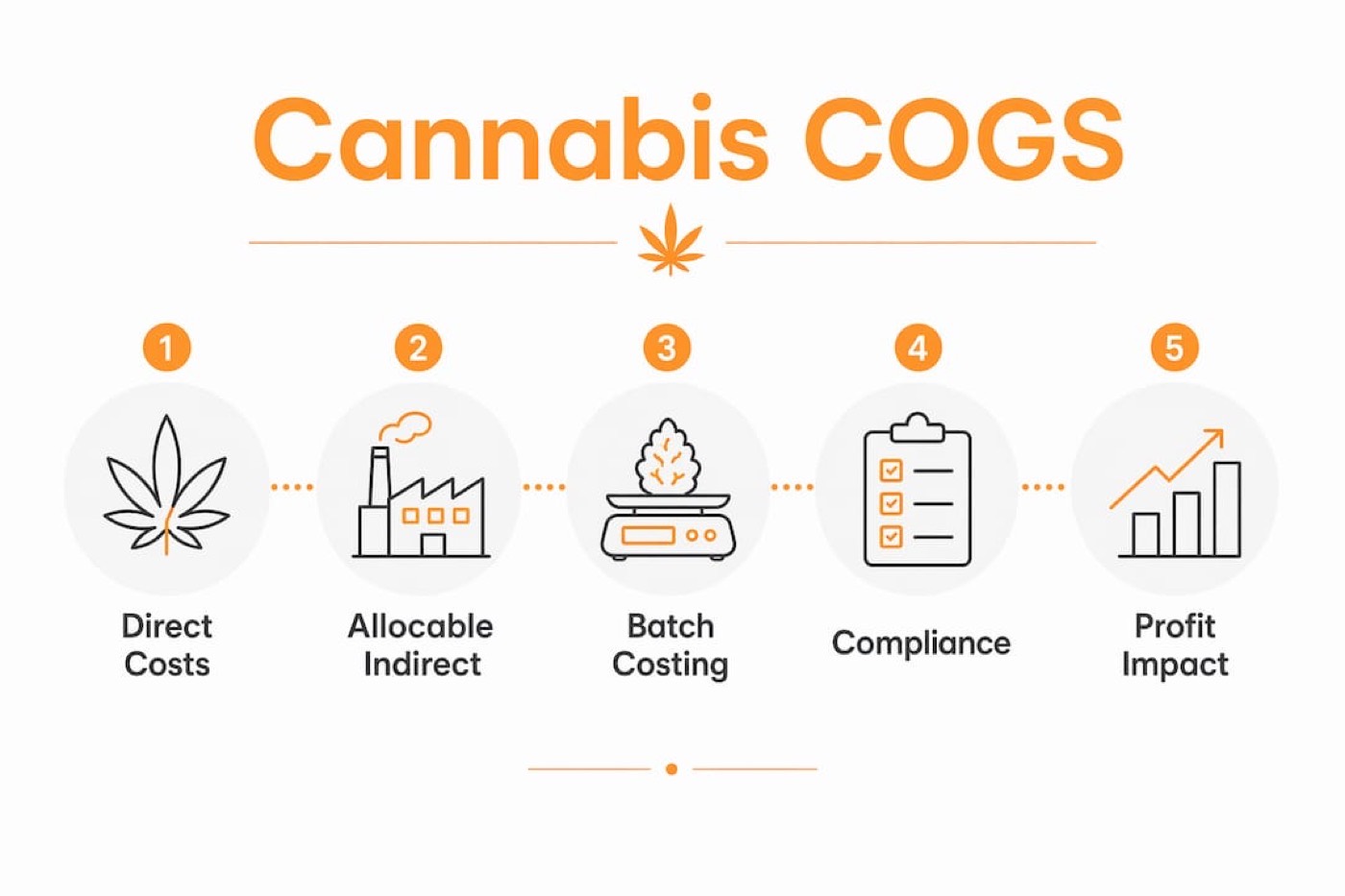
The cost categories eligible for inclusion in cannabis COGS fall into two groups: direct costs and allocable indirect costs. Getting this classification right is where most operators either capture significant tax savings or leave money on the table.
Direct costs include:
- Seeds and clones
- Nutrients, growing media, and pesticides
- Direct labor tied to cultivation, trimming, extraction, and packaging for production (not retail)
- Packaging materials used in production, not point-of-sale packaging
- Testing fees required before product enters inventory
Allocable indirect costs include:
- Production facility rent and occupancy costs
- Electricity, water, and HVAC for grow and processing areas
- Equipment depreciation on cultivation and extraction assets
- Indirect labor: supervisors, quality control, maintenance staff supporting production
- Insurance on production facilities and equipment
The allocation methodology matters as much as the cost category. Square footage ratios work for rent and occupancy when production and non-production spaces are clearly separated. Time and activity studies support labor allocations. Sub-metering utility consumption for production areas is the industry standard for electricity and water. Without sub-meters, operators rely on engineering estimates, which IRS auditors regularly contest.
Pro Tip: Document your allocation methodology in writing before the tax year begins, not after. Retroactive methodology construction is one of the first things an IRS auditor will challenge. Consistency across periods is as important as the methodology itself.
The grey area sits with costs that have dual-use characteristics. A warehouse manager who splits time between production oversight and administrative functions requires a time study to support the production allocation. A utility bill covering both a retail dispensary and a back-of-house processing area requires either sub-metering or a defensible square footage split. The IRS does not accept rough estimates without supporting documentation.
How does batch-level costing affect COGS accuracy?
Accurate batch-level yield tracking is the operational core of cannabis COGS. Without it, per-unit costs are wrong, taxable income is overstated, and pricing decisions are made on bad data.
The conversion factors that matter most in cultivation and extraction are:
- Wet weight to dry weight: Harvested cannabis loses 75% to 80% of its weight during drying and curing. Costs allocated to a wet-weight batch must be converted to reflect the actual dry-weight yield.
- Trim to crude extract: Trim runs through extraction at varying efficiency rates depending on solvent, equipment, and input quality. Each batch has a distinct yield percentage.
- Crude to finished product: Distillation and formulation introduce additional yield losses. Per-unit cost at the finished SKU level requires tracing costs through each conversion stage.
Neglecting these factors produces material misstatements. Misstatements of $100 per pound are common in operations without documented batch costing, and for a midsize cultivator producing thousands of pounds annually, that compounds into hundreds of thousands of dollars in excess federal tax liability.
| Conversion Stage | Typical Yield Loss | Cost Impact if Ignored |
|---|---|---|
| Wet to dry weight | 75–80% weight reduction | Per-pound cost understated by 4x to 5x |
| Trim to crude extract | 10–20% yield | Extraction cost per gram overstated |
| Crude to distillate | 60–80% yield | Finished product cost per unit understated |
Work-in-process (WIP) inventory adds another layer. Under ASC 905, live cannabis plants are biological assets that must be valued as WIP using percentage-completion accounting throughout the grow cycle. At week six of a ten-week cycle, 60% of costs are deployed and must be capitalized. Operators who record zero inventory value for live plants until harvest are misrepresenting their balance sheet and understating COGS for the period.
Seed-to-sale platforms like Metrc track weights and transfers for regulatory compliance. They do not calculate labor absorption or overhead allocation. Reconciling seed-to-sale data into your accounting system is a required step, not an optional one.
What are the biggest COGS pitfalls cannabis operators face?
Most cannabis COGS audit failures stem from immature systems and missing documentation, not aggressive accounting positions. That is a critical distinction. Operators are not typically taking positions that are wrong in theory. They are failing to substantiate positions that are correct.
The four pillars of a defensible COGS system are substantiation, consistency, traceability, and operational alignment. Each one has a specific failure mode:
- Substantiation failures: No time studies for labor allocations, no sub-meters for utilities, no written methodology for overhead splits. The IRS disallows the allocation entirely.
- Consistency failures: Allocation percentages that shift between periods without documented justification. Auditors treat unexplained changes as manipulation.
- Traceability failures: COGS figures that cannot be reconciled back to source documents, batch records, or payroll data. This is where spreadsheet-dependent operations collapse under audit.
- Operational alignment failures: Finance teams building COGS models without input from cultivation or operations managers. The numbers do not match what actually happened in the facility.
Pro Tip: Treat your chart of accounts as a compliance document. A separate chart of accounts with distinct categories for deductible COGS, non-deductible 280E expenses, and non-cannabis costs is the structural foundation of audit readiness. Mixing these categories in a generic QuickBooks setup creates problems that are expensive to unwind under examination.
IRS audit techniques have evolved. Digital payroll, banking, and seed-to-sale data are now standard inputs in cannabis examinations. Auditors cross-reference payroll records against labor allocations, bank statements against vendor invoices, and Metrc transfer records against inventory valuations. Back-of-envelope estimates do not survive that level of scrutiny.
Professional cost studies costing $15,000 to $30,000 routinely generate 5x to 18x ROI through reduced tax liability. That math is straightforward for any operator carrying significant indirect production costs. The cost of not having a defensible methodology is measured in tax overpayments and audit exposure, not just professional fees.
The COGS system is the business system
The operators who treat calculating COGS in cannabis as a once-a-year tax exercise are the ones who get surprised at examination. I have seen well-run cultivation operations with strong compliance programs fail COGS audits because their finance team built the allocation model in isolation from operations. The grow manager did not know what a time study was. The accountant had never walked the facility. The numbers were directionally reasonable but could not be defended at the transaction level.
The IRS is not getting less sophisticated. Digital examination tools mean auditors can now pull payroll records, Metrc data, and bank statements simultaneously and look for inconsistencies across all three. The days of a rough overhead allocation surviving a desk audit are over. What survives is a system: documented methodologies, consistent application, reconciliation to source data, and a chart of accounts that tells the compliance story before an auditor asks a single question.
The operators who build that system early spend less on professional fees, pay less in taxes, and make better pricing decisions. The ones who build it reactively, after an audit notice, spend multiples of what proactive compliance would have cost. There is no version of this where the back-of-envelope approach wins.
The cannabis COGS question is not whether to calculate it carefully. It is whether you build the system before or after the IRS asks you to explain it.
— JN
Build a defensible COGS system with Cannabis Business Minds

Cannabisbusinessminds provides finance professionals and cannabis operators with the technical depth needed to build COGS systems that hold up under IRS examination. The platform covers IRC 471 cost capitalization frameworks, indirect cost allocation methodologies, and batch-level costing structures specific to cultivation, extraction, and dispensary operations. If you are building or auditing a cannabis COGS model, the cannabis inventory costing guide is the starting point. For operators who need the full accounting framework, the cost accounting industry guide covers allocation methods, chart of accounts design, and audit preparation in detail.
FAQ
What is cannabis COGS under Section 280E?
Cannabis COGS is the sum of direct production costs and allocable indirect costs capitalized under IRC Section 471. Under Section 280E, it is the only mechanism available to reduce federal taxable income because ordinary business deductions are disallowed for cannabis businesses.
What indirect costs can cannabis businesses include in COGS?
Allocable indirect costs include production facility rent, electricity and HVAC for grow areas, equipment depreciation, and indirect labor supporting production. Each cost requires a documented allocation methodology such as square footage ratios, time studies, or sub-metered utility data.
Why does batch-level costing matter for cannabis COGS?
Without documented conversion factors for wet-to-dry weight, trim-to-crude, and crude-to-finished product, per-unit costs are inaccurate. Misstatements of $100 per pound are common in operations without batch costing, which translates to significant excess federal tax liability for midsize cultivators.
How do seed-to-sale platforms affect COGS calculations?
Platforms like Metrc track weights and transfers for regulatory compliance but do not calculate labor absorption or overhead allocation. Operators must reconcile seed-to-sale data into their accounting system separately to produce accurate COGS figures.
What does a defensible cannabis COGS system require?
A defensible system requires substantiation through time studies and sub-meters, consistency across periods, traceability to source documents, and operational alignment between finance and production teams. A separate chart of accounts distinguishing COGS, non-deductible expenses, and non-cannabis costs is the structural foundation.
Recommended
- Cannabis COGS explained: your essential compliance guide – Cannabis Business Minds
- Understanding the 280E Deductible COGS Factsheet: Key Insights for Cannabis Businesses
- 7 Key Eligible Business Expenses for Cannabis Companies – Cannabis Business Minds
- How to classify cannabis expenses for tax compliance – Cannabis Business Minds
This article is general education, not tax, legal or accounting advice. Cannabis rules change quickly; confirm how they apply to you with a qualified cannabis CPA or attorney.