Why Cannabis Businesses Need Forecasting for Compliance

2026 update: what rescheduling changed for 280E (reviewed October 2026)
Effective April 22, 2026, a DOJ/DEA final order moved marijuana covered by a qualifying state medical license (and FDA-approved marijuana drugs) to Schedule III. Section 280E only applies to Schedule I and II substances, so state-licensed medical cannabis activity is generally no longer subject to 280E going forward. Adult-use cannabis remains in Schedule I and fully subject to 280E. The DEA proceeding to reschedule all marijuana was temporarily stayed in October 2026, and Treasury/IRS guidance on transition years and mixed medical/adult-use businesses is still pending.
This article was written before the order took effect. Check where your business stands in about a minute.
Most American cannabis dispensary managers face higher financial risks than those in traditional retail, mainly due to strict IRS rules and tax codes like Section 280E. Accurate forecasting is not just about predicting sales; it is about staying ahead of complex regulations that can quickly impact profitability. This overview breaks down why advanced forecasting methods are essential for compliance and highlights how data-driven planning can safeguard your dispensary from costly mistakes.
Key Takeaways
| Point | Details |
|---|---|
| Complexity of Forecasting | Cannabis businesses face unique challenges that require integrating regulatory constraints and market dynamics into forecasting practices. |
| Hybrid Forecasting Strategies | Successful dispensary management benefits from combining both qualitative insights and quantitative data analysis for better sales predictions. |
| Impact of Section 280E | Understanding tax implications under Section 280E is crucial for effective financial planning and compliance in the cannabis sector. |
| Risks of Inaccurate Forecasting | Poor forecasting can lead to inventory mismanagement and financial instability, emphasizing the need for adaptive models and regular reviews. |
Forecasting for Cannabis Businesses Explained
Forecasting in the cannabis industry represents a complex strategic process that goes far beyond simple financial projections. It involves predicting business performance while navigating stringent regulatory requirements unique to this highly regulated sector. Cannabis financial planning efforts must account for dynamic market conditions, evolving legal landscapes, and precise compliance demands.
Unique challenges distinguish cannabis forecasting from traditional business financial modeling. Companies must integrate multiple variables including production capabilities, regulatory constraints, and consumption trends. Controlled environment research demonstrates how sophisticated modeling can predict growth rates, energy usage, and potential yield outcomes under varying environmental conditions. These predictive techniques help cannabis businesses optimize operational strategies while maintaining strict adherence to state and federal guidelines.
Successful cannabis business forecasting requires a multifaceted approach that combines quantitative data analysis with deep regulatory understanding. Financial managers must track consumer behavior shifts, policy changes, and market demand indicators. The Carnegie Mellon University study highlights how consumption trends directly impact business planning, revealing that daily cannabis use now exceeds similar alcohol consumption metrics – a critical insight for strategic forecasting.
Pro tip: Develop a dynamic forecasting model that updates quarterly to reflect the rapidly changing cannabis regulatory and market landscape.
Types of Forecasting for Cannabis Dispensaries
Cannabis dispensaries utilize multiple forecasting approaches to navigate the complex and dynamic market landscape. Demand forecasting methods are primarily categorized into two fundamental types: qualitative and quantitative approaches, each serving distinct strategic purposes in business planning and risk management. These methodologies help dispensary managers predict sales trends, optimize inventory, and make data-driven operational decisions.
Qualitative forecasting relies on expert insights, market knowledge, and subjective assessments when historical data might be limited. This approach involves gathering intelligence from industry professionals, analyzing market trends, and incorporating nuanced understanding of local regulatory environments. Financial managers can leverage qualitative techniques to supplement quantitative models, providing context and depth to numerical projections.
Cannabis production research reveals that quantitative forecasting represents a more statistically rigorous approach. These methods employ advanced statistical models, machine learning algorithms, and comprehensive data analysis to predict future sales, consumption patterns, and inventory requirements. Sophisticated quantitative models can integrate multiple variables such as seasonal demand fluctuations, consumer behavior trends, and regulatory changes to generate precise financial projections for cannabis dispensaries.
Pro tip: Implement a hybrid forecasting strategy that combines both qualitative and quantitative methods to create more robust and accurate business predictions.
Here’s a comparison of qualitative and quantitative forecasting approaches used by cannabis dispensaries:
| Method Type | Data Sources | Strengths | Limitations |
|---|---|---|---|
| Qualitative | Expert opinions, market intel | Adds context to limited data | Can be subjective, less precise |
| Quantitative | Historical sales, analytics | Delivers statistical accuracy | Requires robust data, complex |
Section 280E and IRC 471 Compliance
Section 280E represents one of the most challenging regulatory hurdles for cannabis businesses, dramatically impacting financial planning and operational strategies. Legal research reveals that this Internal Revenue Code provision fundamentally disallows cannabis businesses from deducting typical business expenses due to cannabis’s federal classification as a Schedule I controlled substance. This restriction creates a unique tax landscape that demands sophisticated financial forecasting and meticulous expense management.

Under IRC Section 280E, cannabis businesses face significant tax limitations that require specialized accounting approaches. Comprehensive legal analysis highlights that businesses cannot claim standard deductions or credits for expenses related to substances classified as Schedule I or II controlled substances. This means cannabis companies must carefully calculate their cost of goods sold (COGS) while maintaining strict separation between allowable and non-allowable expenses to minimize potential tax liabilities.
The compliance challenges created by Section 280E necessitate a proactive and strategic approach to financial management. Cannabis businesses must develop robust forecasting models that account for the unique tax constraints, focusing on maximizing allowable COGS deductions and implementing precise expense tracking mechanisms. This requires a deep understanding of both federal tax regulations and the specific nuances of cannabis industry accounting practices.
Pro tip: Invest in specialized cannabis accounting software that can automatically categorize expenses and help navigate the complex Section 280E compliance requirements.
Critical Features in Cannabis Financial Planning
Financial planning in the cannabis industry demands a sophisticated approach that goes beyond traditional business strategies. Research from cannabis sector experts reveals the complex landscape of navigating regulatory environments, managing intricate cash flow challenges, and strategically planning capital investments across cultivation and retail infrastructures. The unique nature of cannabis businesses requires a multifaceted financial approach that anticipates regulatory shifts and market volatility.
Key components of effective cannabis financial planning include comprehensive compliance cost management, strategic tax planning, and robust risk mitigation strategies. Advanced research from public health studies highlights the critical need for data analytics in sales prediction, inventory management, and financial forecasting. Cannabis businesses must develop sophisticated financial models that can adapt to rapidly changing market conditions, limited banking access, and complex regulatory frameworks.
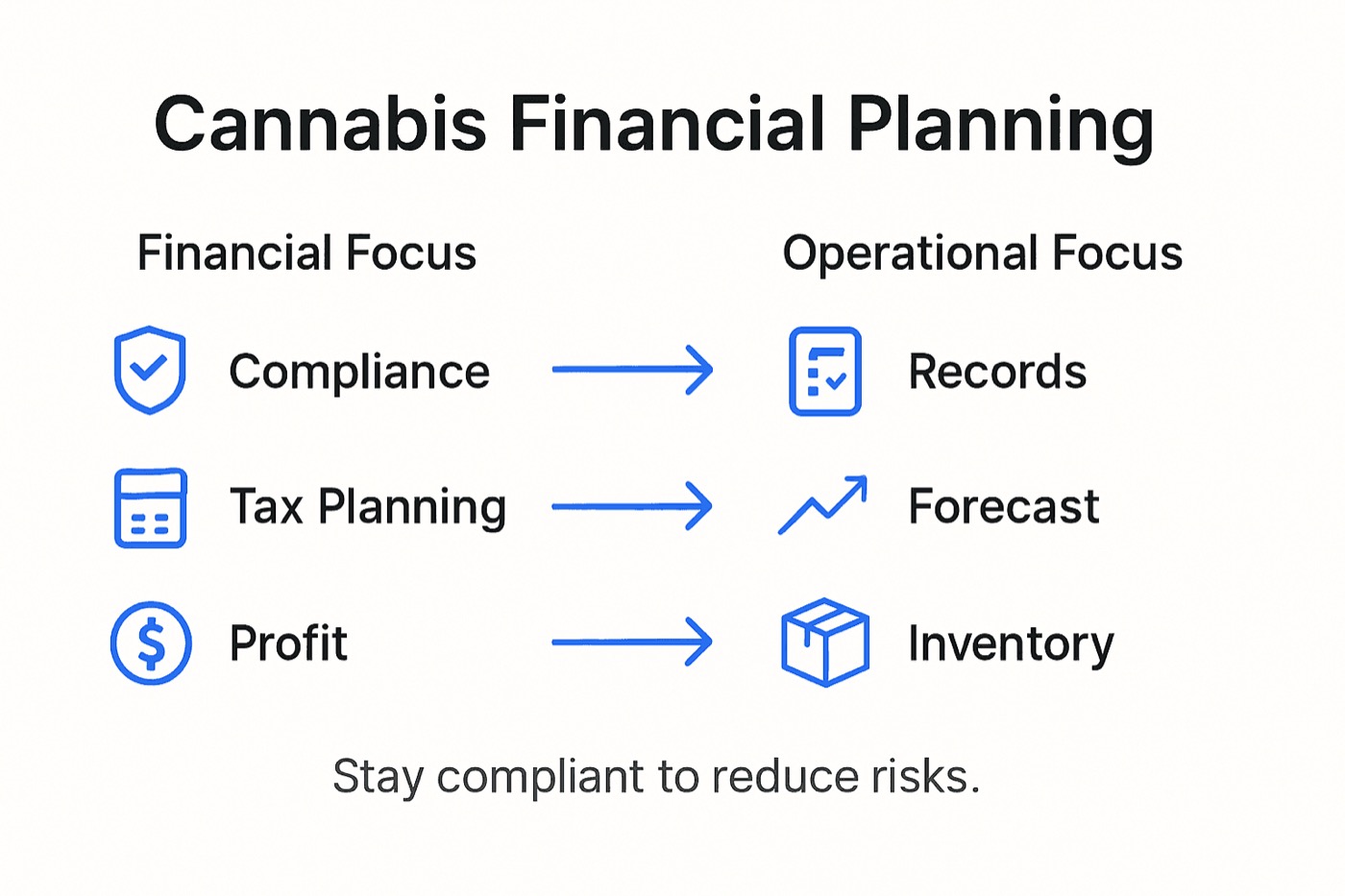
Successful financial planning in the cannabis sector requires a proactive and holistic approach. Financial managers must integrate multiple strategic elements, including detailed expense tracking, comprehensive regulatory compliance monitoring, and dynamic revenue forecasting. This involves creating flexible financial models that can quickly adapt to changes in local and federal regulations, market demand fluctuations, and emerging industry trends. Understanding the intricate balance between operational costs, compliance requirements, and potential revenue streams becomes paramount for sustainable business growth.
Pro tip: Develop a comprehensive financial dashboard that integrates real-time compliance tracking, expense management, and predictive analytics to stay ahead of regulatory and market challenges.
Risks of Poor Forecasting Practices
Poor forecasting practices can devastate cannabis businesses, creating a cascade of financial and operational challenges that extend far beyond simple miscalculations. Empirical research on forecasting practices demonstrates that inaccurate demand and supply predictions can dramatically reduce organizational effectiveness, leading to critical resource misallocations that threaten business sustainability. In the highly regulated cannabis industry, these forecasting errors can compound quickly, transforming minor miscalculations into potentially catastrophic financial risks.
The most significant risks of poor forecasting include inventory management failures, compliance violations, and financial instability. Cannabis businesses might experience sudden stock shortages that interrupt product availability, or conversely, create excessive inventory that ties up capital and risks product degradation. These miscalculations can trigger severe consequences, including potential regulatory penalties, reduced market competitiveness, and diminished investor confidence. Financial planning becomes exponentially more complex when considering the unique constraints imposed by Section 280E and state-level regulatory requirements.
Cannabis businesses must recognize that forecasting is not merely a financial exercise but a critical risk management strategy. Inaccurate predictions can lead to missed market opportunities, inefficient resource allocation, and increased operational costs. The interconnected nature of cannabis industry regulations means that a forecasting error in one area can create cascading problems across inventory management, tax compliance, and overall business strategy. Financial managers must develop sophisticated, adaptive forecasting models that can quickly respond to market fluctuations, regulatory changes, and evolving consumer demand patterns.
This summary outlines the primary risks resulting from poor forecasting in cannabis businesses:
| Risk Type | Negative Impact | Potential Consequence |
|---|---|---|
| Inventory mismanagement | Lost sales or surplus stock | Reduced profit, product wastage |
| Compliance failures | Regulatory infractions | Fines, business license revocation |
| Financial instability | Cash flow disruptions | Impaired growth, investor withdrawal |
Pro tip: Implement quarterly forecast reviews and invest in predictive analytics software specifically designed for the cannabis industry to minimize forecasting risks and maintain regulatory compliance.
Operational and Tax Strategies for Dispensaries
Tax compliance forms the cornerstone of successful cannabis dispensary operations, requiring sophisticated strategies that navigate complex regulatory landscapes. Cannabis tax research demonstrates the critical importance of implementing precise tax management approaches that maximize allowable deductions while maintaining strict adherence to federal and state regulations. Dispensary financial managers must develop nuanced strategies that protect profitability within the constraints of Section 280E and multiple taxation layers.
Operational strategies must integrate comprehensive tax planning with meticulous record-keeping and compliance mechanisms. State-level tax guidelines highlight the complexity of managing wholesale and retail excise taxes, local tax requirements, and systematic tax registration processes. Successful dispensaries develop integrated systems that can track and categorize expenses, distinguish between allowable and non-allowable deductions, and maintain transparent financial documentation to mitigate potential regulatory risks.
Vertically integrated cannabis businesses face additional operational challenges that require advanced tax and compliance strategies. This involves creating robust financial frameworks that can adapt to changing regulatory environments, manage multi-tier tax obligations, and maintain precise inventory and expense tracking. Financial managers must develop sophisticated forecasting models that anticipate potential tax implications, optimize allowable deductions under Section 280E, and create financial resilience in a highly regulated market environment.
Pro tip: Invest in specialized cannabis accounting software that can automatically categorize expenses, track tax obligations, and generate compliance-ready financial reports.
Frequently Asked Questions
What is forecasting in the cannabis industry?
Forecasting in the cannabis industry involves predicting business performance while considering market conditions, regulatory requirements, and compliance demands unique to this sector.
Why is forecasting important for cannabis compliance?
Forecasting helps cannabis businesses navigate complex regulations, manage financial planning, and ensure compliance with tax laws, particularly Section 280E, which impacts expense deductions.
How can poor forecasting affect cannabis businesses?
Poor forecasting can lead to inventory mismanagement, compliance violations, and financial instability, which may cause lost sales, regulatory penalties, and diminished investor confidence.
What are the key components of successful cannabis financial planning?
Successful cannabis financial planning includes compliance cost management, strategic tax planning, and robust risk mitigation strategies, all tailored to adapt to regulatory changes and market dynamics.
Recommended
- Understanding Cannabis Financial Forecasting Explained – Cannabis Business Minds
- What Is Cannabis Compliance: Impact on U.S. Businesses – Cannabis Business Minds
- 7 Key Cannabis Accounting Trends for 2025 – Cannabis Business Minds
- Cannabis Report Filing: Ensuring Legal Compliance – Cannabis Business Minds
- How to Create a Marketing Plan for Business Success
This article is general education, not tax, legal or accounting advice. Cannabis rules change quickly; confirm how they apply to you with a qualified cannabis CPA or attorney.