Best 7 Cannabis Business Tax Software 2025 – Expert Comparison

2026 update: what rescheduling changed for 280E (reviewed October 2026)
Effective April 22, 2026, a DOJ/DEA final order moved marijuana covered by a qualifying state medical license (and FDA-approved marijuana drugs) to Schedule III. Section 280E only applies to Schedule I and II substances, so state-licensed medical cannabis activity is generally no longer subject to 280E going forward. Adult-use cannabis remains in Schedule I and fully subject to 280E. The DEA proceeding to reschedule all marijuana was temporarily stayed in October 2026, and Treasury/IRS guidance on transition years and mixed medical/adult-use businesses is still pending.
This article was written before the order took effect. Check where your business stands in about a minute.
Running a cannabis business means facing new questions every day about compliance, finance, and how to stay ahead of shifting rules. Some companies need expert guidance for tricky accounting challenges while others want all their sales and inventory in one trusted system. The right tools can make tough jobs easier or help spot problems before they grow. With so many options promising to simplify operations or tighten control, finding what actually fits your needs can feel confusing. Curious which solutions stand out for real-world demands and offer more than empty promises? See what makes these options different and discover what matches your business best.
Table of Contents
- Cannabis Business Minds
- Greenbits by Dutchie
- Adilas ERP Software
- Flowhub
- MJ Freeway
- Nextec Group
- GrowFlow
Cannabis Business Minds

At a Glance
Cannabis Business Minds is a focused, expert-driven resource designed to help cannabis finance professionals navigate accounting, tax, and regulatory complexity. It delivers in-depth guides, practical checklists, and side-by-side comparisons of tax solutions that are tailored to dispensaries and other cannabis operations. If you need industry-specific clarity on issues like accrual accounting, revenue recognition, and compliance strategies, this platform is built for you. It’s less a generic how-to site and more a specialist knowledge base—precise, technical, and actionable.
Core Features
The site’s core capabilities center on education and practical implementation: expert guides on cannabis accounting and tax compliance; clear comparisons of top tax solutions for dispensaries; detailed instruction on accrual accounting and revenue recognition; financial reporting checklists; and step-by-step budgeting and financial planning tools tailored to dispensary operations. These resources are organized to move a reader from concept to execution—policy context, accounting treatment, selection of tools, and operational checklists for ongoing compliance.
Pros
- Specialized content tailored for the cannabis industry: The platform focuses exclusively on cannabis finance and compliance, which means recommendations reflect industry realities and regulatory nuance.
- Provides comprehensive and up-to-date industry guides: Guides synthesize current accounting practices and tax considerations into structured, practical materials.
- Tools and tips to improve compliance and financial success: Checklists and planning resources are designed to reduce audit risk and improve month-to-month financial control.
- Focus on education and practical implementation strategies: The site doesn’t stop at theory—each guide emphasizes how to implement best practices in real operations.
- Expertise targeted at cannabis business financial needs: Content speaks directly to issues like licensing impacts, tax solution choices, and dispensary reporting requirements.
Who It’s For
Cannabis Business Minds is aimed at cannabis business owners, chief financial officers, accountants, and regulatory professionals who require industry-specific guidance on accounting, tax, and compliance. It’s particularly useful for dispensary operators who must reconcile product-level accounting with complex tax rules and state-federal regulatory patchworks. If your role requires precise financial controls and defensible tax positions, this site is relevant to your daily work.
Unique Value Proposition
Cannabis Business Minds differentiates itself by combining legal and accounting focus—covering regulatory context (including education about codes like IRC 471 and Section 280E) alongside hands-on financial procedures. Rather than general small-business advice, the platform delivers cannabis-specific templates, comparisons of tax solutions, and compliance checklists that reflect U.S. state and federal tensions. That niche focus creates superior relevance: fewer irrelevant recommendations, faster path to compliant financial reporting, and reduced implementation friction. For finance teams and accountants who must justify positions to auditors or regulators, this focused expertise is a decisive advantage over broader accounting resources.
Real World Use Case
A dispensary owner uses Cannabis Business Minds to interpret new tax regulations, compare tax solution providers, and implement financial reporting checklists—resulting in cleaner month-end closes and a defensible audit trail aligned with industry standards.
Pricing
Not specified on the website.
Website: https://cannabisbusinessminds.com
Greenbits by Dutchie

At a Glance
Greenbits by Dutchie is an easy-to-use point of sale system built specifically for dispensaries, covering check-in through checkout while automating inventory, compliance, and reporting. Its strength is simplifying daily retail operations so staff can focus on customers instead of paperwork. That said, some important commercial details—like pricing and integration caveats—aren’t provided in the source material, which means you’ll need to ask sales for specifics.
Core Features
Greenbits delivers a dispensary-focused POS with automated traceability of inventory and sales data, real-time inventory synchronization, and automated compliance reminders for sale limits. The platform bundles integrated cash-free payment options and automated reports that surface sales and product-performance insights. It also supports scaling to additional locations and product lines, positioning itself as an end-to-end retail solution for cannabis operators.
Simple. Focused.
Pros
- User-friendly interface designed for dispensary staff: The system emphasizes ease of use, which reduces onboarding time and training headaches for retail teams.
- Automated compliance reduces manual effort and errors: Built-in compliance reminders and traceability help enforce sale limits and regulatory requirements without constant manual checks.
- Real-time data synchronization enhances inventory management: Immediate inventory updates across transactions help prevent oversells and keep stock accuracy high.
- Flexible payment options improve customer experience: Integrated cashless payments streamline checkout and meet consumer expectations for quick, modern transactions.
- Comprehensive support and training available: The vendor offers support and training resources to help operators adopt the system effectively.
Cons
- Lack of disclosed limitations or drawbacks in the provided content makes risk assessment difficult: Because potential product weaknesses aren’t described, you don’t get a full picture of edge-case behavior or performance under load.
- Pricing information is not specified in the provided content: Without published pricing, it’s impossible to compare total cost of ownership or forecast margins accurately.
- Potential integration challenges with existing systems are not discussed: The source does not describe third-party integrations or API capabilities, so you may encounter unexpected costs or complexity when connecting to accounting or ERP systems.
Who It’s For
Greenbits is aimed at cannabis dispensaries and retail operators seeking a POS that handles sales, inventory, compliance, and cashless payments in one package. If you run a single store or are scaling to multiple locations and want an industry-tailored solution to reduce manual compliance work, this product fits that brief.
Unique Value Proposition
Greenbits combines dispensary-first point-of-sale workflows with automated compliance and real-time inventory synchronization, reducing the operational overhead that typically burdens cannabis retailers. Its focus on traceability and reporting turns transactional data into actionable business insight.
Real World Use Case
A mid-sized dispensary deploys Greenbits to automate sales workflows, sync inventory across terminals and locations, enforce sale limits automatically, and accept cashless payments at checkout—freeing managers to analyze automated reports and optimize assortments rather than chase spreadsheets.
Pricing
Not specified in the provided content.
Website: https://greenbits.com
adilas ERP Software
At a Glance
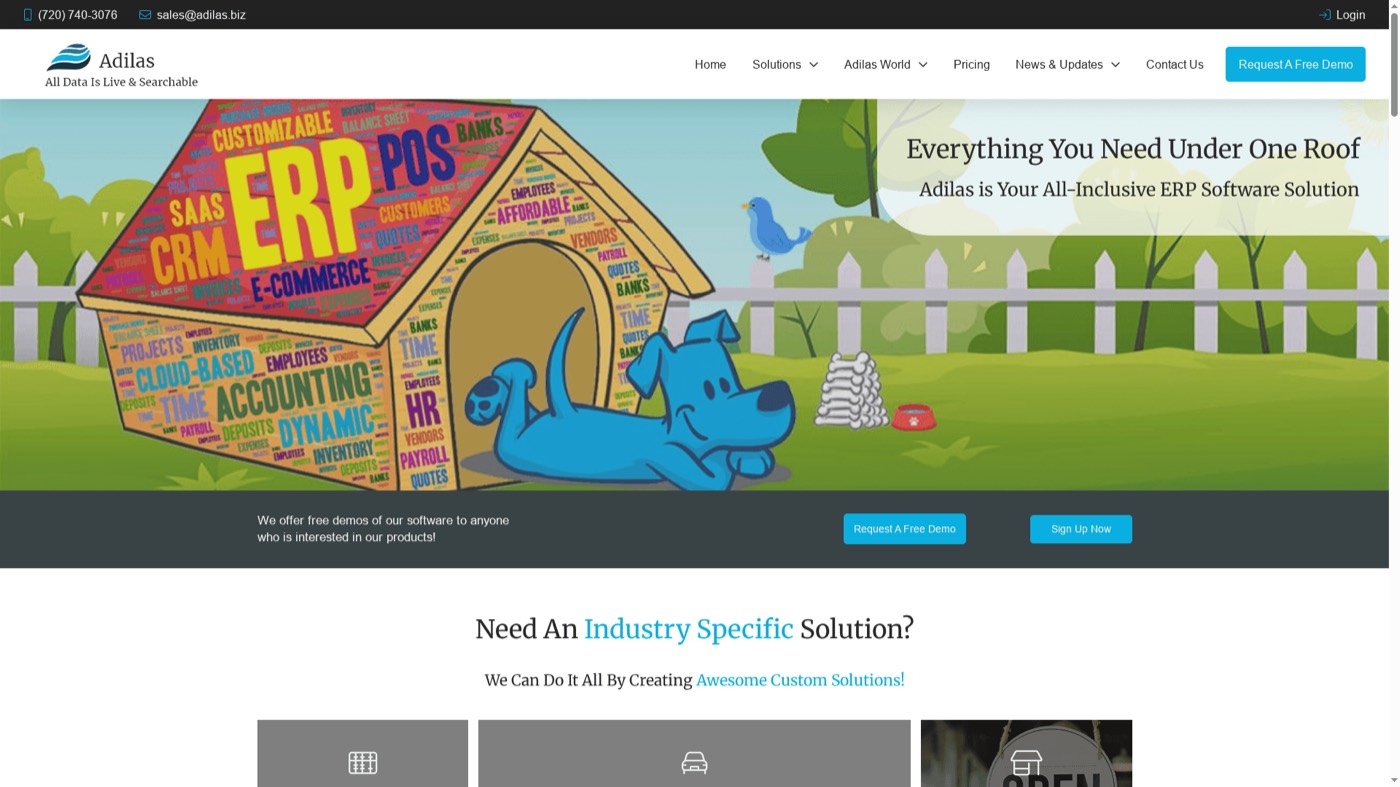
adilas is an all-in-one ERP platform that unifies CRM, inventory, accounting, e-commerce, HR, and time management into a single system. It’s built to scale with multiple users and locations, offering serialized inventory tracking, live searchable data, and customizable solutions. If you need to replace several disconnected tools with one centralized system, adilas delivers depth and breadth—but expect a learning curve and possible custom development for niche integrations.
Core Features
adilas combines core business systems into a single package: CRM and e-commerce integration, serialized inventory management, a full accounting suite (including balance sheets and deposits), plus time management and HR functionality. The platform emphasizes secure data storage, multiple user permissions, fast data retrieval, and adaptable interfaces targeted to different departments. The vendor also offers custom solutions and regular updates to keep the system aligned with changing business requirements.
Pros
- Comprehensive single-platform approach: adilas reduces the need for multiple disconnected applications by consolidating sales, inventory, accounting, and HR into one system. This simplifies workflows and centralizes data.
- Customizable for industry needs: The platform can be tailored to specific verticals, which helps you adapt workflows and reports to your business rather than forcing you to change processes.
- Robust inventory capabilities: Serialized inventory tracking and efficient search tools improve traceability and speed up reconciliations.
- Scalable multi-location support: adilas supports multiple users and locations, making it suitable as your business grows.
- Inclusive feature set at no extra cost: Many core tools are bundled together, so you avoid purchasing separate software for CRM, accounting, and e-commerce.
Cons
- Can be complex for small teams without IT support: Smaller businesses may find setup and customization challenging if they don’t have dedicated technical resources.
- Pricing requires custom quotes: While there’s a published starting price, the need for custom quoting can lengthen the procurement process and make immediate budgeting harder.
- Some integrations may require custom development: If you need niche or third-party integrations, expect additional development time and cost to implement them.
Who It’s For
adilas is aimed at mid-sized to large businesses that need an integrated management system covering sales, inventory, accounting, and HR. If you’re consolidating multiple systems, operating across locations, or require serialized inventory control, adilas is designed to handle that scale and complexity.
Unique Value Proposition
adilas’s main value is its breadth: a single, configurable ERP that brings commerce, inventory, finance, and personnel management into one searchable, secure database. That unified data model reduces manual reconciliation and surfaces actionable insights across departments.
Real World Use Case
A retail business integrates point-of-sale, online orders, inventory, and accounting into adilas so sales, stock levels, and financials update in real time. The result is fewer data silos, faster month-end closes, and automated reports that save staff hours each week.
Pricing
Starting at $287/month, with custom quotes available based on business needs.
Website: https://adilas.biz
Flowhub

At a Glance
Flowhub is a purpose-built cannabis dispensary platform that unifies POS, ecommerce, payments, and marketing into a single system for high-volume operators. Its architecture and open APIs are designed to help multi-store retailers scale while maintaining real-time compliance and near-continuous availability. Bottom line: if you run multiple dispensaries and need a single source of truth for operations and compliance, Flowhub is clearly tailored for that use case.
Core Features
Flowhub combines a unified POS, ecommerce, payments processing, and marketing tools in one platform, with open APIs that support integrations and custom workflows. It includes real-time compliance monitoring and live reporting to help you stay audit-ready, and it’s engineered for high reliability with a published 99.99% uptime. Centralized management means multi-store expansion and day-to-day operations can be controlled from a single interface.
Pros
- Reliable uptime reduces operational risk: The platform advertises 99.99% availability, which minimizes downtime across busy retail hours and reduces lost sales windows.
- Built for multi-store growth: Flowhub supports expansion and management across multiple locations, making it suitable for operators scaling regionally or nationally.
- Open APIs enable flexibility: Developers and integrators can connect Flowhub to third-party systems or custom tools, which preserves investment in existing software stacks.
- Real-time compliance oversight: Live reporting and compliance monitoring are embedded, helping dispensaries maintain consistent regulatory controls across stores.
- Cannabis-focused toolset: The product is designed specifically for cannabis retail, meaning features and workflows reflect sector-specific needs rather than generic retail assumptions.
Cons
- Potential high dependency on platform infrastructure could be risky: Relying on one integrated system for POS, payments, and ecommerce concentrates operational risk if you outgrow or need modular replacements.
- Not suitable outside cannabis retail: The platform’s cannabis-specific design means it may not translate well to other retail sectors or mixed retail models.
- Enterprise onboarding may require significant training: Because Flowhub targets high-volume operators, implementation and onboarding can be resource-intensive and may need dedicated support and training.
Who It’s For
Flowhub is ideal for multi-store cannabis dispensaries and high-volume operators who need a centralized platform that handles sales, payments, ecommerce, marketing, and compliance. If you’re expanding across multiple locations and want a single operational backbone with integration options, this platform matches that profile.
Unique Value Proposition
Flowhub’s unique value is the combination of cannabis-specific features with enterprise-grade reliability and open APIs. That blend lets dispensaries manage compliance and scale operations without stitching together multiple disconnected systems.
Real World Use Case
A multi-store cannabis retailer rolling out new locations across states uses Flowhub to unify POS, centralize compliance reporting, and synchronize ecommerce and payments across stores, enabling faster store launches and consistent operational controls with minimal downtime.
Pricing
Not specified on website
Website: https://flowhub.com
MJ Freeway

At a Glance
MJ Freeway is a mature, data-rich seed-to-sale platform built to help cannabis operators achieve preventative compliance, tighter inventory control, and operational scale. With more than a decade of experience, the system targets the full supply chain—from cultivation and manufacturing to distribution, retail, and delivery. It’s powerful and comprehensive, but that breadth brings implementation and cost considerations that smaller operators should weigh carefully.
Core Features
MJ Freeway delivers end-to-end cannabis compliance and operations management: seed-to-sale tracking across cultivation, manufacturing, distribution, retail, and delivery; genetics tracking and yield forecasting for grow operations; supplier and customer management for manufacturers; real-time sales and inventory visibility for distributors and dispensaries; route optimization and live inventory for delivery; plus data and reporting tools and an open API for integrations. The platform emphasizes preventative compliance and customizable workflows so you can tune reporting and controls to fit your operational model.
Pros
- Comprehensive seed-to-sale coverage: The platform tracks every stage of production and distribution, reducing blind spots that create compliance risk.
- Real-time inventory and sales monitoring: Live visibility across channels helps prevent stockouts, shrinkage, and reporting errors.
- API integrations enable customization: An open API allows you to connect MJ Freeway to CRMs, accounting systems, and other tools to automate workflows.
- Built-in compliance and forecasting tools: Features for compliance reporting, yield forecasting, and profitability analysis support operational planning and regulatory readiness.
- Proven industry experience: Operating over a decade and serving multiple states and countries gives the platform a depth of domain knowledge that newer vendors may lack.
Cons
- Complex system requiring training: The breadth of features means staff will likely need significant training and change management to use the system effectively.
- Unclear pricing can be a barrier to evaluation: Pricing details are not published, which makes budgeting and vendor comparison difficult for smaller businesses.
- Limited UI detail disclosed: The product data does not include user interface or experience specifics, which leaves questions about day-to-day ease of use and speed of adoption.
Who It’s For
MJ Freeway is best suited for cannabis business operators and finance teams that require an end-to-end software foundation for compliance, inventory, and sales management across the entire seed-to-sale lifecycle. If you run multiple functions—cultivation, manufacturing, distribution, retail, or delivery—or plan to scale across locations, this platform is designed for your needs.
Unique Value Proposition
MJ Freeway’s unique value lies in its combination of comprehensive supply chain coverage and industry tenure: a single, configurable platform that combines compliance-first workflows with real-time operational controls and integration capabilities, backed by experience in regulated cannabis markets.
Real World Use Case
A dispensary integrates MJ Freeway to automate compliance reporting, gain real-time inventory visibility across in-store and delivery channels, forecast yields from its affiliated grow, and analyze sales to optimize assortment and pricing—streamlining operations from cultivation through retail.
Pricing
Pricing details are not specified on the website.
Website: https://mjfreeway.com
Nextec Group

At a Glance
Nextec Group is a veteran technology consulting and ERP services provider with more than thirty years of experience delivering industry-specific ERP solutions like Acumatica and Sage X3. They position themselves as a trusted partner for mid-sized businesses across North America, emphasizing migration to cloud ERP, deep customizations, and ongoing support. If you need a consultancy that combines technical depth with a long-term partnership mindset, Nextec is built for that—but expect engagements to be bespoke and potentially premium-priced.
Core Features
Nextec’s core capabilities center on industry-specific ERP implementations (notably Acumatica and Sage X3), migration services from legacy systems to modern cloud ERP, and extensive customization driven by deep technical knowledge. Their offerings include comprehensive support and maintenance, expert consultants with sector experience, and a proven implementation methodology focused on delivering rapid ROI. The firm also emphasizes long-term optimization rather than one-off deployments, positioning itself as an end-to-end ERP partner.
Pros
- Established industry expertise: Nextec brings over thirty years of experience, which helps reduce implementation risk for mid-sized firms seeking proven ERP approaches.
- High customer satisfaction: With a reported customer score of 4.5 out of 5, the company demonstrates consistent client approval across projects.
- End-to-end services: Nextec provides migration, implementation, customization, and ongoing optimization so you can avoid juggling multiple vendors.
- Deep technical customization: Their strong technical knowledge enables tailored solutions that map to unique business processes rather than forcing workflows to fit the software.
- Long-term partnership focus: The firm’s emphasis on long-term value means they aim to support your ERP beyond go-live to improve efficiency over time.
Cons
- No publicly listed pricing: The company does not provide specific product or service pricing, which makes initial budgeting and vendor comparison difficult.
- Limited SLA and pricing detail: There is little public detail on support SLAs or pricing models, so you’ll need to clarify response times and cost structures in proposals.
- Potentially higher cost profile: Given the depth of expertise and bespoke services, engagements may be more expensive than commodity ERP implementations.
Who It’s For
Nextec is best for mid-sized organizations in manufacturing, distribution, or services that require an industry-specific cloud ERP and value deep customization and hands-on consulting. If your operation has complex processes, legacy systems to migrate, or you prioritize a partner for long-term optimization, Nextec fits well. Smaller firms or those needing a low-cost, out-of-the-box solution may find the offering more than they need.
Unique Value Proposition
Nextec combines award-winning ERP partnership with sector-focused technical depth, delivering customized cloud ERP migrations and implementations that aim to produce rapid ROI and sustained operational gains. Their long-term support model and high customer satisfaction are designed to convert initial projects into ongoing performance improvements.
Real World Use Case
A mid-sized manufacturing company migrates from legacy on-premise software to a cloud ERP (Acumatica or Sage X3) via Nextec to improve supply chain visibility, reduce manual reconciliations, and enable real-time inventory control—leveraging custom modules and post-launch optimization to increase throughput and reduce lead times.
Pricing
Not specified; likely customized based on client needs and scope of project.
Website: https://nextecgroup.com
GrowFlow

At a Glance
GrowFlow is a unified seed-to-sale platform built to reduce operational chaos for cannabis businesses by centralizing cultivation, processing, inventory, sales, and compliance in one place. Its strength lies in bringing retail, wholesale, marketplace, and ecommerce workflows under a single login so teams avoid juggling multiple systems. If you need an all-in-one system to tighten accuracy and produce actionable dashboards, GrowFlow delivers—though expect a learning curve as you onboard.
Core Features
GrowFlow provides a full seed-to-sale stack: cultivation and processing tracking, inventory management, dispensary POS, and compliance reporting. It also supports wholesale workflows for cultivators, processors, manufacturers, and distributors, plus a marketplace to expose wholesale inventory to retailers and ecommerce tools that let you manage digital and physical storefronts from a single platform. The platform emphasizes operational control and compliance automation, with dashboard analytics and time-saving utilities like a label editor and transfer intake features.
Pros
- One integrated platform reduces complexity: Combining cultivation, processing, retail, wholesale, marketplace, and ecommerce in a single system cuts down on cross-system reconciliation and duplicate data entry.
- Automated compliance and integrations save time: Built-in compliance reports and system integrations help mitigate regulatory risk and reduce manual reporting burdens.
- Practical time-savers for daily operations: Tools such as the label editor and transfer intake streamline repetitive tasks that otherwise absorb staff hours.
- Actionable dashboards and analytics: Clear visualizations provide operational insight so you can spot inventory issues or sales trends faster.
- Responsive industry-savvy support: A support team familiar with cannabis operations can accelerate troubleshooting and implementation.
Cons
- Potential learning curve for new users due to comprehensive features: The breadth of functionality means onboarding requires time and training before teams reach peak productivity.
- Dependence on internet connectivity for cloud-based system: As a cloud platform, GrowFlow requires reliable network access to function, which can be a constraint for locations with poor connectivity.
- Limited pricing transparency in the provided content: The available information does not include clear pricing details, which makes budgeting and side-by-side vendor comparison harder.
Who It’s For
GrowFlow is aimed at cannabis businesses of any size that want an integrated seed-to-sale management platform—growers, manufacturers, distributors, and retail dispensaries that prefer a single-pane-of-glass solution to run production, sales, and compliance will benefit most. If your operation spans cultivation through retail or you plan to scale across channels, GrowFlow fits that multi-role use case well.
Unique Value Proposition
GrowFlow’s unique value is the consolidation of end-to-end cannabis workflows into one platform that supports both B2B wholesale marketplace connections and B2C ecommerce plus POS. That combination reduces handoffs, shortens reporting cycles, and centralizes compliance controls in a way purpose-built for cannabis operations.
Real World Use Case
A retail dispensary uses GrowFlow to manage point-of-sale transactions, reconcile inventory in real time, and generate compliance reports—streamlining operations and cutting down manual reconciliation while giving managers immediate insight into stock levels and sales trends.
Pricing
Not specified in the provided content.
Website: https://growflow.com
Cannabis Business Management Tools Comparison
This table provides a comprehensive comparison of cannabis business tools, highlighting key features, pros, cons, pricing, and usability to help you select the best solution for your needs.
| Product | Key Features | Pros | Cons | Pricing |
|---|---|---|---|---|
| Cannabis Business Minds | In-depth guides, financial planning tools | Specialized content, up-to-date guides, implementation strategies | Pricing not specified | Not specified |
| Greenbits by Dutchie | Dispensary-focused POS, real-time inventory sync | User-friendly, automated compliance, flexible payments | Lack of detail on pricing, integration challenges possible | Not specified |
| adilas ERP | All-in-one ERP system | Comprehensive, customizable, robust inventory capabilities | Complexity for small teams, custom pricing | Starting at $287/month |
| Flowhub | Unified POS, ecommerce, high reliability | Reliable uptime, built for growth, real-time compliance | High dependence on platform, limited to cannabis retail | Not specified |
| MJ Freeway | Seed-to-sale tracking, compliance management | Comprehensive coverage, real-time monitoring, proven industry experience | Complex system, unclear pricing | Not specified |
| Nextec Group | ERP implementations, customization | Established expertise, high customer satisfaction, end-to-end services | No public pricing, potentially higher cost | Not specified |
| GrowFlow | Integrated seed-to-sale platform | Reduces complexity, automated compliance, actionable dashboards | Learning curve, internet dependent, pricing transparency limited | Not specified |
Frequently Asked Questions
What features should I look for in cannabis business tax software for 2025?
Look for features like automated tax compliance reporting, integration with accounting systems, and specialized cannabis tax calculations. Prioritize software that streamlines processes and reduces compliance risks, especially under regulations such as IRC 471 and Section 280E. Evaluate options based on how well they support specific cannabis finance needs.
How can cannabis business tax software help with compliance?
Cannabis business tax software helps ensure compliance by automating calculations and generating accurate reports required by tax authorities. By integrating regulations into the software, businesses can reduce manual errors and ensure they meet all regulatory obligations within designated timelines.
What are essential considerations for selecting cannabis tax software?
When selecting tax software, consider user-friendliness, the ability to handle multiple state regulations, and compatibility with your existing systems. Analyze how quickly the software can be implemented—aim for a deployment time of less than 60 days to ensure timely compliance with upcoming tax deadlines.
How can I ensure my cannabis tax software stays updated with regulations?
Choose software that offers regular updates and has a dedicated team monitoring cannabis tax laws. Look for solutions that automatically integrate updates to ensure your system remains compliant without requiring your intervention.
What kind of support should I expect from cannabis tax software vendors?
Expect vendors to provide extensive customer support, including training materials and access to live support teams. A responsive support system is crucial—aim for vendors that offer assistance within 24 hours to resolve any issues that may arise during your operations.
How can cannabis tax software improve financial reporting for my business?
Cannabis tax software enhances financial reporting by automating data collection and generating detailed reports on tax liabilities and revenue recognition. Utilize features that provide real-time analytics, allowing your team to gain insights quickly and improve decision-making processes.
Recommended
- Best 7 Tax Solutions for Dispensaries – Expert Comparison 2025 – Cannabis Business Minds
- Best Cannabis Accounting Software – Expert Comparison 2025 – Cannabis Business Minds
- Cannabis Accounting – Cannabis Business Minds
- Master Cannabis Accounting Best Practices for 2025 Success – Cannabis Business Minds
This article is general education, not tax, legal or accounting advice. Cannabis rules change quickly; confirm how they apply to you with a qualified cannabis CPA or attorney.